


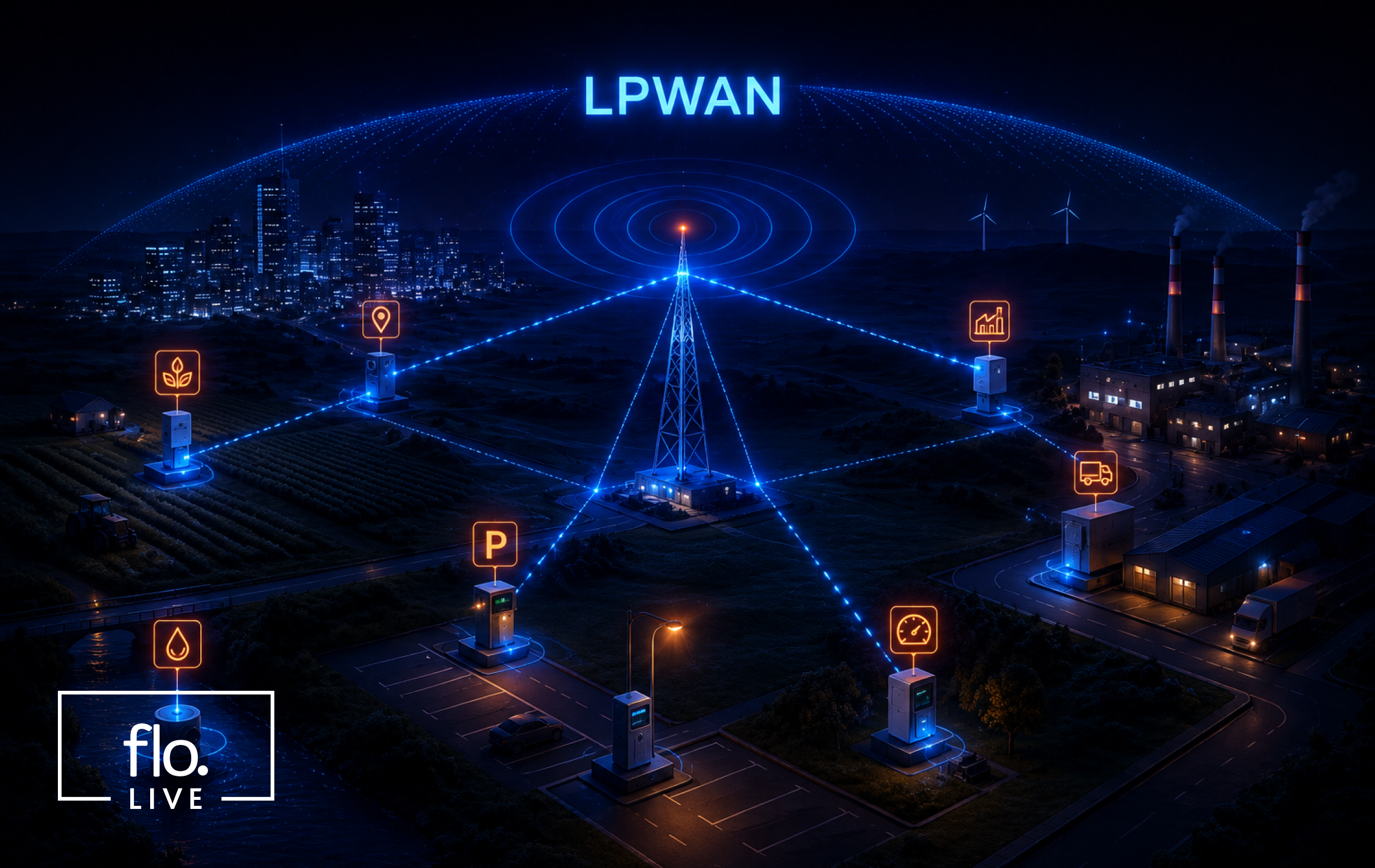
What Is LPWAN?
LPWAN (Low-Power Wide-Area Network) is a wireless telecommunication network designed to connect battery-powered devices. It allows for long-range communication at low bit rates. This technology is the backbone of the Internet of Things (IoT) and machine-to-machine (M2M) communication. It provides deep building penetration and can reach up to kilometers of distance.
Key characteristics:
- Ultra-low power: Devices can operate on small batteries for years.
- Long range: Can reach from 2 km up to 1,000 km 40–50 km in open rural environments, depending on the technology.
- Low data rate: Designed for small packet sizes (10 to 1,000 bytes), avoiding high-bandwidth needs.
- High device capacity: Supports tens of thousands of devices per cell or gateway, and millions across a full network.
Common use cases:
- Smart cities: Traffic and street light monitoring.
- Connected healthcare and wearables: Remote patient monitoring, health tracking, and medical alert devices.
- Industrial IoT: Equipment monitoring, predictive maintenance, and utility infrastructure management.
- Asset tracking and logistics: Tracking vehicles, containers, pallets, and high-value assets.
This is part of a series of articles about cellular technologies
Why LPWAN Matters for IoT
LPWAN matters because many IoT devices do not require high bandwidth. Instead, they need reliable, cost-effective connectivity that can operate for years with minimal maintenance and power consumption:
- Long battery life: Enables devices to run on small batteries for several years by reducing power usage during communication.
- Wide coverage: Supports long-range communication across large geographic areas or remote locations.
- Lower infrastructure costs: A small number of gateways can provide coverage for a large area.
- Support for large device deployments: Designed to connect thousands of devices simultaneously.
- Optimized for small data transfers: Suited for applications that send small amounts of data periodically, such as sensor readings and status updates.
- Connectivity in challenging environments: Provides connectivity where wired networks are impractical or traditional cellular solutions are too costly or power-intensive.
- Broad range of IoT applications: Includes smart metering, asset tracking, smart city infrastructure, agriculture, environmental monitoring, and industrial IoT systems.
Related content: Explore our overview of IoT connectivity requirements, components, and technologies.
Key Characteristics of LPWAN
1. Ultra-Low Power
A defining feature of LPWAN is its ultra-low power consumption. LPWAN protocols are built so that connected devices spend most of their time in sleep mode, waking only to transmit or receive small data packets at scheduled intervals. This approach allows battery-powered sensors and actuators to function for years, sometimes up to a decade, without battery replacement. This is important for devices deployed in hard-to-reach or hazardous environments where regular servicing is impractical or costly.
Low power operation is achieved through optimized protocols and simple hardware requirements, which reduce active radio usage and processing overhead. Many LPWAN devices operate on coin-cell batteries, making them inexpensive to deploy at scale. By keeping power demands low, LPWAN supports large IoT deployments where device accessibility and maintenance schedules are constraints.
2. Long Range
LPWAN technologies provide connectivity over long distances, typically from several kilometers in urban areas to over 15 kilometers in rural or open environments. This is achieved through resilient modulation schemes and highly sensitive receivers, allowing signals to travel farther and penetrate obstacles such as buildings and terrain. A single LPWAN gateway can cover a large geographic area, reducing the need for dense infrastructure and lowering deployment costs.
Long-range connectivity is valuable when devices are spread across wide areas, such as in agriculture, utility metering, or transportation tracking. The extended range also supports IoT use cases in remote or rural locations that lack traditional cellular or Wi-Fi coverage. LPWAN supports scalable solutions for both urban and rural deployments.
3. Low Data Rate
LPWAN is optimized for low data throughput, typically a few bits to several kilobits per second. This matches many IoT use cases, where devices periodically send small packets of sensor data rather than continuous streams. Low data rates support energy-efficient transmissions and reduce interference.
Despite limited bandwidth, LPWAN suits status updates, alerts, and simple sensor readings. Typical use cases include environmental monitoring, utility metering, and asset tracking, where small amounts of data are sent at intervals. Focusing on low data rates supports network efficiency and device longevity.
4. High Device Capacity
LPWAN networks support large numbers of connected devices within a single coverage area. This is achieved by optimizing spectrum use, reducing collisions, and using scalable access methods. A single LPWAN cell or gateway can support tens of thousands of endpoints, and a full network can reach into the millions.
Connecting many devices is important as IoT adoption grows. Whether monitoring city infrastructure, environmental conditions, or logistics assets, LPWAN supports connectivity and data collection at scale. This scalability distinguishes it from many traditional wireless networks that face congestion in dense device environments.
Main Types of LPWAN Technologies
LoRaWAN
LoRaWAN is an open LPWAN protocol built on the proprietary LoRa (Long Range) physical layer technology. It operates mainly in unlicensed ISM bands and supports both public and private network deployments. LoRaWAN uses a star-of-stars topology, where end devices communicate with gateways that forward data to a centralized network server. The protocol supports low power, long-range, and bidirectional communication.
Advantages:
- LoRaWAN has a broad ecosystem and community support.
- Organizations can deploy their own LoRaWAN networks without relying on mobile operators, supporting scalable solutions for cities, campuses, or rural areas.
- The technology supports adaptive data rates that adjust power consumption and range based on network conditions.
- It also includes security features and is supported by global alliances and open standards.
NB-IoT
Narrowband IoT (NB-IoT) is a cellular LPWAN technology standardized by 3GPP that operates in licensed spectrum bands. It provides secure, energy-efficient connectivity for IoT devices using existing mobile network infrastructure. NB-IoT supports deep indoor penetration and can connect many devices per cell, making it suitable for smart metering and building automation.
Advantages:
- NB-IoT can integrate with carrier networks, offering managed reliability and support for large deployments.
- It includes security features, quality of service management, and roaming capabilities.
However, NB-IoT typically involves recurring connectivity costs and may require SIM cards or eSIMs for authentication.
LTE-M
LTE-M, or LTE Cat-M1, is a cellular LPWAN standard developed by 3GPP. It offers higher data rates and lower latency than NB-IoT. Like NB-IoT, it operates in licensed spectrum and uses existing LTE infrastructure. LTE-M supports device mobility, voice services, and over-the-air firmware updates.
Advantages:
- LTE-M supports mobile use cases such as wearables, asset tracking, and connected vehicles, where devices move between cells or require continuous connectivity.
- It offers greater data throughput than other LPWAN options but typically consumes more power than NB-IoT or LoRaWAN.
- Connectivity costs and reliance on carrier networks are similar to NB-IoT.
Sigfox
Sigfox is a proprietary LPWAN technology that operates in unlicensed ISM bands. It is owned by UnaBiz, which acquired Sigfox in 2022. It uses ultra-narrowband modulation to achieve long-range, low-power communication. Sigfox networks are deployed globally and offer connectivity through a subscription model. Devices send small, infrequent messages to Sigfox base stations, which forward the data to the cloud.
Advantages:
- The simplicity of the Sigfox protocol results in low device cost and power consumption.
- It is suitable for asset tracking, remote monitoring, or environmental sensing.
However, its limited data rates and payload sizes restrict its use to basic IoT scenarios. Coverage may be limited in some regions, and private network deployments are not supported.
Common Use Cases of LPWAN
Smart Cities
LPWAN technologies support large-scale sensor networks for applications such as smart street lighting, waste management, and air quality monitoring. With long range and low power requirements, LPWAN devices can be deployed across urban environments to collect and transmit data to city management systems.
Common examples include:
- Smart parking
- Water metering
- Environmental monitoring
The ability to connect thousands of low-cost devices over a wide area without frequent battery changes or extensive infrastructure makes LPWAN a practical option for city deployments.
Connected Healthcare and Wearables
LPWAN is used in connected healthcare systems and wearable devices that require reliable communication and long battery life. Medical sensors can monitor patient vital signs such as heart rate, blood pressure, glucose levels, or activity data and transmit updates to healthcare providers. Many healthcare devices send small amounts of data periodically, making LPWAN a suitable alternative to more power-intensive wireless technologies.
For wearable devices and remote patient monitoring, LPWAN supports extended operation without frequent charging or battery replacement. This is useful for
- Elderly care
- Chronic disease management
- Home healthcare programs.
LPWAN also supports deployments in rural or underserved areas where broadband connectivity is limited.
Industrial IoT
LPWAN connects sensors, meters, and monitoring equipment across factories, warehouses, utilities, and energy infrastructure. Industrial assets often operate in locations where wired connectivity is expensive or impractical. LPWAN allows organizations to gather operational data from distributed equipment while reducing deployment and maintenance costs.
Common applications include:
- Predictive maintenance
- Equipment monitoring
- Leak detection
- Energy management
- Environmental sensing
The long range and low power characteristics of LPWAN are useful for monitoring assets across large industrial sites or remote facilities.
Asset Tracking and Logistics
LPWAN is used for asset tracking and logistics applications that require visibility into the location and status of goods, vehicles, containers, or equipment. Tracking devices with LPWAN connectivity can transmit:
- Location data
- Movement information
- Environmental conditions (e.g., temperature and humidity)
In logistics operations, LPWAN supports tracking of large numbers of assets over extended periods. Shipping containers, pallets, rental equipment, and fleet vehicles can be monitored across cities, regions, or countries while maintaining long battery life.
Pros and Cons of LPWAN
LPWAN offers long-range connectivity, low power consumption, and scalability, making it widely used for IoT deployments. However, its design priorities also limit its suitability for some applications.
Pros
- Long battery life: Devices can operate for several years on small batteries.
- Wide coverage area: Supports communication over several kilometers.
- Low deployment costs: Requires fewer infrastructure components than many traditional wireless technologies.
- Scalability: Supports thousands or millions of connected devices within a large coverage area.
- Suitable for remote locations: Provides connectivity in rural, underground, or hard-to-reach environments.
- Low-cost devices: Simple hardware requirements reduce sensor and endpoint costs.
- Optimized for IoT workloads: Designed for small, periodic data transmissions.
- Flexible deployment options: Technologies such as LoRaWAN allow private network deployments.
Cons
- Limited data rates: Not suitable for high-bandwidth applications such as video streaming or large file transfers.
- Higher latency: Data transmission delays can make it unsuitable for many real-time applications.
- Small payload sizes: Most technologies restrict the amount of data per message.
- Limited support for frequent communication: Constant connectivity or continuous data exchange may exceed capabilities.
- Potential network congestion: Dense deployments with many devices competing for airtime can affect performance.
- Coverage variability: Signal quality and range can be affected by terrain, building density, and environmental conditions.
- Technology fragmentation: Different standards have varying capabilities and coverage models.
- Carrier dependence for cellular LPWAN: NB-IoT and LTE-M rely on mobile operators and often involve subscription costs.
How to Choose the Right LPWAN Technology
Here are some useful criteria to consider when evaluating which LPWAN technology to use.
1. Coverage Requirements
Coverage should be one of the first factors considered when selecting an LPWAN technology. Options differ in geographic reach, indoor penetration, and network availability. Organizations deploying sensors across cities, rural regions, or industrial sites need reliable connectivity throughout the target area.
- LoRaWAN is often chosen when organizations want to build coverage in specific locations using private gateways.
- NB-IoT and LTE-M may be better choices where carrier coverage already exists.
Evaluating signal penetration, terrain, building density, and available infrastructure helps reduce deployment risks.
2. Battery Life Expectations
Battery life requirements directly affect technology selection. Some deployments require devices to operate for five to ten years without maintenance, especially in remote locations. Technologies optimized for infrequent communication generally provide the longest lifespan.
- LoRaWAN, Sigfox, and NB-IoT are often selected for applications that prioritize battery life.
- LTE-M may consume more power due to higher data rates and mobility features.
Organizations should estimate transmission frequency, device activity patterns, and environmental conditions when assessing long-term power needs.
3. Data Volume and Message Frequency
LPWAN technologies differ in how much data they can transmit and how often devices can communicate. Applications that send sensor readings every few hours differ from systems that require frequent updates, remote control, or firmware downloads.
- LoRaWAN and Sigfox are suited for small, infrequent messages.
- LTE-M supports larger payloads and more frequent communication.
- NB-IoT supports moderate data volumes.
Understanding payload sizes and reporting intervals helps avoid selecting a technology that limits future growth.
4. Mobility Needs
Some IoT devices remain fixed, while others move between locations. Asset trackers, fleet systems, and wearables often require connectivity while in motion. Mobility support should be evaluated early.
- LTE-M is generally the strongest option for mobile applications because it supports handovers between cellular cells.
- NB-IoT is mainly optimized for stationary deployments.
- LoRaWAN and Sigfox can support limited mobility scenarios.
5. Private vs. Public Network
Organizations must decide whether to operate their own network infrastructure or rely on a service provider. This affects deployment flexibility, operational control, security management, and long-term costs.
- LoRaWAN is widely used for private networks because organizations can install and manage gateways and network servers.
- Cellular technologies such as NB-IoT and LTE-M typically depend on mobile operators and public infrastructure.
6. Licensed vs. Unlicensed Spectrum
LPWAN technologies operate in licensed or unlicensed radio spectrum. Licensed spectrum is managed by regulatory authorities and generally offers more predictable performance and reduced interference. Unlicensed spectrum offers flexibility and lower deployment costs but may face congestion.
- NB-IoT and LTE-M operate in licensed bands and benefit from carrier-managed quality of service.
- LoRaWAN and Sigfox primarily use unlicensed ISM bands, allowing deployments without acquiring spectrum licenses.
7. Deployment Cost
Deployment costs include device hardware, gateways or infrastructure, connectivity fees, maintenance, and operational expenses. Different LPWAN technologies have different cost structures.
- Private LoRaWAN deployments may require upfront investment in gateways but can reduce recurring connectivity fees.
- Cellular technologies often require less infrastructure but usually involve subscription costs per device.
Organizations should evaluate both initial and ongoing expenses.
8. Regulatory Requirements
Certain industries and regions impose regulatory requirements related to security, data privacy, spectrum usage, and reliability. These requirements can influence technology selection. Healthcare, utilities, transportation, and critical infrastructure projects may require specific security controls or compliance measures.
- Cellular LPWAN technologies benefit from established security frameworks and operator-managed infrastructure
- Private deployments provide more control over data handling.
Evaluating regulatory obligations early helps avoid compliance issues later.
How FLOLIVEⓇ Delivers Reliable LPWAN and IoT Connectivity at Global Scale
Choosing the right LPWAN technology is only half the challenge; deploying it consistently across regions, carriers, and regulatory environments is where most IoT projects struggle. FLOLIVEⓇ solves this with one localized global network that keeps every device connected and compliant. IoT devices are diverse, complex, and hard to manage globally, and Flolive’s software-defined, cloud-managed connectivity applies local profiles and enables local breakout across continents, giving enterprises global reach with local performance from a single platform.
Key capabilities of Flolive:
- Any cellular technology from 2G to 5G and NTN: Flolive fully controls its entire technology stack and globally distributed core networks, supporting the full range of cellular technologies, including LPWA, so you can adopt the right technology for each deployment under one platform.
- Converged cellular and satellite connectivity: The global network unifies all cellular technologies with satellite Non-Terrestrial Networks (IoT NTN), where the satellite behaves like any other cellular network and supports use cases such as “satellite as backup.”
- Localized global connectivity: With 15+ carrier partners and 750+ networks, devices connect to a local core in their region, ensuring compliance, low latency, and consistent behavior everywhere, with real-time visibility and full control.
- Support for any SIM type: The platform supports every SIM form factor used in IoT today and tomorrow, including plastic SIMs, embedded MFF2 eSIMs, iSIM, and softSIM, with seamless activation, smart switching, and full lifecycle control.
- Data privacy and sovereignty compliance: Localized cellular connectivity keeps data within the country it originates in, helping enterprises adhere to regulations such as GDPR and CCPA, which is impossible with roaming-based solutions.
- Permanent roaming safe connectivity: Local IMSIs are applied to devices when they land in highly regulated countries, ensuring compliance with permanent roaming restrictions.
- Low latency and high throughput: Localized core networks and regional breakouts route data along the shortest path, reducing latency, improving uptime, and cutting the retransmissions that drain device batteries.
To connect your IoT devices reliably across any LPWAN and cellular technology worldwide, explore Flolive’s Global IoT Connectivity solution.