


TL;DR: eUICC SIMs let smart devices switch carrier profiles over the air without swapping hardware. Best for global, compliant deployments: FLOLIVE®; outage-proof connectivity: Hologram; hybrid multi-IMSI: Velocity IoT; white-label MVNO connectivity: Cobira.
What Is an eUICC SIM?
An eUICC SIM for smart devices is a physical chip embedded in a device that allows for the remote, over-the-air (OTA) management of multiple cellular network profiles. It allows users to switch between network providers without physically changing the SIM card.
This technology offers flexibility for IoT and other connected devices by providing seamless, remote management, global connectivity, and the ability to adapt to different network conditions.
Key features:
- Remote profile management: Network operator profiles can be downloaded, updated, enabled, or disabled remotely via software, eliminating the need to swap physical SIM cards.
- Multi-carrier support: A single eUICC can store multiple network profiles from different carriers, allowing for easy switching based on location or other needs.
- Global connectivity: eUICC technology simplifies global deployments by allowing devices to switch to local networks when they move to a different country.
- Enhanced security: eUICC solutions provide strong encryption and authentication to protect sensitive data transmitted between devices and networks.
- Long-term flexibility: For long-lasting devices, eUICC provides the ability to adapt to changing business needs or network conditions over the device’s lifespan without requiring physical intervention.
- Single SKU: Instead of producing and managing different SIM configurations for each market or carrier, manufacturers can ship the same device worldwide.
eUICC SIMs for Smart Devices at a Glance
The table below summarizes the key differences between the eUICC SIM solutions covered in this guide. We explore each of them in more detail in the sections that follow.
| Category | Solution | Best For | Key Strengths | Things to Consider |
| Hybrid multi-IMSI & eUICC | Flolive | Global IoT needing local compliance and one platform | Owned core network; patented multi-IMSI over eUICC; unified CMP | Full-stack platform geared to operators and larger programs |
| Hybrid multi-IMSI & eUICC | Velocity IoT | Single-SIM global IoT with local breakout | Multi-IMSI + eSIM hybrid; 40+ breakout points; no idle fees | Enterprise features and pricing are quote-based |
| Hybrid multi-IMSI & eUICC | ThingsData | European-focused IoT with unified SIM management | 650+ networks; multi-IMSI; non-steered eSIM | Coverage leans on partner networks; strongest in Europe |
| Managed eUICC platform | Hologram | Outage-proof, easy-to-manage global cellular IoT | Dual-core SIMs; 99.95% uptime SLA; SGP.32 | Premium pricing and email-led support noted by users |
| Managed eUICC platform | Cobira | White-label IoT connectivity for MVNOs/resellers | FlexiSIM multi-carrier/partner failover; white-label CMP | LTE-M/NB-IoT in select countries; no 5G listed |
Evolution of SIM Technology for Smart Devices
Traditional SIM cards originated as removable chips linked to a single carrier, requiring physical replacement to switch providers or update connectivity options. These physical SIMs evolved into smaller formats (mini, micro, and nano) reflecting device miniaturization, but their underlying limitations remained.
The advent of eSIM and, subsequently, eUICC SIM technology directly addresses these constraints. Based on global standards defined by the GSMA, eUICC SIMs now offer profile switching, remote provisioning, and long-term adaptability. This evolution supports the smart device industry’s need for continuous network access, especially for devices deployed in remote, mobile, or hard-to-access environments, such as asset trackers, connected cars, and industrial sensors.
Key Features of eUICC for Smart Devices
Remote Profile Management
eUICC SIMs introduce the capability for over-the-air remote profile management, an advantage over traditional alternatives. Users and device operators can remotely download, activate, deactivate, and delete carrier profiles on the SIM without physical intervention. This capability reduces downtime, eliminates the need for device recalls, and streamlines the onboarding process for large device fleets.
With remote profile management, businesses achieve greater operational efficiency when deploying smart devices at scale. Configuration changes, carrier migrations, and troubleshooting can all be performed centrally. This remote flexibility is particularly valuable in industries requiring dynamic updates or devices deployed in locations that are physically difficult to access for maintenance or SIM swaps.
Multi-Carrier Support
Another key feature of eUICC SIMs is multi-carrier support. Instead of locking a device to a single network, eUICC SIMs allow for multiple carrier profiles to be stored and used as needed. This enables smart devices to switch between network operators, optimizing connectivity and often reducing costs by leveraging the most appropriate carrier for a given location or use case.
Multi-carrier support is vital for maintaining reliable connectivity across regions or in applications where network performance varies significantly. For device manufacturers and enterprises, this removes negotiation and logistics barriers associated with regional SIMs, supporting rapid expansion into new markets and ensuring optimal network coverage regardless of geography.
Global Connectivity
eUICC SIMs are designed for global connectivity, effectively ending the constraints of country-specific or region-locked SIM cards. Devices equipped with eUICC can operate worldwide by provisioning local carrier profiles on demand. This is crucial for industries like logistics, travel, automotive, and consumer electronics, where devices routinely cross borders and need uninterrupted access to local networks.
By enabling smart devices to dynamically select and switch to the best available network anywhere in the world, eUICC SIMs reduce roaming charges and improve service quality. Enterprises managing international fleets or services benefit from single-SKU logistics, and simplified profile management for users or IoT assets globally.
Enhanced Security
Enhanced security is built into the eUICC SIM architecture. These SIMs use hardware-level security protocols, cryptographic authentication, and secure profile management techniques to prevent tampering or unauthorized access. Each carrier profile downloaded or managed on the SIM follows strict GSMA standards for data integrity and encryption.
Security enhancements extend to remote management operations, where only authorized entities can make changes to SIM profiles. This approach mitigates the risk of SIM cloning, fraud, and other common threats associated with legacy SIM cards. For enterprises deploying devices for sensitive applications—such as financial services, healthcare, or critical infrastructure—these security upgrades are indispensable.
Long-Term Flexibility
Long-term flexibility is inherent in the eUICC SIM’s design. Devices can continue adapting their connectivity well after deployment, extending the useful life of the hardware. As network operators merge, upgrade technologies, or alter terms, eUICC-equipped devices can switch networks or profiles accordingly, without the cost or complexity of physical SIM swaps.
For smart device manufacturers, this translates into future-proofing products, reducing support burdens, and ensuring continued compliance with evolving connectivity regulations or customer requirements. Over the lifecycle of a device, eUICC SIMs significantly lower total cost of ownership by simplifying updates, migrations, and end-of-life management.
Single SKU
eUICC SIMs enable a single SKU (stock keeping unit) strategy for global device distribution. Instead of producing and managing different SIM configurations for each market or carrier, manufacturers can ship the same device worldwide. Local network profiles can then be provisioned over-the-air based on region, customer, or deployment needs.
This significantly simplifies supply chains, reduces inventory complexity, and lowers logistics costs. A single SKU approach also accelerates time to market by removing the need for market-specific variants, making it easier to scale IoT deployments and manage global product lifecycles with uniform hardware.
Related content: Read our guide to eUICC vs eSIM
Notable eUICC SIM Providers for Smart Devices
How we selected these tools: We shortlisted eUICC SIM solutions for smart devices based on remote over-the-air profile management, multi-network global coverage, support for GSMA Remote SIM Provisioning standards, SIM form-factor flexibility, and connectivity management capabilities.
Hybrid Multi-IMSI and eUICC Connectivity Solutions
1. Flolive

Best for: Global IoT deployments needing local compliance and control
Strengths: Owned core network, patented multi-IMSI over eUICC, unified CMP
Things to consider: Full-stack platform geared to operators and larger programs
Flolive delivers a full-stack, standards-based eUICC connectivity solution built for large-scale global IoT deployments. It is powered by a patented multi-IMSI over eUICC (eSIM) design that runs on the company’s own globally distributed, locally compliant core network. Devices can switch automatically between satellite, roaming, regional, and local IMSIs across more than 180 countries based on signal conditions, policy, and regional regulations. Because the core network maintains a local presence in each region, traffic can be kept in-country to support requirements such as GDPR and CCPA and to respect permanent-roaming restrictions.
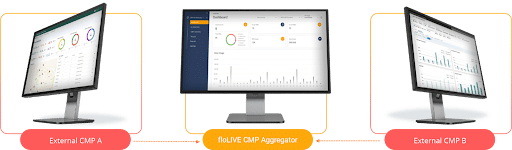
The platform centers on the Flolive Connectivity Management Platform (CMP), a cloud-native system for SIM provisioning, policy and profile management, lifecycle automation, real-time diagnostics, and billing. Flolive supports all major SIM form factors, aligns with GSMA Remote SIM Provisioning standards, and offers an optional CMP Aggregator that consolidates SIMs from multiple providers under one interface. REST APIs and white-label options let operators and enterprises embed connectivity management into their own systems and branded services.
Key features include:
- Patented multi-IMSI over eUICC: Flolive encapsulates multi-IMSI capabilities within an eUICC profile, so a single SIM can hold and switch between multiple network identities while remaining under a GSMA-aligned eUICC management model. Profile changes are driven by rules such as signal loss, geo-fencing, or roaming constraints, and switching happens without reboots or downtime. This combines the reach and redundancy of multi-IMSI with the lifecycle control of eUICC.
- Owned cloud-native core network: Connectivity runs on the Flolive globally distributed core with integrated packet gateways, rather than reselling another operator’s infrastructure. Local breakout and in-region data handling reduce latency and support data-residency and permanent-roaming compliance in markets with strict regulations. Owning the core also lets the company adapt routing and policy as conditions change.
- Connectivity Management Platform (CMP): The cloud-native CMP provides a single interface for SIM provisioning, connectivity policies, lifecycle events such as activate, suspend, and terminate, diagnostics, and billing. It includes real-time SIM status monitoring, role-based access with audit logs, and a multi-tier architecture for resellers and enterprise accounts. Bulk actions and an integrated OSS/BSS suite support fleets from dozens to millions of devices.
- Broad SIM form-factor and standards support: Flolive supports removable plastic SIMs, embedded MFF2 eUICCs, iSIMs, and softSIM, letting OEMs standardize on one connectivity architecture across device lines. It aligns with GSMA Remote SIM Provisioning across M2M, consumer, and IoT models, including SGP.01/02, SGP.21/22, and SGP.31/32. Coverage spans 2G through 5G with optional satellite (NTN) connectivity.
- Optional CMP Aggregator: For operators managing mixed fleets, the optional CMP Aggregator unifies SIMs from any provider, including SGP.32 profiles, under a single pane of glass. This lets teams manage legacy and multi-vendor SIMs without replacing hardware. It reduces the operational overhead of coordinating multiple eUICC profiles, operators, and management platforms.
- API-first integration and white-labeling: REST APIs let customers embed SIM management, usage data, and diagnostics directly into their own applications, CRMs, and operational tools. The platform is fully white-label ready, so MVNOs and operators can offer branded connectivity and onboard their own resellers and tiers. This supports custom workflows rather than relying only on the standard dashboard.
Limitations (as reported by users on G2):
- Newly released features may need refinement: Some users note that the newest platform capabilities can require follow-up iterations shortly after release before they are fully stable, though the team addresses issues as they arise.
- Hands-on partnership for complex setups: More advanced or highly customized deployments tend to benefit from close technical collaboration with Flolive during onboarding rather than fully self-service configuration.
2. Velocity IoT

Best for: Single-SIM global IoT with local breakout and active-only billing
Strengths: Multi-IMSI plus eSIM hybrid, 40+ breakout points, no idle fees
Things to consider: Enterprise features and pricing are quote-based
Velocity IoT provides global IoT connectivity through VIoT-Flex, a hybrid that combines multi-IMSI and eSIM (eUICC) technologies in a single SIM. The eUICC-compliant SIMs connect a single SKU across more than 750 networks in over 190 countries, with around 15 direct carrier integrations and 40+ local breakout points that reduce latency and support data residency. Local IMSI profiles let devices operate in markets that restrict permanent roaming, so the same SIM works across regions without carrier-specific negotiations.
The hybrid design pairs multi-IMSI for automatic failover and redundancy with eSIM provisioning under SGP.32 for longer-term flexibility. A unified dashboard tracks SIM status, data usage, location, and network performance across carriers, with over-the-air updates and API integration. Velocity IoT bills only for SIMs actively using data, with no idle fees, suspension charges, or minimum-usage requirements, and offers a self-serve Flex tier alongside quote-based enterprise management.
Key features include:
- VIoT-Flex multi-IMSI and eSIM hybrid: VIoT-Flex combines multi-IMSI switching with eUICC-based eSIM provisioning in one SIM. Multi-IMSI provides automatic failover and built-in redundancy across networks, while the eSIM layer supports remote profile provisioning under SGP.32. This gives devices immediate multi-network reliability alongside longer-term standards-based flexibility.
- Global single-SIM coverage: A single SIM connects across more than 750 networks in over 190 countries, with roughly 15 direct-to-carrier integrations. This removes the need for regional SIM variants or separate carrier contracts. Devices can attach to local networks wherever they operate, from 2G through 5G, LTE-M, and NB-IoT.
- Local breakout and IMSI profiles: More than 40 local breakout points keep traffic regional to reduce latency and meet data-residency needs. Local IMSI profiles let a single SIM operate in markets with permanent-roaming restrictions. This supports compliant deployments without swapping hardware.
- Multiple SIM form factors: Velocity IoT offers plastic triple-cut SIMs (2FF/3FF/4FF), embedded MFF2 eSIM, iSIM, and SoftSIM formats. The same connectivity profile can be applied across these formats, letting hardware teams choose the right physical option per device. Hybrid satellite-cellular connectivity is also available for devices needing coverage beyond terrestrial networks.
- Active-only billing model: Customers are billed only for SIMs that are actively using data, with no charges for idle SIMs, no suspension fees, and no minimum-usage commitments. This aligns cost with deployment pace for fleets that activate gradually. A self-serve Flex tier is available, with quote-based plans for larger enterprise programs.
- Unified management and APIs: A single dashboard provides visibility into SIM status, data consumption, location, and network performance across all carriers. SIM management supports over-the-air updates and integrates with customer systems through APIs. This centralizes control of multi-network fleets in one place.
Limitations (based on publicly available sources):
- Quote-based enterprise pricing: Enterprise features and pricing require direct sales engagement rather than fully transparent self-serve options; only the Flex tier is openly self-service.
- eUICC delivered through the hybrid tier: The base offering centers on multi-IMSI, with standards-based eUICC provisioning available via the hybrid VIoT-Flex tier, so deployments wanting a purely standards-based configuration should confirm the setup.
- Limited third-party review coverage: Velocity IoT has little presence on independent review platforms, so prospective buyers have fewer external sources to evaluate the offering.
3. ThingsData

Best for: European-focused IoT with unified multi-operator SIM management
Strengths: 650+ networks, multi-IMSI, non-steered eUICC eSIM
Things to consider: Coverage leans on partner networks; strongest in Europe
Thingsdata is an IoT connectivity specialist that provides secure multi-network SIM cards with access to more than 650 roaming networks across over 190 countries. Its SIMs use multi-IMSI technology so a single card can hold multiple IMSIs and switch automatically to the operator with the strongest coverage, which the company backs with a 99.5% service-availability guarantee. All data is transported encrypted in line with GSMA security guidelines, and private APN and IP-SEC VPN options keep device traffic isolated.
Connectivity is managed through Thingsdata Control, a unified SIM management system that works across SIMs from different operators. It offers per-SIM diagnostics, configurable usage thresholds and alerts, real-time consumption and cost reporting, and SOAP or REST APIs for integration. Thingsdata also offers a non-steered eSIM (eUICC) activated by QR code, supports all SIM form factors including industrial MFF2, and provides flexible subscription types (pooled, pay-as-you-go, and tiered) across regional partner networks such as KPN and Tele2 in Europe and Blue IoT worldwide.
Key features include:
- Multi-network and multi-IMSI SIMs: Thingsdata SIMs connect to more than 650 networks and use multi-IMSI technology, letting one card hold several IMSIs and switch automatically between them. Devices attach to the provider with the strongest signal, which underpins a stated 99.5% service-availability guarantee. This provides redundancy across operators without manual intervention.
- Non-steered eSIM (eUICC): The company offers a non-steered eSIM based on eUICC, activated quickly via a QR code or activation string. Being non-steered means the device is not locked to a single preferred operator and can use the strongest available network. This supports redundant coverage across multiple carriers.
- Thingsdata Control SIM management: Thingsdata Control is a unified management system for SIMs from different operators. Users can run diagnostics on individual SIMs, set usage limits and alerts, define maximum usage times, and download consumption and cost overviews. It gives visibility and control across a mixed fleet from one portal.
- APIs, private APN, and security: All control and management functions are available through SOAP or REST APIs for integration with external applications. Private APN options let devices register on their own secure access point, and an IP-SEC VPN encrypts and forwards traffic to the customer cloud. Data is transported encrypted according to GSMA guidelines.
- Broad form factors and subscriptions: SIMs are available in all form factors, including mini (2FF), micro (3FF), nano (4FF), and embedded MFF2, in both standard and industrial versions. Subscription types include pooled data bundles, pay-as-you-go, and graduated plans, which can be mixed. Regional subscriptions run on partner networks such as KPN and Tele2 in Europe and Blue IoT worldwide.
- Coverage across network technologies: Thingsdata supports 2G, 3G, 4G, LTE-M, NB-IoT, and LoRa, with NTN satellite connectivity also referenced for hard-to-reach locations. This lets a single provider cover both mainstream cellular and low-power wide-area use cases. Coverage extends to more than 190 countries through its roaming partners.
Limitations (based on publicly available sources):
- Regional emphasis on Europe: Coverage is organized around regional partner networks such as KPN and Tele2 for Europe, with a separate worldwide option, so actual global reach depends on the chosen subscription tier.
- Reliance on partner networks and upstream platforms: Thingsdata operates as a value-add reseller on top of roaming partners and third-party connectivity platforms, so network performance depends on those upstream suppliers.
- Smaller specialist operation: As a smaller specialist team compared with the largest global providers, its scale and support capacity may be worth evaluating for very large or widely dispersed fleets.
Managed eUICC Platforms with Network Redundancy
4. Hologram

Best for: Outage-proof, easy-to-manage global cellular IoT
Strengths: Dual-core SIMs, 99.95% uptime SLA, SGP.02 and SGP.32
Things to consider: Premium per-MB pricing and email-led support noted by users
Hologram provides eUICC-enabled Hyper SIM cards for global cellular IoT, connecting devices across more than 550 carriers in over 190 countries. The SIMs use two independent mobile cores, and the company’s Outage Protection detects carrier outage events and switches to an alternative network or profile to restore connectivity within minutes, backed by a contractual 99.95% uptime SLA. Devices automatically select the strongest available network and gain access to new networks as they launch.
Hyper SIMs support both the SGP.02 and SGP.32 eUICC standards for remote profile provisioning, with SGP.32’s pull-based model suited to large-scale operations in environments with intermittent connectivity. Coverage spans 2G, 3G, 4G LTE, 5G, LTE-M, and NB-IoT, with speeds up to 300 Mbps and latency as low as 50 ms. The Conductor layer automates profile switches, defines failover rules, and audits changes across the fleet, while a dashboard and REST API provide monitoring, alerting, and integration.
Key features include:
- Dual-core outage protection: Each Hyper SIM uses two independent mobile cores. Outage Protection detects carrier outage events and switches to an alternative network or profile, restoring connectivity within minutes, and is backed by a contractual 99.95% uptime SLA. It works alongside Conductor’s rules-based failover for layered fleet resilience.
- SGP.02 and SGP.32 eUICC support: Hyper SIMs support both the SGP.02 and SGP.32 eUICC standards for remote SIM provisioning. SGP.32 uses a pull-based model in which the SIM initiates profile updates, making large-scale operations more reliable in intermittent-connectivity environments. Cellular profiles can be swapped over the air without touching hardware.
- Global multi-network coverage: Devices connect across more than 550 carriers in over 190 countries and automatically select the strongest signal. Supported technologies include 2G, 3G, 4G LTE, 5G, LTE-M, and NB-IoT, with automatic access to new network options as they become available. Speeds reach up to 300 Mbps with latency as low as 50 ms.
- Conductor automation: Conductor lets teams automate profile switches, define failover rules, and audit every change across the fleet. This provides centralized, rules-based control over connectivity at scale. It pairs with the SGP.32 SIMs for more granular fleet management.
- Dashboard and REST API: A management dashboard provides real-time visibility into device status and usage with alerting. A REST API lets teams automate fleet operations and integrate connectivity into their own systems. SIMs are device-agnostic as long as the device is not locked to a single carrier.
- Industrial-grade SIM hardware: Hyper SIMs are available in a triple-cut form factor (2FF/3FF/4FF) and an embedded MFF2 chip rated for industrial conditions, with wide operating temperature ranges. This suits deployments in harsh environments. Additional SIM types are available to contracted customers.
Limitations (as reported by users on G2):
- Email-led support: Users report that support is primarily handled over email without direct phone access, and response times can lag when issues are urgent, particularly across time zones.
- Premium and fixed pricing: Per-megabyte pricing is reported to run higher than local operators, and annual commitments plus fixed costs on paused or inactive SIMs add to overall expense.
- Limited dashboard carrier control: The dashboard does not allow direct carrier selection and switching, and filtering and reporting options are limited, with some network diagnostics requiring a support ticket.
- Regional latency: Some users experience higher latency in regions without nearby servers, which can affect real-time data-transfer applications.
5. Cobira

Best for: White-label IoT connectivity for MVNOs and resellers
Strengths: FlexiSIM multi-carrier and multi-partner failover; white-label CMP
Things to consider: LTE-M/NB-IoT in select countries; no 5G listed
Cobira is a Denmark-based connectivity enabler aimed at MVNOs, resellers, and service providers, providing a global footprint of more than 700 mobile networks across over 200 countries and territories from a single SIM. Its multi-IMSI SIMs connect across multiple networks with intelligent, over-the-air control of network selection, and its FlexiSIM option adds redundancy on both multiple mobile carriers and multiple connectivity partners. If a local carrier or a connectivity partner has an outage, the SIM can switch to an alternative to maintain service.
Cobira’s connectivity management platform can be branded so it appears as the MVNO’s own solution, giving near real-time visibility and control over SIM inventory, usage, and network status. The platform supports over-the-air network whitelisting and prioritization, both Consumer and M2M variants of the GSMA eSIM Remote SIM Provisioning standard, and Secure Connect, which encrypts data from the edge to a trusted zone. Regional points of presence in North America, South America, Asia, and Western Europe help reduce latency for distributed deployments.
Key features include:
- FlexiSIM multi-layer redundancy: FlexiSIM provides redundancy across multiple mobile carriers within a country and across multiple connectivity partners. If a local carrier has an outage, the SIM can switch to another carrier; if a connectivity partner has an outage, it can switch partners. This gives high-availability connectivity for mission-critical services.
- Multi-IMSI single-SIM coverage: Cobira’s multi-IMSI SIMs connect across more than 700 networks in over 200 countries and territories from one SIM. Intelligent logic selects networks and can be optimized for redundancy, coverage, or traffic cost. Network selection can be updated over the air on already-deployed devices.
- Over-the-air network control: Cobira supports network whitelisting to restrict which networks or countries a SIM may use, and network prioritization to steer devices toward preferred networks. These controls help manage cost, avoid unwanted cross-border attachment, and reduce misuse. Configuration changes can be pushed over the air after rollout.
- eSIM RSP and white-label platform: Cobira supports both Consumer and M2M variants of the GSMA eSIM Remote SIM Provisioning standard. Its connectivity management platform offers near real-time visibility and control of SIM inventory and usage, and can be white-labeled so MVNOs and resellers present it as their own. A multi-tenant model lets partners manage their own customers.
- Secure Connect and regional POPs: Secure Connect protects data from the edge to a trusted zone without exposing it unencrypted on the public network. Regional points of presence in North America, South America, Asia, and Western Europe reduce latency for distributed fleets. Permanent roaming is allowed in the majority of countries.
- Multiple radio access technologies: Cobira supports a combination of 2G, 3G, and LTE on mobile networks, plus LTE-M and NB-IoT in select countries, and private LoRa networks for geographically limited solutions. This covers both mainstream and low-power wide-area use cases. The radio-technology offering continues to expand.
Limitations (based on publicly available sources):
- LPWA coverage in select countries: LTE-M and NB-IoT availability is limited to select countries rather than offered globally, which may affect low-power deployments in some regions.
- No 5G listed: Cobira does not list 5G among its supported radio access technologies, which could be a constraint for deployments planning 5G.
- Regional latency outside core POPs: Low-latency regional infrastructure is concentrated in North America, South America, Asia, and Western Europe, so devices elsewhere may see higher latency.
- Reseller-oriented model: The platform is primarily designed for businesses reselling connectivity through a multi-tenant, white-label model rather than for direct enterprise customers.
Use Cases for eUICC in Smart Devices
eUICC SIM technology supports a broad range of smart device applications that benefit from remote management, flexible connectivity, and reduced physical intervention. Below are some of the most relevant use cases across industries:
- IoT device fleets: eUICC allows centralized control over thousands of deployed IoT devices, such as smart meters, industrial sensors, and asset trackers, without on-site SIM replacement. Operators can update network profiles over the air to maintain connectivity as coverage or business requirements change.
- Connected vehicles: Automotive OEMs use eUICC to manage global connectivity for telematics, navigation, diagnostics, and infotainment systems. Vehicles can switch to local carriers when crossing borders to maintain service continuity and regulatory compliance.
- Wearables and consumer electronics: eUICC enables smaller device designs in smartwatches, tablets, and fitness trackers by removing the physical SIM slot. Users can activate service and change carriers without visiting service centers.
- Logistics and asset tracking: Logistics devices frequently operate across countries. eUICC supports local connectivity in multiple regions, enabling continuous tracking and communication without roaming-related gaps.
- Smart cities and infrastructure: Traffic sensors, surveillance systems, and public kiosks require long-term connectivity with minimal maintenance. eUICC allows devices to stay connected throughout their lifecycle without manual SIM replacement.
- Healthcare and medical devices: Remote patient monitors and emergency alert systems rely on continuous and secure connectivity. eUICC supports carrier flexibility and network control aligned with healthcare compliance requirements.
- Manufacturing and Industry 4.0: Connected machinery and monitoring systems in smart factories depend on stable network access. eUICC allows remote
Conclusion
eUICC SIM technology is a foundational enabler for the next generation of smart, connected devices. Its ability to support remote provisioning, global carrier switching, and long-term operational flexibility aligns with the growing demands of IoT, automotive, industrial, and consumer electronics applications. By decoupling connectivity from physical infrastructure and enabling centralized control, eUICC reduces operational complexity, improves uptime, and future-proofs deployments.
The primary difference is that eSIM is the hardware form factor, while eUICC is the software technology that enables remote management. An eSIM is a non-removable chip soldered into a device. In contrast, eUICC is the operating system on that chip that allows enterprises to store, delete, and switch multiple carrier profiles over-the-air.
The most critical GSMA standards for IoT are SGP.02 for legacy M2M and the newer SGP.32 for modern IoT deployments. While SGP.02 relies on complex operator integrations and SMS, the SGP.32 standard simplifies the process by using a server-driven “push” model. This allows for bulk provisioning without the need for manual user intervention or complex backend coordination.
Enterprises choose eUICC because it enables a “single-SKU” strategy and eliminates the need for physical SIM swaps. By supporting over-the-air (OTA) profile updates, eUICC allows a single hardware build to comply with local roaming regulations globally. This significantly reduces operational friction, prevents vendor lock-in, and ensures long-term connectivity resilience for devices deployed in remote locations.
When comparing eUICC providers, evaluate their support for the SGP.32 standard, their global roaming footprint, and their management API capabilities. Ensure the provider offers a carrier-agnostic platform to avoid long-term lock-in. You should also verify their ability to handle automated failover and “bootstrap” profiles, which are essential for maintaining connectivity during initial device deployment in international markets.