

IoT Library
Solution Brief:
Built for Robots That Never Clock Out
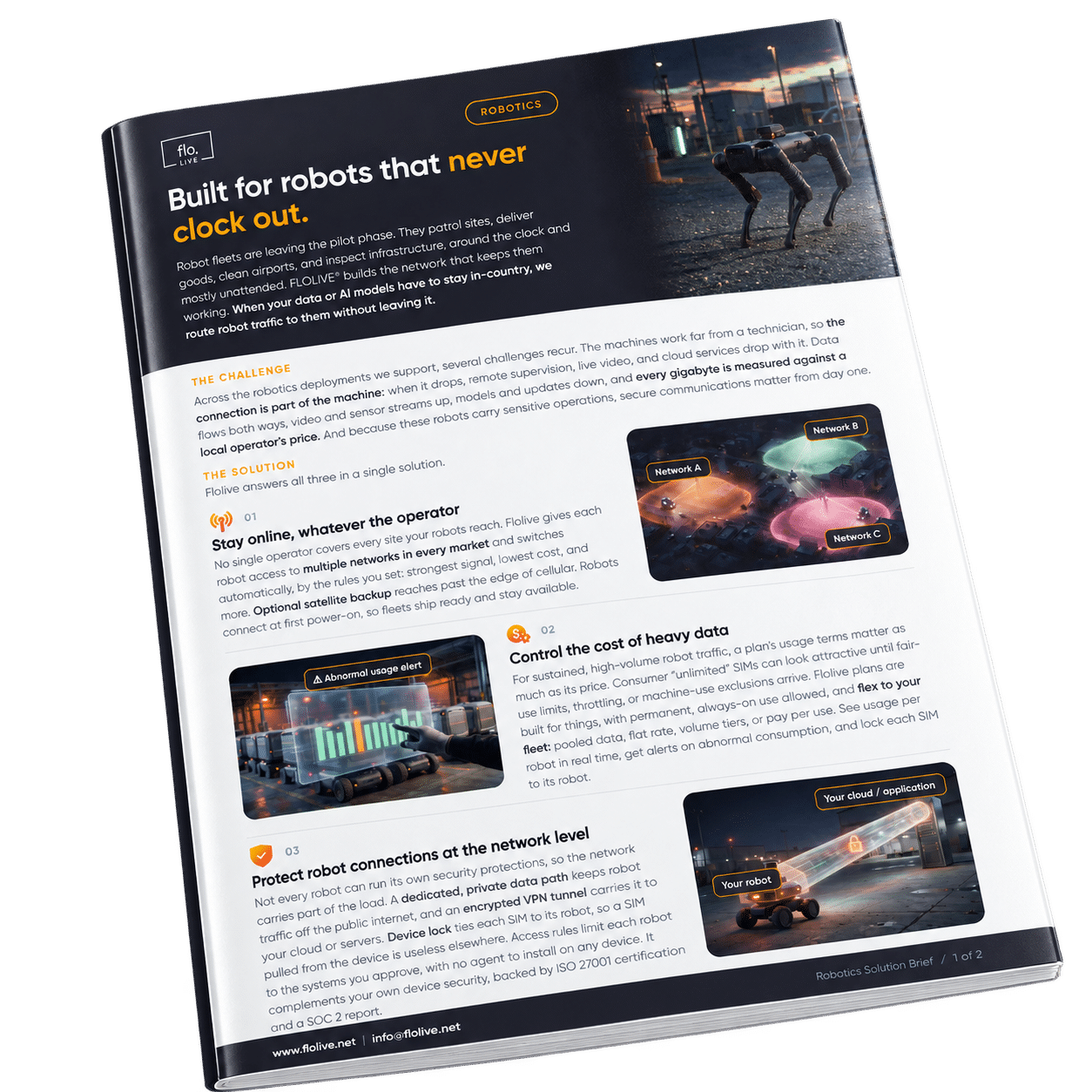
Robot fleets are leaving the pilot phase, patrolling sites and delivering goods with no technician nearby. When the connection drops, remote supervision and live video drop with it. See how FLOLIVE® keeps robots online across multiple networks, keeps heavy data costs predictable, and routes traffic to in-country AI.
What you’ll learn
- Keep robots online with automatic switching across networks, plus satellite backup
- Choose plans built for always-on machine use: pooled, flat rate, tiered, or pay per use
- Meet data residency and sovereign-AI rules through 40+ in-country traffic exits
- Ship one factory-fit SIM to 190+ countries under a single contract

Analyst report:
Transforma Insights: Connectivity and the Quality of AI Data
When an IoT device drops off the network, the AI keeps running on missing or late data. Its answers can look right and still be wrong. Transforma Insights traces how coverage gaps and packet loss turn into missed events and false alerts, then maps what AI-ready and AI-native connectivity have to deliver.
- 3 types of AI on IoT data, and why one device can feed all 3
- 5 connectivity factors that turn into missed events and false alerts
- 7 data elements behind an AI-native connectivity platform
- How closed-loop remediation stops network problems becoming data problems

Webinar:
Connecting IoT devices to edge AI infrastructure: the role of global IoT connectivity providers

Edge AI is moving intelligence closer to where data is generated – but without the right connectivity, physical AI systems cannot operate reliably or scale effectively.
In this webinar you’ll learn:
- What the distributed physical AI stack looks like
- The connectivity requirements of edge AI
- What to look for in an IoT connectivity provider

Case Study:
Global by Design. Sovereign by Law. Ready for Physical AI.
Odido, the largest mobile operator in the Netherlands, rebuilt its IoT business on FLOLIVE® and became the country’s first fully compliant IoT platform. Read how a sovereign core turned a regulatory deadline into a national differentiator, and cleared the ceiling for high-bandwidth, AI-driven use cases.
What You’ll Discover
- How the RVIT reset the Dutch IoT market, and what compliance actually requires
- The four requirements that decided Odido’s RFP
- How multi-IMSI architecture extends an operator’s own roaming footprint into truly global coverage

Analyst report:
Your Edge AI Is Only as Good as the Network Underneath It
Analysys Mason analysts Joseph Attwood and Gorkem Yigit map the five design constraints that decide whether IoT devices can reach edge AI infrastructure at the latency, sovereignty and resilience that physical AI demands. Read the article, commissioned by FLOLIVE®.
Analyst report:
Network level security anomaly detection is emerging as a critical requirement for IoT
Discover why network-level security anomaly detection is becoming critical for IoT, as CRA and NIS2 raise expectations for continuous monitoring, risk management and incident response.
Case Study:
How FreeWave closed the security gap in cellular-backhauled telemetry
Bots pinged FreeWave’s publicly visible static IPs, got in through default credentials, and wiped hundreds of Linux environments. Working with Velocity IoT and FLOLIVE®, FreeWave rebuilt the connectivity layer behind its Elements ES1000 gateway: no static IPs, no port forwarding, no carrier lock-in. Devices now ship pre-configured and connect on power-up across 190+ countries.
What you’ll read:
- Public static IPs eliminated fleet-wide
- 100% of devices ship pre-configured
- One SIM, 190+ countries, one bill
Webinar:
Keep Every Fleet Connected, Across Every African Border
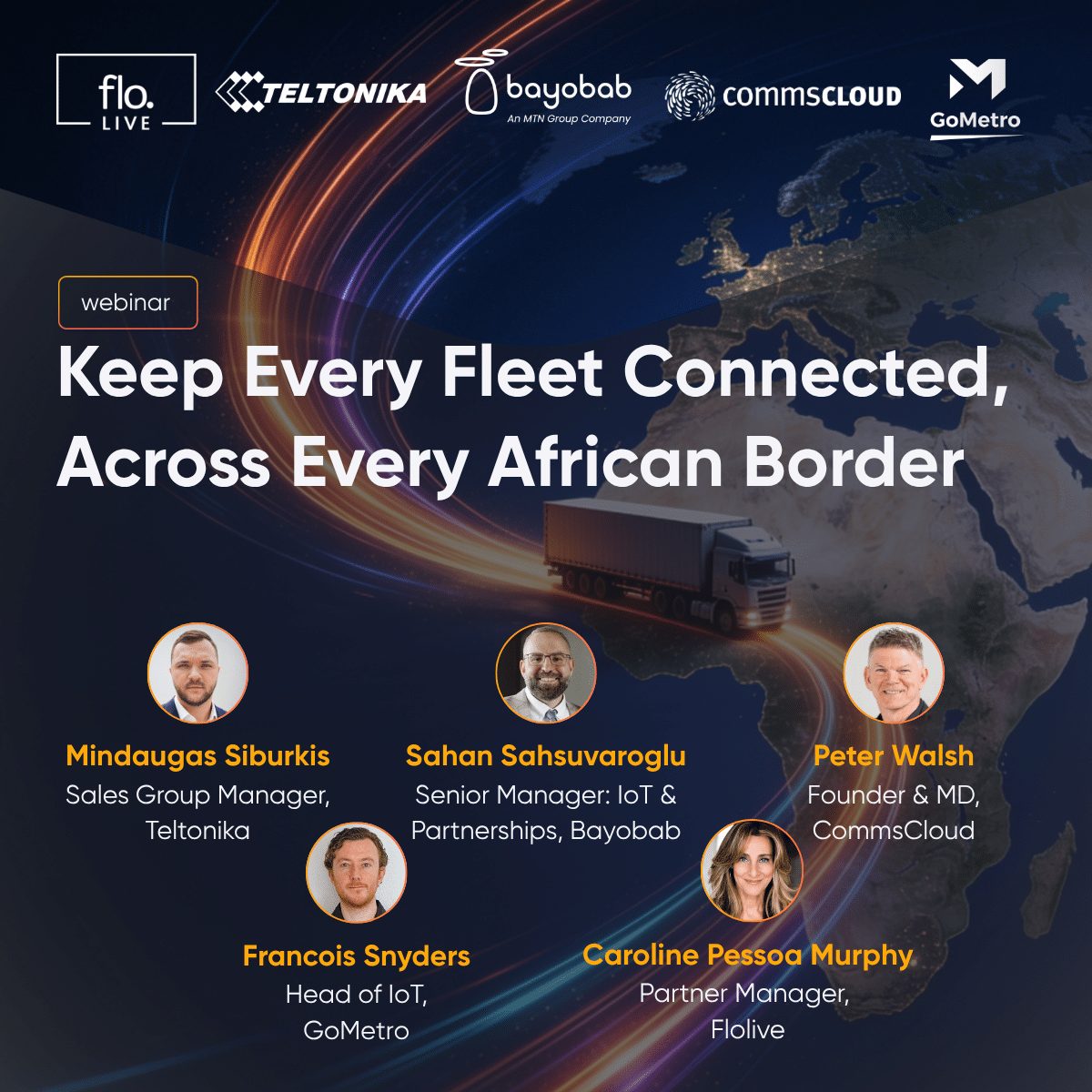
This live panel brings together Teltonika devices, Bayobab’s Pan-African backbone, CommsCloud’s multi-IMSI, geo-redundant connectivity, orchestrated on Flolive – with GoMetro bringing the real-world story of what changes when the full stack works together.
In this webinar you’ll learn:
- What actually breaks at a border crossing
- Multi-IMSI setup handles local-SIM requirement
- Why connectivity is a strategy, not an add-on
Solution Brief:
SGP.32 Risks & Opportunities for Enterprises
This brief walks through SGP.32’s push-and-pull architecture, the seven real risks enterprises need to plan around (security, interoperability, cost, and more), and where the genuine opportunity lies for teams managing large, distributed IoT fleets.
What you’ll learn
- How SGP.32’s push-and-pull architecture differs from SGP.02 and SGP.22
- The seven real risks to plan around
- Where the actual opportunity lies
- Why Transforma Insights recommends treating SGP.32 as a managed service
Webinar:
Networks for the AI Era: How Connectivity Infrastructure Must Evolve to Meet Enterprise AI Demands
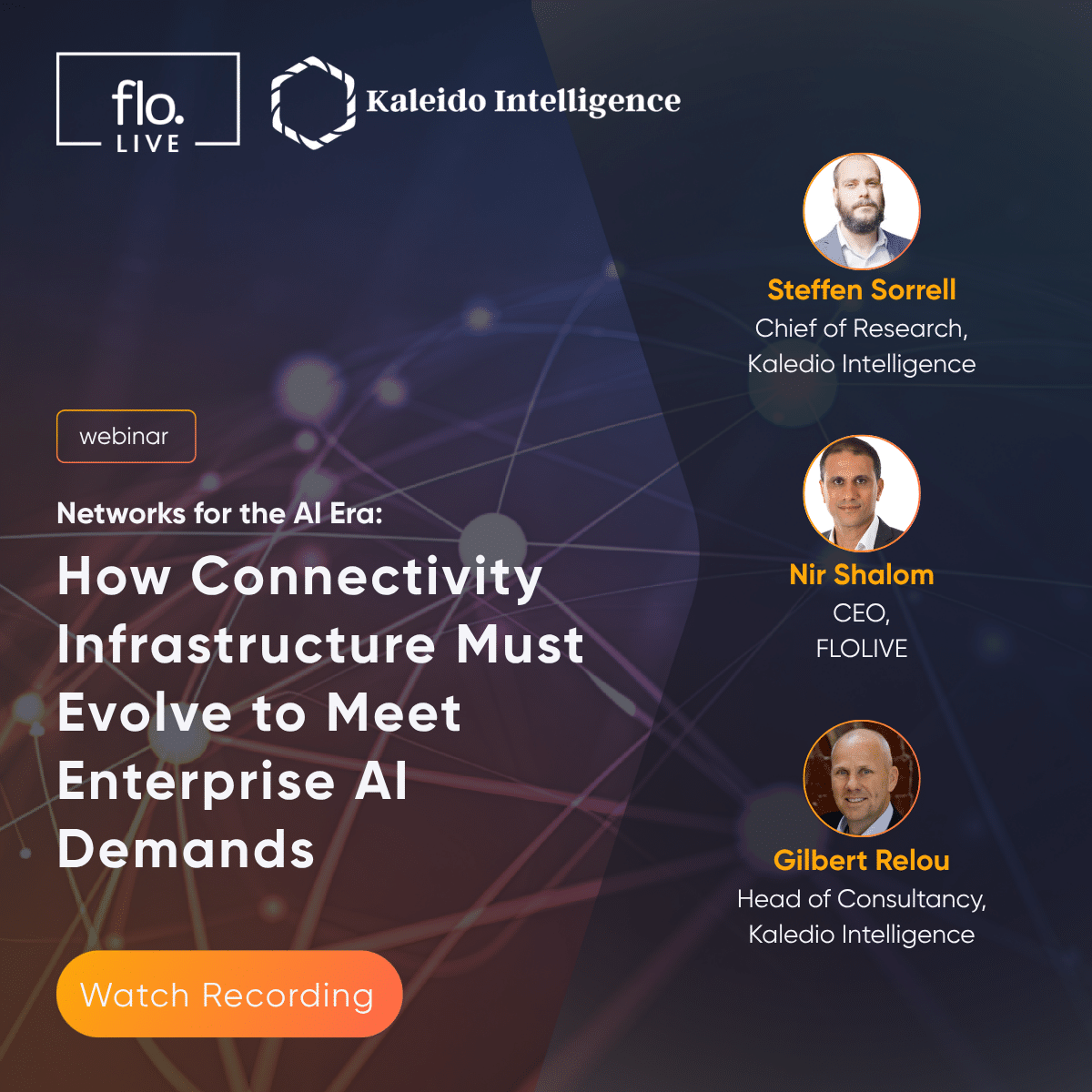
Unpack how legacy approaches to connectivity and connectivity infrastructure must evolve to meet emerging requirements, and best practices to deliver value for the customer.
In this webinar you’ll learn:
- How AI is reshaping the traditional IoT network
- How regulation has disrupted traditional connectivity strategies
- Key capabilities that enterprises need
Solution Brief:
How MNOs Can Turn SGP.32 from a Revenue Threat into a $26B Opportunity
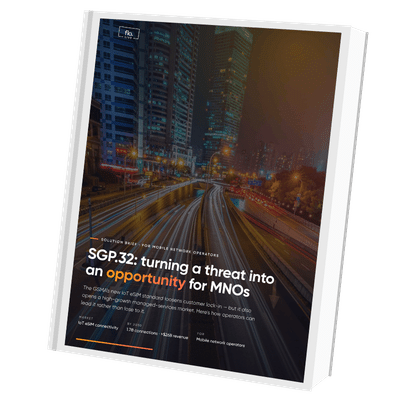
SGP.32 lets enterprises switch connectivity providers without MNO approval, putting roaming revenue at risk. IoT eSIM connections are set to reach 1.7 billion by 2030, with revenue forecast above $26 billion. Move first, or lose the market to someone who did.
Inside:
- Keep enterprise customers in your ecosystem with managed SGP.32 eSIM services
- Meet permanent-roaming compliance through localized breakouts, no infrastructure overhaul required
- Manage global IoT from a single CMP portal with the FLOLIVE® hybrid Multi-IMSI and SGP.32 model
Webinar:
Agentic AI Reaches the IoT Edge with Easy-to-Use Options
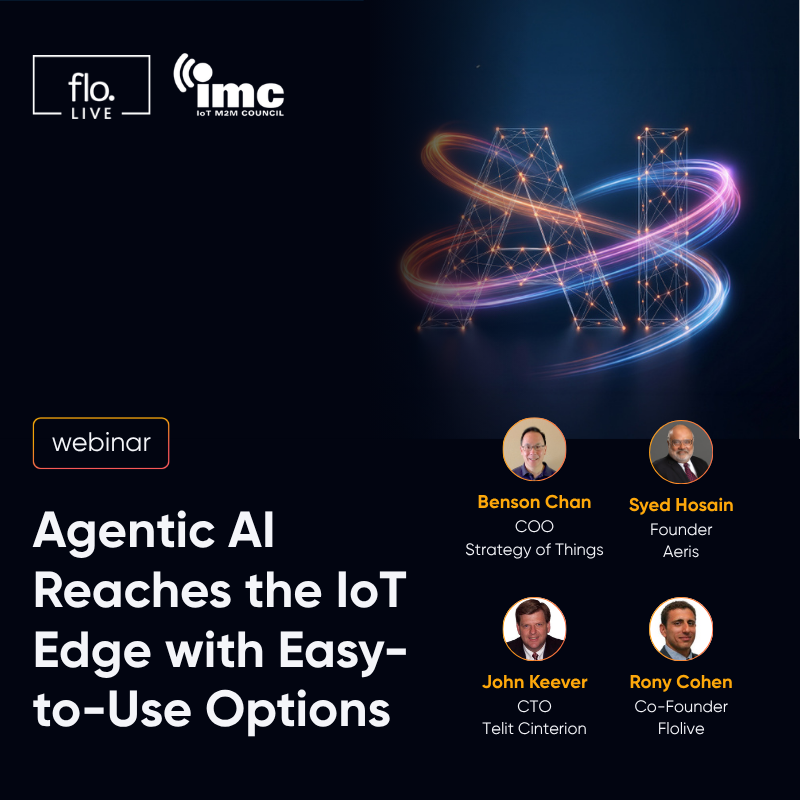
AI workloads are moving from the cloud to gateways, routers, and other edge devices. New standardized edge stack and “AI App Stores” are making adoption easy.
In this webinar you’ll learn:
- The newest use-cases for AI at the edge
- How AI is moving into the physical world
- What this means for your IoT connectivity