


Local Breakout.
Keep IoT traffic in-region.
Route IoT data out to the internet in the country where the device sits, instead of hauling it back to a home network on the other side of the world.
FLOLIVE® runs 40+ local breakout locations, so traffic from a device in São Paulo reaches a São Paulo application without a round trip through Europe.
What Is a Packet Gateway (PGW) and what is a local breakout?
A Packet Gateway, also written PGW or P-GW, is the component of a 4G mobile core network that connects a device’s data session to the public internet or to a private network. Every byte a cellular IoT device sends passes through one. Its location decides the physical path that data takes.
Local breakout means placing that gateway in the same region as the device, so traffic exits to the internet locally instead of being carried back to the operator’s home country first. A device in Brazil talking to a Brazilian application stays in Brazil. The alternative, home routing, sends the same traffic to the SIM’s home network and back, which adds distance, latency and a data residency problem.
Flolive operates 40+ local breakout locations across public cloud, private cloud, edge and on-premises deployments, with policy control over which gateway each device uses.
-
 Keep data within geographic boundaries for residency laws.
 -
 Choose cloud, on-prem, or hybrid deployment models.
 -
 Localize traffic to reduce latency and costs.
Local breakout vs home routing vs regional breakout
| Local breakout | Home routing | Regional breakout | |
|---|---|---|---|
|
Where traffic exits to the internet |
In the country where the device sits |
In the SIM’s home country |
In a regional hub, often in a nearby country to the device |
|
Data residency |
Traffic can stay inside the jurisdiction |
Traffic leaves the jurisdiction by design |
Depends on where the hub sits |
|
Suits |
Latency-sensitive and regulated deployments |
Low-volume deployments with no residency requirement |
Deployments where per-country breakout is not justified |
How local breakout supports edge computing and distributed AI
Edge workloads only pay off if the network gets data to the edge node quickly. A device that reaches a local inference server in 20 ms and a device that reaches the same server in 300 ms are running the same application with very different results.
Local breakout sets that distance. Placing the gateway in-region means device traffic reaches a regional edge node or cloud region directly, rather than travelling to a home network first and back again.
Your connectivity fabric for practical, scalable edge intelligence.
-
Traffic exits in-region
AI and IoT data reaches a local processing point without a home-network detour. -
Policy-Driven Routing
Steer traffic to the device, the edge node or the cloud, per device group, changed from the platform rather than the device. -
Data stays inside borders
AI workloads processing personal or regulated data can be kept within the jurisdiction that governs them. -
No new core to stand up
Breakout runs on the Flolive core, so adding a region doesn’t mean deploying and operating your own EPC.
Why enterprises choose the Flolive PGW network
Most IoT connectivity providers rent breakout from a handful of partner locations. Flolive owns and operates 40+ of them, and runs the mobile core behind them, so policy, routing and observability sit in one platform rather than three.

40+ breakout locations:
The largest PGW footprint in the industry.
Available as a Service:
Launch via AWS or OCI Marketplace for instant reach.
Unified operations:
Centralize policy, observability, and orchestration across sites.
Regulatory alignment:
Keep traffic in-region GDPR, CCPA and national data residency rules.
Local breakout deployment models compared
Choose the deployment that fits your latency, sovereignty, and cost requirements.
Managed, self-operated, cloud, edge, on-prem, or hybrid—your call.
Public or Private Cloud
Deploy PGWs in public, or private cloud regions for flexible scalability and rapid rollout.
Edge
Choose your edge: Device, Network, Cloud, CSP, or application server.
Om-Prem / Data Center
Deploy PGWs inside your own data centers for full control, sovereignty, and private routing.
Hybrid
Combine cloud, on-prem, and edge breakouts for maximum performance, routing flexibility, and regulatory compliance.
Management Options
Managed by floLIVE, PGW-as-a Service.
Self-Operated You host and run PGWs, with full policy control and orchestration.
| Deployment | Where the PGW runs | Best when | Who operates it | Rollout time |
|---|---|---|---|---|
|
Public cloud |
AWS or OCI region, via marketplace listing |
You need a new region quickly and the application already runs in that cloud |
Flolive managed, or self-operated |
Fastest |
|
Private cloud |
Your own cloud tenancy |
Cloud economics are fine but the tenancy must be yours |
Either |
Fast |
|
Edge |
Device, network, cloud, CSP or application server |
Latency budget is tight and processing happens near the device |
Either |
Varies by edge site |
|
On-premises / data centre |
Inside your own facility |
Regulation or policy requires the gateway on your premises |
Usually self-operated |
Slowest |
|
Hybrid |
A mix of the above |
Different markets have different rules or latency needs |
Mixed |
Varies |
Who uses Flolive local breakout?
One PGW fabric, multiple outcomes, tailored controls for each operator model.

MNOs
Localize traffic, reduce latency, and meet residency requirements with a unified view across all sites.
MVNOs & IoT Providers
Place breakout in key markets, align policy with SLAs, and manage SIM steering – all in one platform.

Enterprises
Achieve sovereignty and performance for mission-critical apps with flexible, region-specific routing.
What makes Flolive local breakout different
A globally local PGW network, operationalized for IoT.
-
 40+ breakout locations, owned and operated by FloliveMost IoT providers resell breakout from partner gateways.
 -
 Available on AWS and OCI MarketplaceProcure through an existing cloud commitment rather than a new vendor contract.
 -
 Runs on the same core as Flolive connectivityOne platform for SIM policy, breakout policy and session visibility, rather than a gateway bolted onto someone else’s core.
 -
 Multi-IMSI alongside local breakoutDevices can attach as local subscribers and break out locally in the same market.
Global-Local Deployment Map
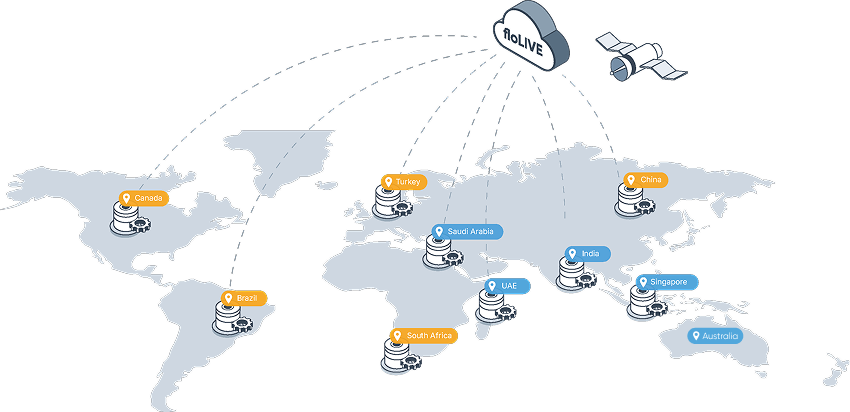
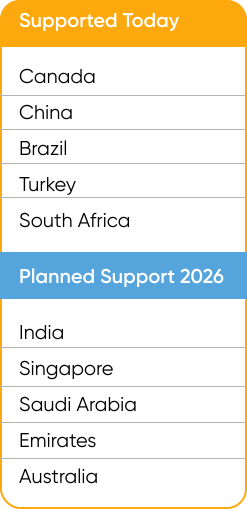
The unique Flolive approach to global IoT connectivity ensures compliance with Permanent Roaming restrictions in highly regulated countries, since local IMSIs or profiles are applied to the devices when they land in any such country. We already guarantee “Permanent Roaming Safe” connectivity in Canada, China, Brazil, Turkey and South Africa, with India, Singapore, Saudi Arabia, Emirates and Australia in the works.

Ready to localize your IoT traffic?
Our Latest Updates

Edge Computing in 2026: Use Cases, Technology, Edge IoT and Edge AI
floLIVE Launches Local Breakout Service, Redefining IoT Connectivity with Low-Latency Performance and Localized Data Privacy Management

PDN Gateway: Core Functions, Pros/Cons, and Best Practices
What Our Customers Are Saying




Frequently Asked Questions
A packet gateway, abbreviated PGW or P-GW, is the mobile core component that connects a cellular device’s data session to the internet or to a private network. Its physical location determines the route a device’s traffic takes, which is why gateway placement drives both latency and data residency.
Local breakout means routing a device’s data out to the internet in the region where the device is located, rather than carrying it back to the SIM operator’s home country first. It reduces round-trip latency and keeps traffic inside the jurisdiction that governs it.
Flolive operates 40+ PGW breakout locations worldwide, and also offers virtual PGWs through AWS Marketplace and Oracle Cloud Infrastructure. Deployments can be public cloud, private cloud, edge or on-premises.
Mobile network operators, MVNOs, IoT service providers and enterprises with cross-border device fleets use local breakout, generally for one of two reasons: a latency budget that home routing cannot meet, or a regulation requiring data to stay in-country.
Yes. Flolive PGWs can be deployed inside your own data centre, in your own cloud tenancy, or in a hybrid model where Flolive manages some locations and you operate others. Policy control runs through the Flolive Connectivity Management Platform in every model.
Home routing carries a device’s traffic back to the SIM operator’s home network before it reaches the internet, which adds distance in both directions. Local breakout exits to the internet in the device’s own region. For a device in Brazil talking to a Brazilian application, home routing through Europe can add several hundred milliseconds that local breakout removes entirely.