


What Is an IoT Gateway?
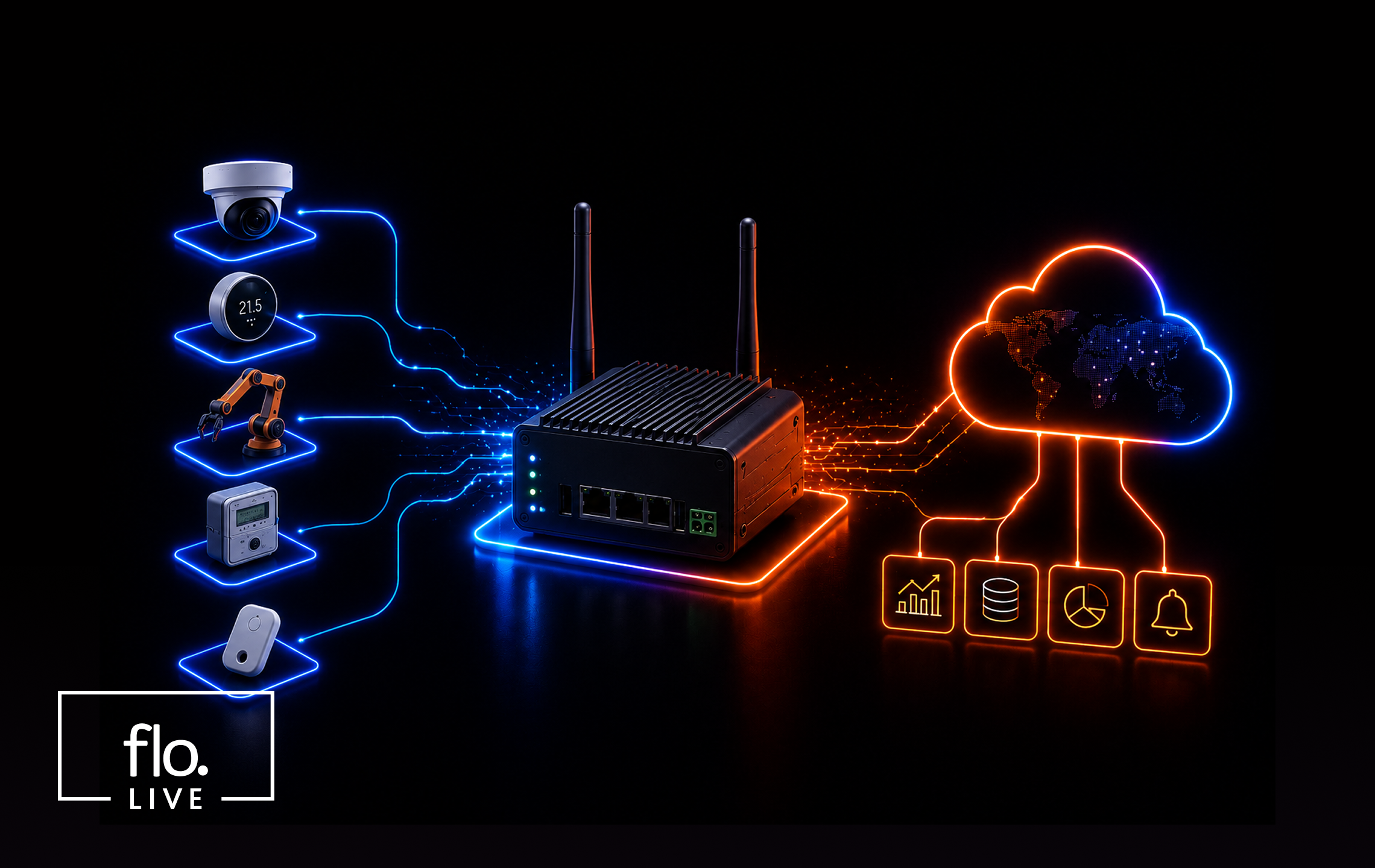
An IoT gateway is a physical device or software that acts as a central hub between smart devices, sensors, and the cloud. It bridges communication protocols, aggregates and filters data, and performs local edge computing to ensure secure, efficient, and reliable operations.
Key functions:
- Protocol translation: Converts data from specialized, low-power IoT protocols (e.g., Bluetooth, Zigbee, LoRaWAN) into standard internet protocols (like MQTT or HTTP).
- Edge computing: Processes and analyzes data locally before sending it to the cloud, reducing latency and bandwidth costs.
- Security: Acts as a firewall, encrypting sensitive data and authenticating traffic to prevent cyber threats.
- Offline buffering: Temporarily stores data locally if the internet connection drops, uploading it once connectivity is restored.
When do you need one?
You need an IoT gateway when your sensors cannot connect directly to the internet, or when you are operating a large-scale network from a central point. Gateways let low-power devices share one backhaul connection instead of each carrying its own wide-area radio, which lowers device cost and power draw. Where devices can carry cellular radios directly, using LPWA technologies such as NB-IoT or LTE-M, a gateway may not be needed at all.
This is part of a series of articles about IoT device management
When Do You Need IoT Gateways?
You need an IoT gateway when devices cannot communicate directly with cloud platforms or when additional processing, security, and protocol management are required. While some IoT deployments can connect devices directly to the internet, gateways become important as systems grow in size, complexity, or operational requirements:
- Devices use different communication protocols: Gateways translate between protocols such as Modbus, BACnet, Zigbee, Bluetooth Low Energy (BLE), LoRaWAN, and MQTT.
- Internet connectivity is limited or unreliable: Gateways can store data locally and forward it when connectivity is restored.
- Low latency is required: Gateways can process data at the edge instead of waiting for cloud-based processing.
- Bandwidth usage must be reduced: Gateways can filter, aggregate, and compress data before transmission.
- Additional security controls are needed: Gateways handle device authentication, encryption, access control, and threat monitoring.
- Legacy equipment must be connected: Gateways connect systems that use older communication standards to modern IoT architectures.
- Large numbers of devices need centralized management: Gateways act as a local management point for connected devices.
IoT Gateway Architecture
1. Device Layer
The device layer consists of sensors, actuators, controllers, and embedded systems that generate or consume data at the edge. These devices often operate using communication protocols such as Zigbee, Bluetooth, Wi-Fi, Modbus, or proprietary standards, which can complicate direct cloud integration. The device layer captures raw data from the physical world and enables control commands to be executed on physical assets.
This layer is typically characterized by resource-constrained hardware with limited processing power, memory, and battery life. Devices may operate in challenging environments and require reliable connectivity. The heterogeneity of this layer drives the need for IoT gateways, which aggregate and normalize data from multiple sources for further processing or transmission.
2. Gateway Layer
The gateway layer acts as the intermediary between the device layer and higher-level systems such as the cloud or enterprise applications. It aggregates data from multiple devices, performs protocol translation, and provides initial processing or filtering of collected information. Gateways can handle tasks such as data normalization, encryption, and real-time analytics or local decision-making.
Gateways also manage local network connectivity, including device addressing, authentication, and security. This layer is important where bandwidth is limited, latency must be minimized, or continuous cloud connectivity cannot be guaranteed. By performing these functions at the edge, gateways help maintain reliable and secure IoT system operation.
3. Cloud or Application Layer
The cloud or application layer receives data from the gateway layer and provides processing, storage, analytics, and visualization capabilities. Cloud platforms aggregate data from many gateways, enabling large-scale monitoring, predictive analytics, and integration with enterprise systems. This layer is where data-driven decision-making and business process automation occur.
Security, scalability, and interoperability are key considerations at this layer. Cloud services often offer APIs, dashboards, and integration tools for developers and operators. The cloud or application layer makes insights from edge devices accessible to users, applications, or automated systems.
Key Functions of an IoT Gateway
Protocol Translation
Protocol translation is a core function of an IoT gateway. Many IoT devices use communication protocols that are not directly compatible with each other or with standard internet protocols. Gateways translate data between protocols such as MQTT, CoAP, Modbus, Zigbee, and HTTP, allowing heterogeneous devices to communicate within an IoT ecosystem.
Importance:
This capability is important in industrial and enterprise settings, where legacy equipment often uses proprietary protocols. By handling protocol translation at the gateway, organizations can integrate new and old devices without overhauling their infrastructure. It ensures that devices can send and receive information as needed.
Edge Computing
Edge computing on IoT gateways involves processing data close to where it is generated instead of sending all data to the cloud. Gateways can perform tasks such as filtering, aggregation, real-time analytics, and local decision-making. This reduces latency and bandwidth consumption and enables faster responses to critical events.
Importance:
By using edge computing, organizations can ensure that only relevant or summarized data is transmitted to the cloud, reducing costs and improving system performance. This is useful in applications requiring real-time control, such as industrial automation, remote monitoring, or smart infrastructure management.
Security
Security is a core function of IoT gateways, acting as the first line of defense between edge devices and external networks. Gateways implement encryption, authentication, and access control to protect data in transit and at rest. They also monitor for suspicious activity and enforce security policies at the edge, preventing unauthorized access to connected devices.
Importance:
With the increasing number of IoT devices and cyber threats, gateway security protects sensitive data and maintains system integrity. By offloading security functions to the gateway, organizations can centralize security management and reduce the attack surface of their IoT deployments.
Offline Buffering
Offline buffering allows IoT gateways to store data locally when connectivity to the cloud or central servers is lost. This ensures that data is not lost during network outages or disruptions. Once connectivity is restored, buffered data is forwarded to maintain continuity for downstream analytics or operations.
Importance:
This function is critical in remote or unreliable network environments, such as industrial sites, transportation systems, or rural infrastructure. Offline buffering helps maintain operations when real-time connectivity is unavailable.
Types of IoT Gateways
Cellular IoT Gateways
Cellular IoT gateways use mobile networks such as 3G, 4G, LTE, or 5G to connect devices to the internet or cloud services mobile networks such as LTE (4G) or 5G to connect devices to the internet or cloud services. These gateways are suitable for remote locations or mobile assets where wired connectivity is not feasible. They support use cases such as vehicle tracking, remote monitoring, and mobile point-of-sale systems. They often support multiple cellular providers for redundancy.
These gateways may include:
- SIM card management
- Network failover
- VPN connections
Industrial IoT Gateways
Industrial IoT (IIoT) gateways operate in environments such as factories, energy plants, or outdoor installations. They are built for temperature extremes, vibration, dust, and moisture. Industrial gateways support protocols such as Modbus, PROFIBUS, and OPC UA to integrate legacy and modern equipment. Industrial IoT gateways support data collection, local analytics, and remote management in manufacturing, energy, and infrastructure applications.
These gateways may offer:
- Extended temperature ranges
- Flexible power supply options
- Ruggedized enclosures for harsh industrial environments
Edge AI Gateways
Edge AI gateways combine gateway functions with on-device artificial intelligence and machine learning capabilities. These gateways process sensor data locally using AI models, enabling applications such as video analytics, predictive maintenance, and anomaly detection without sending raw data to the cloud.
Edge AI gateways are used where low latency, privacy, or regulatory requirements limit cloud processing. They may include:
- Hardware acceleration for AI workloads
- Integration with cloud AI services
- Support for local AI inference and real-time decision-making
IoT Gateway Use Cases
Remote Machine Monitoring
Remote machine monitoring uses IoT gateways to collect and transmit data from industrial equipment such as pumps, generators, or HVAC systems to centralized platforms. Gateways aggregate sensor data, perform initial diagnostics, and send alerts when anomalies are detected. Gateways may support legacy industrial protocols and operate in harsh conditions. By processing and filtering data locally, the gateway ensures that relevant information is transmitted.
Example:
A manufacturing company deploys IoT gateways across multiple plants to collect data from pumps and compressors. The gateway detects abnormal vibration patterns and alerts maintenance teams before equipment failure occurs.
EV Charging Infrastructure
IoT gateways connect EV charging stations to network operators, utility providers, and payment systems. The gateway manages communication between charging hardware, user interfaces, and backend systems, supporting remote monitoring, diagnostics, and firmware updates. Gateways in EV charging applications handle multiple protocols and secure transactions. They also support load balancing and demand response.
Example:
A network of public EV charging stations uses IoT gateways to manage charger status, process payments, and automatically adjust charging rates during peak electricity demand periods.
Point-of-Sale and Retail Connectivity
IoT gateways connect point-of-sale (POS) terminals, payment systems, inventory sensors, digital signage, and other in-store devices. The gateway transmits transaction data, inventory updates, and operational metrics between local devices and cloud-based retail platforms. Gateways can provide local processing and offline transaction buffering during network outages. They also help secure payment data and manage device updates.
Example:
Evaluating signal penetration, terrain, building density, and available infrastructure helps reduce deployment risks.
Fleet, Transportation, and Telematics
IoT gateways in fleet management and transportation systems collect data from vehicles, onboard sensors, GPS receivers, cameras, and diagnostic systems. The gateway aggregates information such as vehicle location, fuel consumption, engine performance, driver behavior, and cargo conditions before transmitting it to fleet management platforms. Gateways often include local processing and data buffering to handle inconsistent network coverage. Some support edge analytics for real-time alerts related to driving behavior or equipment faults.
Example:
A logistics provider installs IoT gateways in delivery vehicles to collect GPS, engine diagnostics, and driver behavior data, enabling real-time fleet visibility and proactive maintenance scheduling.
Related content: Explore how connected vehicles work in our guide to telematics and IoT.
How to Choose an IoT Gateway
Here are some important considerations when selecting an IoT gateway.
1. Connectivity Options
Connectivity is one of the first factors to evaluate when selecting an IoT gateway. The gateway should support required network technologies such as Ethernet, Wi-Fi, cellular (LTE or 5G), satellite, or LPWAN technologies like LoRaWAN, NB-IoT, and LTE-M. Many deployments use gateways that support multiple connectivity options for redundancy. For example, a gateway may use Ethernet as its primary connection and switch to cellular service during outages.
Key actions:
- Verify support for required network technologies and failover options.
- Evaluate cellular, Wi-Fi, Ethernet, or LPWAN support based on deployment needs.
- Consider future connectivity requirements as deployments expand and data demands increase.
2. Protocol Support
An IoT gateway should support the communication protocols used by devices and cloud platforms. Device-side protocols include Modbus, BACnet, Zigbee, Bluetooth Low Energy (BLE), CAN bus, and OPC UA, while cloud communication often relies on MQTT, HTTPS, or AMQP. Protocol support is especially important when connecting legacy equipment. A gateway with protocol translation capabilities allows organizations to integrate older systems into modern IoT architectures without replacing existing assets.
Key actions:
- Confirm compatibility with device-side and cloud communication protocols.
- Ensure protocol translation is available for legacy equipment integration.
- Consider potential future protocol requirements and support for software updates.
3. Edge Processing Capability
The required level of edge processing depends on the application. Some deployments need basic data forwarding, while others require local filtering, aggregation, analytics, or automated decision-making. Edge processing reduces latency and the volume of data sent to the cloud. Organizations should evaluate whether the gateway supports containers, custom applications, or AI frameworks to extend functionality over time.
Key actions:
- Assess local processing requirements for filtering and analytics.
- Verify support for containers, custom applications, or AI workloads.
- Evaluate CPU, memory, and storage resources for future expansion.
4. Security Features
Security should be a primary consideration when evaluating IoT gateways. Features to look for include secure boot, hardware-based security modules, device authentication, encryption, firewall capabilities, and role-based access control. Gateways may also support certificate management and security updates. Since the gateway serves as an entry point between operational technology and external networks, strong security controls are necessary.
Key actions:
- Verify support for secure boot, encryption, and device authentication.
- Ensure regular security updates and certificate management capabilities.
- Review compliance support for relevant industry regulations.
5. Cloud Compatibility
The gateway should integrate with the cloud platforms and applications used by the organization. Many gateways support services such as AWS IoT, Microsoft Azure IoT, Google Cloud, and other IoT platforms. Cloud compatibility includes support for required APIs, data formats, and messaging standards. Organizations should also evaluate support for bidirectional communication, digital twins, and remote commands.
Key actions:
- Confirm integration with existing cloud platforms and services.
- Verify support for required APIs, messaging protocols, and data formats.
- Ensure support for remote commands, device twins, and bidirectional communication.
6. Remote Management
Remote management simplifies large-scale IoT deployments. A gateway should allow administrators to monitor device health, update firmware, modify configurations, troubleshoot issues, and manage security settings without on-site access. Organizations should look for features such as bulk device provisioning, remote diagnostics, automated software updates, and alerting mechanisms.
Key actions:
- Verify support for remote monitoring and diagnostics.
- Ensure firmware and software updates can be deployed over the air.
- Evaluate bulk provisioning, configuration management, and alerting capabilities.
Power Your IoT Gateway Deployments with FLOLIVEⓇ Global Connectivity
An IoT gateway is only as reliable as the network behind it, and connecting devices across regions, carriers, and regulatory environments is where most large-scale deployments run into trouble. FLOLIVEⓇaddresses this with one localized global network that keeps every device connected and compliant, no matter where it operates. Its cloud-managed core applies local profiles and enables local breakout across continents, giving gateway-based deployments consistent behavior, low latency, and full control from a single platform, backed by 15+ carrier partners and 750+ networks.
Key capabilities of Flolive:
- Localized global connectivity: A cloud-managed network applies local profiles and enables local breakout across continents, delivering compliance, low latency, and consistent device behavior everywhere.
- Any cellular technology from 2G to 5G and NTN: The platform combines cellular and satellite connectivity under one roof, with IoT NTN behaving like any other cellular network to support use cases such as “satellite as backup.”
- Support for every SIM type: Plastic SIMs, embedded eSIMs, iSIM, and softSIM are all supported, with seamless activation, smart switching, and full lifecycle control across devices and geographies.
- Single-pane-of-glass management: A unified Connectivity Management Platform (CMP) lets you monitor data usage, manage security policies, and switch network profiles for all global devices from one central dashboard.
- Data privacy and roaming compliance: Local breakout keeps traffic inside the country where it originates, so deployments can meet in-country data residency requirements and reduce cross-border transfer exposure under frameworks such as GDPR. In tightly regulated markets that restrict long-term roaming, Flolive provisions devices with a native local identity so fleets stay connected without manual intervention.
- Low latency and high throughput: Localized core networks and regional breakouts route data along the shortest path, shortening round trips and improving uptime. Keeping high-volume telemetry off long-haul backhaul also preserves throughput as fleets scale.
Ready to keep your connected devices online, compliant, and easy to manage at scale? Explore Flolive’s Global IoT Connectivity solution.