
Reading into the Research: Why Kaleido Intelligence Say Future IoT Success Starts With The Right Network Strategy
The IoT market is entering a decisive phase. What once worked, namely roaming-based connectivity, centralized architectures, and best-effort coverage, is no longer enough. As regulation tightens and AI reshapes how data is generated, moved, and acted on, the network itself is becoming a critical success factor.
That’s exactly what a new Kaleido Intelligence report, Networks for Future IoT: Customer Demands & Service Provider Readiness sets out to explore. This independent research is grounded in how the market is actually evolving, and takes a deep look at how IoT connectivity must change.
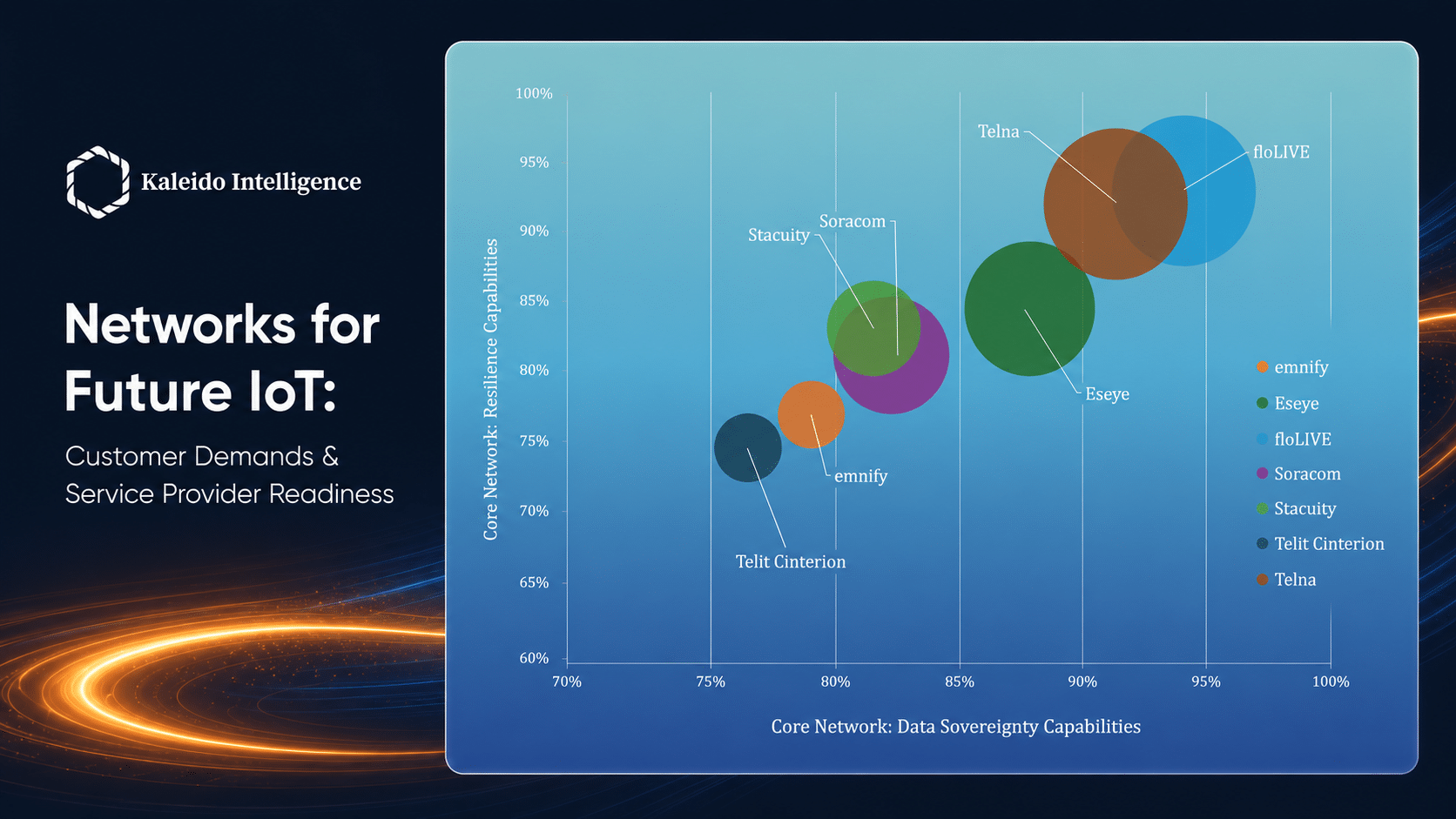
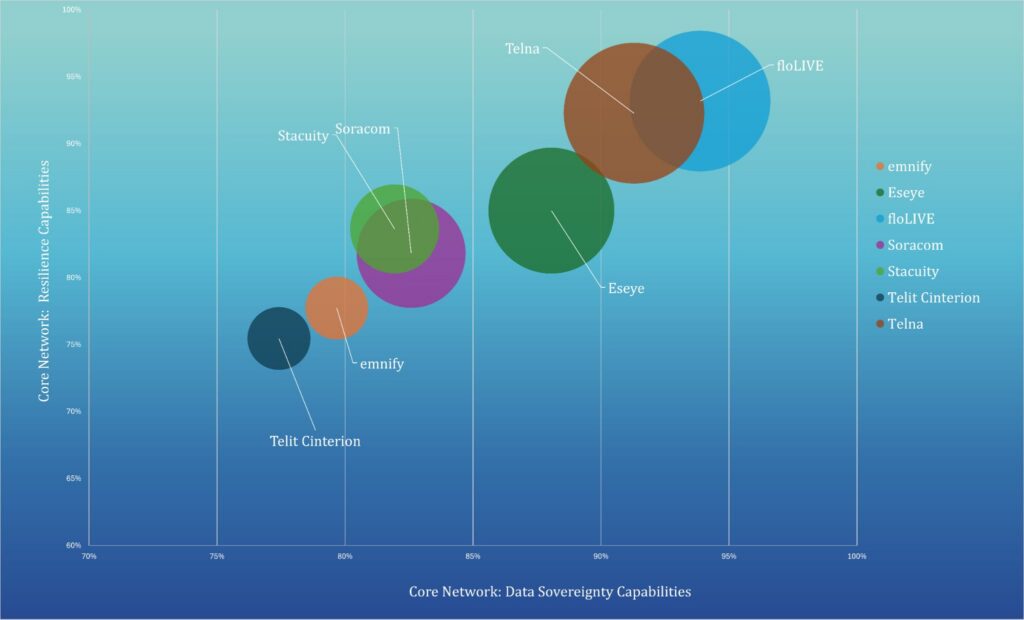
Kaleido evaluates 7 service providers against the capabilities that will define success in the years ahead. The result is a clear picture of what “future-ready” really means, and where the market stands today.
IoT Is Entering A More Demanding Phase
As IoT expands globally, it is colliding with two major forces at once: regulation and AI.
On the regulatory side, requirements around data sovereignty, local licensing, and permanent roaming are tightening across markets. What used to be fine as a scalable, roaming-based model is now increasingly constrained.
At the same time, AI is reshaping how IoT systems operate. Devices are no longer just collecting data, they are part of real-time decision loops, where latency, routing, and data locality directly impact performance. Technical and operational factors include protecting the data used to train AI models, compliance overhead, and internationally, and the requirement for local connectivity to ensure low latency demands are met.
This is where network topology becomes critical. Traditional home-routed architectures, where traffic is backhauled to a central core, introduce latency, inefficiencies, and unnecessary cross-border data flows. In an environment shaped by AI and regulation, that model starts to break down. Instead, IoT networks need to be far more distributed and locally responsive, with traffic handled closer to where devices operate.
Enterprise Expectations Have Already Redefined Connectivity
Kaleido’s research shows that as IoT deployments scale across regions, enterprises are no longer willing to accept variability in how connectivity behaves. Performance, latency, and compliance just can’t change market by market, especially when applications are increasingly real-time and AI-driven.
What enterprises are asking for instead is a network that provides both consistency and control. The ability to route data intelligently, keep traffic local where required, and maintain predictable performance regardless of geography is becoming a baseline expectation, not a premium feature. In fact, Kaleido reports that 68% of enterprise buyer respondents rate low-latency data routing of high or highest importance, and 72% rate data sovereignty as high or highest importance.
Anyone responsible for network design needs to pay attention. Because once enterprises expect the network to behave consistently across countries, adapt to regulatory requirements, and support AI workloads in real time, traditional models start to fall short. Managing connectivity market by market becomes too complex, and relying on centralized architectures introduces too much risk in both performance and compliance.
How Seven Providers Stack Up, And Why The Criteria Matter
With a structured evaluation of seven IoT connectivity providers, each assessed against the capabilities that will define success in the years ahead, Kaleido was able to provide an independent assessment that supports enterprises in becoming future proof when it comes to IoT connectivity.
To do that, they issued the same set of 18 technical questions to every provider, covering core network architecture, routing, observability, resilience, and AI-readiness. The criteria map directly to the pressures we shared above.
- Data sovereignty: Can the network control where data flows and where it is processed, not just store it?
- Connectivity resilience: Can it maintain consistent performance across regions, networks, and failure scenarios?
- Enterprise AI workloads: Can it support low-latency, distributed, and dynamic data environments where decisions happen in real time?
Kaleido looked at the underlying mechanics that actually make those outcomes possible, things like path optimization, point-of-presence distribution, traffic termination, jitter control, and real-time observability. These are not necessarily the features you see in a pricing sheet, but rather they are exactly what determine whether an IoT deployment works smoothly at scale or starts to break under pressure.
Within that context, we were proud to see that FLOLIVE® stands out from the crowd. In Kaleido Intelligence’s words: “Flolive was found to excel in all categories. The company has placed a heavy focus on developing core and packet gateway instances across numerous locations across the globe, and has strong capabilities to enable complex routing requirements in order to meet data sovereignty requirements at a granular level. The cloud-native architecture coupled to high availability mechanisms supports a high level of resilience, which is bolstered by the company’s strategy to host IMSIs at strategic locations. Tooling to monitor connectivity jitter and optimise connectivity pathways, coupled to the ability to support edge AI workloads means that the company is well-positioned to meet complex enterprise requirements.”
What This Means For IoT Leaders
As regulations tighten and AI reshapes how IoT operates, connectivity can no longer be treated as an afterthought. It is becoming a defining layer in how systems perform, scale, and stay compliant across markets.
The question is no longer whether your devices are connected, but whether your network is built for what IoT is becoming.
If you’re thinking about how your IoT strategy holds up against what’s coming next, download Networks for Future IoT: Customer Demands & Service Provider Readiness to explore:
- The full vendor comparison across all seven providers
- A deeper breakdown of network architectures and topology evolution
- Detailed insights into how AI and regulation are reshaping connectivity design



Get the latest tips and insights in our monthly newsletter.