


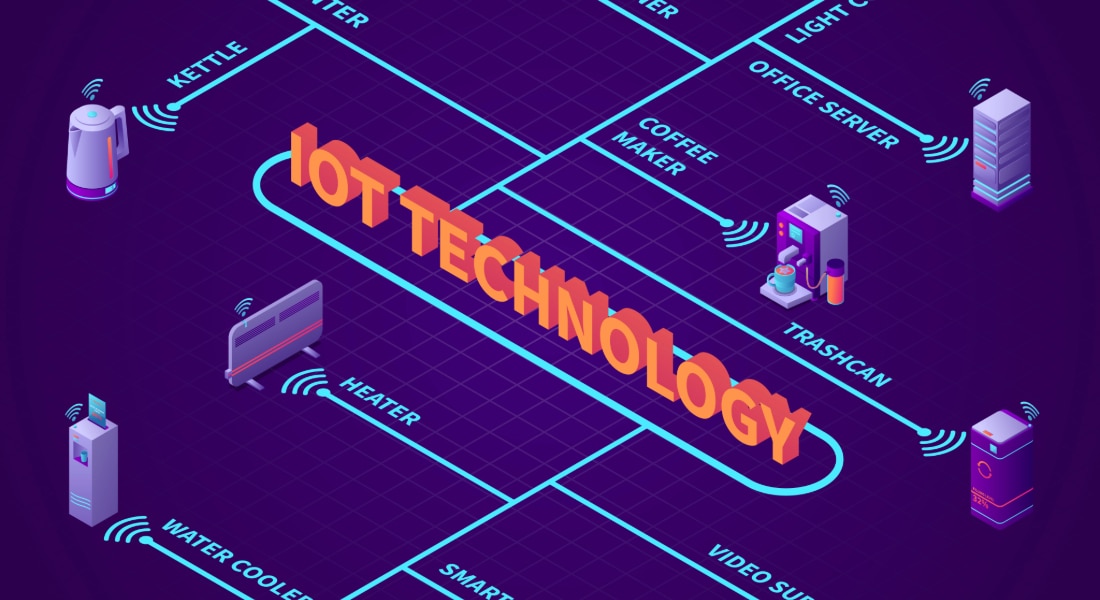
What Is IoT Platform Architecture?
An IoT platform’s architecture is typically structured in layers, including a device/sensing layer (hardware, sensors), a communication layer (gateways, network protocols), a data processing layer (edge and cloud computing, analytics, AI/ML), a platform layer (device management, data management, security), and an application layer (dashboards, user interfaces, business intelligence) to collect, transmit, process, and utilize data from connected devices to create actionable insights.
An effective architecture must support device integration, data processing, security, and communication between different technologies. It must accommodate scalability for millions of devices, heterogeneous environments, and real-time or near real-time data flows. Each element of the architecture has a distinct function, often grouped into layers, that together enable reliable IoT operations.
Core Layers of IoT Platform Architecture
1. Device/Sensing Layer
The device/sensing layer consists of the physical devices and sensors responsible for collecting and transmitting data from the environment. This layer includes sensors (temperature, humidity, motion, etc.), actuators, RFID tags, and embedded systems. Devices here are characterized by their ability to sense environmental parameters or execute physical actions upon instruction. The performance, reliability, and constraints of these devices, like power consumption and computational capability, set an upper limit to the sophistication of potential IoT solutions.
Managing device heterogeneity is a major concern in this layer. Devices originate from several vendors, have different capabilities, and often utilize proprietary interfaces. For an IoT experience, this layer must standardize data formats, device discovery, and communication procedures. Mechanisms for device authentication, secure boot, and remote updates are embedded here, laying the groundwork for downstream secure and reliable operations.
2. Communication Layer
The communication layer provides the communication backbone between devices and the rest of the IoT platform. It covers wired and wireless connectivity, including protocols like Wi-Fi, Bluetooth, Zigbee,, LoRaWAN, NTN (Satellite) and cellular (3G, 4G, 5G). This layer is critical for managing network topology, communication delays, bandwidth allocation, and network reliability, all of which have a direct impact on system latency and robustness.
Cellular connectivity plays a critical role in IoT deployments that require wide-area coverage, mobility support, and reliable communication in diverse geographic regions. Technologies such as LTE-M and NB-IoT are optimized for low-power, low-bandwidth devices, enabling long battery life while maintaining consistent connectivity.
For applications needing high throughput or ultra-low latency, such as autonomous vehicles or industrial automation, 5G provides network slicing, massive device density, and edge-computing integration. Cellular networks also benefit from established infrastructure, carrier-grade reliability, and built-in authentication mechanisms, making them well-suited for large-scale and mission-critical IoT applications.
3. Data Processing Layer
The data processing layer is responsible for ingesting, filtering, aggregating, transforming, and storing data generated by IoT devices. It typically includes data pipelines, event stream processors, databases, and storage solutions optimized for high throughput and low latency. Functions in this layer enable real-time analytics for monitoring, alerting, and operational decision-making while supporting historical storage for batch analysis and compliance.
Design considerations in this layer involve data schema management, retention policies, and integrating scalable storage strategies such as distributed databases or cloud object stores. Ensuring data quality, removing duplicates, handling missing values, and timestamping is essential for downstream application reliability. Security measures such as data encryption at rest and access control mechanisms are also central components at this stage of the architecture.
4. Platform Layer
The platform layer provides centralized services for device lifecycle management, data management, and system security. It acts as the middleware that abstracts device heterogeneity and presents a unified interface for higher layers. Typical functions include device registration, authentication, firmware distribution, monitoring, and status reporting. It also manages data ingestion pipelines, enforces retention policies, and ensures data is stored and retrieved efficiently across distributed systems.
Security enforcement is another critical aspect of this layer. The platform enforces role-based access, manages encryption keys, monitors anomalies, and integrates with identity providers for unified authentication. It also coordinates over-the-air (OTA) updates and compliance policies, ensuring consistent governance across diverse fleets.
5. Application Layer
The application layer is where processed IoT data is transformed into tangible services and user-facing applications. This layer contains APIs, business logic, dashboards, visualization tools, and integration components that bridge IoT data with external enterprise systems or cloud platforms. Its focus is on providing actionable insights, automating responses, and enabling interaction with IoT solutions.
This layer supports custom application development, integration with legacy systems, and the creation of services tailored to different business use-cases. It also abstracts underlying technical complexity, presenting users, operators, or developers with intuitive interfaces and workflows. Well-designed APIs facilitate interoperability, scalability, and reusability across different verticals such as smart cities, healthcare, and industrial automation.
Extended IoT Platform Architecture Elements
In addition to the core layers listed above, here are some additional elements that play a role in many IoT platform architectures.
Edge and Fog Computing
Edge and fog computing extend the traditional IoT architecture by enabling data processing closer to the data source. Edge computing involves performing computation and filtering on devices themselves or localized gateways, reducing latency, conserving bandwidth, and supporting real-time applications. This lowers the burden on centralized data centers and enables offline operation in environments with unreliable connectivity.
Fog computing complements edge strategies by distributing data processing across intermediate nodes (e.g., gateways, routers) situated between devices and the cloud. These nodes allow for more granular resource allocation and real-time analytics at a local level. Adoption of edge and fog paradigms supports scalability, enhances privacy, and enables localized compliance with regional data governance laws. Selecting the right mix of edge, fog, and cloud resources is driven by application-specific requirements like latency sensitivity and regulatory constraints.
Cloud Integration Models
Cloud integration models describe how IoT platforms interact with public, private, or hybrid clouds for scalable data processing, storage, and analytics. Integration models can be cloud-first, with devices sending data directly to the cloud; or hybrid, with critical processing handled locally but long-term storage and heavy analytics performed in the cloud. The choice affects latency, cost, security, and compliance considerations.
Native integration with cloud services (AWS IoT, Azure IoT Hub, etc.) enables rapid provisioning, elasticity, and access to advanced analytics or AI services. Multi-cloud and hybrid strategies improve reliability and avoid vendor lock-in but add architectural complexity. Effective IoT platforms standardize APIs and support consistent data governance regardless of deployment topology.
Security Layer
The security layer is embedded across all architectural layers in an IoT platform, addressing threats such as device impersonation, data hijacking, and denial-of-service attacks. It implements authentication, identity management, and encryption protocols for device-to-cloud and device-to-device communications. Secure boot mechanisms, hardware root-of-trust, and periodic vulnerability assessments maintain system integrity and resilience.
Continuous monitoring, anomaly detection, and incident response capabilities help mitigate the risks of emerging cyber threats. Security policies must be tailored for resource-constrained endpoints as well as powerful back-end servers. Regulatory compliance, such as GDPR or HIPAA, demands strict controls on data access, retention, and deletion. A well-architected IoT platform makes security a foundational element, not an afterthought.
Several widely recognized security standards guide the implementation of secure IoT systems:
- NISTIR 8259A and 8259B outline baseline cybersecurity capabilities for IoT devices and recommended federal agency actions, respectively, offering a structured framework for device-level and system-wide security.
- The GSMA IoT Security Guidelines provide practical advice for securing IoT services across the device, network, and service layers, with a strong emphasis on mobile connectivity.
- ETSI EN 303 645 is a baseline standard for consumer IoT, defining mandatory and recommended security provisions such as secure storage, software integrity, and vulnerability disclosure.
AI and Machine Learning in IoT Platforms
AI and machine learning are increasingly integrated into IoT platforms to automate data insights, anomaly detection, predictive maintenance, and autonomous system responses. Machine learning models deployed at the edge or in the cloud can process sensor data to identify outliers, optimize operations, or make recommendations in real-time. This enhances value extraction while reducing dependency on manual interpretation.
Developers must address challenges related to data quality, model lifecycle management, and resource limitations on edge devices. Leveraging standardized ML pipelines and integration with established AI frameworks enables organizations to quickly iterate and deploy solutions. Advanced use cases include image or audio analysis, contextual awareness, and collaborative intelligence across distributed devices.
Best Practices for Building a Successful IoT Platform Architectures
1. Prioritize Security by Design
Security should be integrated from the earliest stages of architecture planning, not treated as a separate or secondary concern. Employing secure coding practices, strong device identity management, and mutual authentication establishes a baseline defense. All communication pathways must use encryption such as TLS/DTLS, and devices should support secure boot and hardware-based trust anchors.
Proactive risk assessments and ongoing threat monitoring strengthen security postures across the platform. Patch management, over-the-air updates, and regular vulnerability scanning are needed to address evolving threats and compliance standards. Embedding security at every architectural layer not only protects assets but also builds user and business trust in large-scale IoT deployments.
2. Use Open Standards and Interoperable Protocols
Open standards and interoperable protocols prevent vendor lock-in and ensure scalability as IoT ecosystems evolve. Standardized data formats (such as JSON, CBOR) and messaging protocols (MQTT, CoAP, HTTP) allow devices from different vendors to communicate reliably. Choosing mature, widely adopted protocols facilitates integration with existing enterprise systems and future technology upgrades.
Support for industry-wide standards also streamlines device onboarding, management, and ecosystem development. Interoperability drives down operational friction and future-proofs investments against rapid technological turnover. Adhering to open standards simplifies certification, compliance, and cross-vendor collaboration in dynamic, multi-vendor environments.
3. Ensure Scalable Cloud-Native Infrastructure
Building with cloud-native principles enables rapid scaling, automated failover, and efficient lifecycle management as device fleets and data volumes grow. Employing containerization (Docker, Kubernetes), microservices architectures, and managed orchestration platforms ensures elasticity and high availability. Efficient resource allocation and horizontal scaling keep costs manageable while delivering reliable service levels.
Automation for deployment, configuration management, and updates is essential for minimizing human error and accelerating innovation. Adopting infrastructure-as-code and CI/CD pipelines streamlines releases and rollback. Cloud-native tooling also supports observability, with fine-grained logging and real-time monitoring across all deployed workloads.
4. Implement Strong Data Governance
Data governance encompasses data quality, security, compliance, and access control throughout its lifecycle. Establishing policies for data ingestion, processing, retention, and deletion is critical for privacy and regulatory requirements. Data lineage tracking, audit trails, and compliance tooling should be enabled at each storage and processing endpoint.
Enforcing fine-grained access controls protects sensitive information and ensures that only authorized users or services access critical datasets. Continuous data quality management, covering deduplication, validation, and enrichment, maximizes the reliability of downstream analytics and machine learning outcomes. Good data governance underpins trust and regulatory compliance for all stakeholders.
5. Optimize for Energy Efficiency
Energy efficiency is essential both for reducing operational costs and supporting sustainable IoT deployments, particularly in battery- or energy-constrained environments. Low-power wireless communication protocols, intelligent duty cycling, and edge processing should be prioritized to reduce device and network energy overhead. Hardware selection and device firmware optimization also have substantial impact.
Energy-efficient architectures prolong device lifespan, lower maintenance costs, and decrease the environmental impact of large-scale deployments. Adaptive scheduling, efficient workload placement, and predictive maintenance further minimize energy consumption across the platform. Balancing performance with power savings is a core design trade-off for architects of future-proof IoT systems.
6. Design for Lifecycle Management and Upgradability
IoT systems must be built with device, software, and network lifecycle management in mind, ensuring adaptability to changing requirements and threats. Features like remote provisioning, software updates, and over-the-air (OTA) patching reduce manual intervention and support mass device management. Lifecycle management tools should provide real-time status, alerting, and policy enforcement.
Upgradability supports new features, security enhancements, and compliance updates over the deployed system’s life. Modular design principles enable easy component replacement without service disruption. Predictive analytics can be integrated to schedule proactive maintenance, reducing downtime. Careful attention to lifecycle management ensures the longevity and efficiency of any large-scale IoT deployment.
Cellular Connectivity in IoT Architecture with floLIVE
[In a 5‑layer IoT platform architecture, floLIVE spans the Connectivity/Network layer (access + routing) and the Platform/Services layer (connectivity management, policy, security, and APIs). Its purpose is to deliver resilient, compliant, and observable cellular connectivity at global scale—without stitching together dozens of carrier contracts.
What floLIVE adds to the Connectivity & Platform layers
- Multi‑IMSI + eUICC (eSIM) flexibility. One global SIM SKU can hold multiple IMSIs and autonomously switch networks based on rules (signal, geofence, policy) or compliance needs, and it’s compatible with SGP.32 for IoT remote provisioning. This lets fleets “localize” in‑country while keeping a single control plane.
- Cloud‑native mobile core with local breakout. floLIVE runs a distributed, containerized 3GPP core (AMF/SMF/UPF/UDM, etc.) so traffic can be anchored close to devices for lower latency and data‑residency control which is critical for governance and performance SLAs. floLIVE+1
- Connectivity Management Platform (CMP). A single dashboard/API for SIM lifecycle, policy/rules, diagnostics, and analytics, including OTA profile actions and autonomous switching.
- Radio access breadth. Designed for 2G/3G/4G/5G plus LTE‑M/Cat‑M and NB‑IoT to serve both mobile and low‑power, deep‑coverage use cases.
Why this matters (compliance, uptime, and TCO)
Many regions restrict permanent roaming for M2M/IoT, pushing enterprises to use local IMSIs (or equivalent localization) for devices that stay in‑country. For example, Brazil’s regulator (ANATEL) clarified in Oct 2024 that roaming becomes “permanent” after 90 consecutive days on a visited network; enforcement can include fines rather than automatic disconnection, and the topic remains under review, so providers commonly localize profiles to remain compliant and predictable.
Industry practice also reflects this: IoT connectivity offers for Brazil explicitly use local profiles to avoid roaming restrictions . floLIVE’s multi‑IMSI/eUICC approach generalizes that pattern across regions via one control plane.