
What an AI robot fleet needs from a network
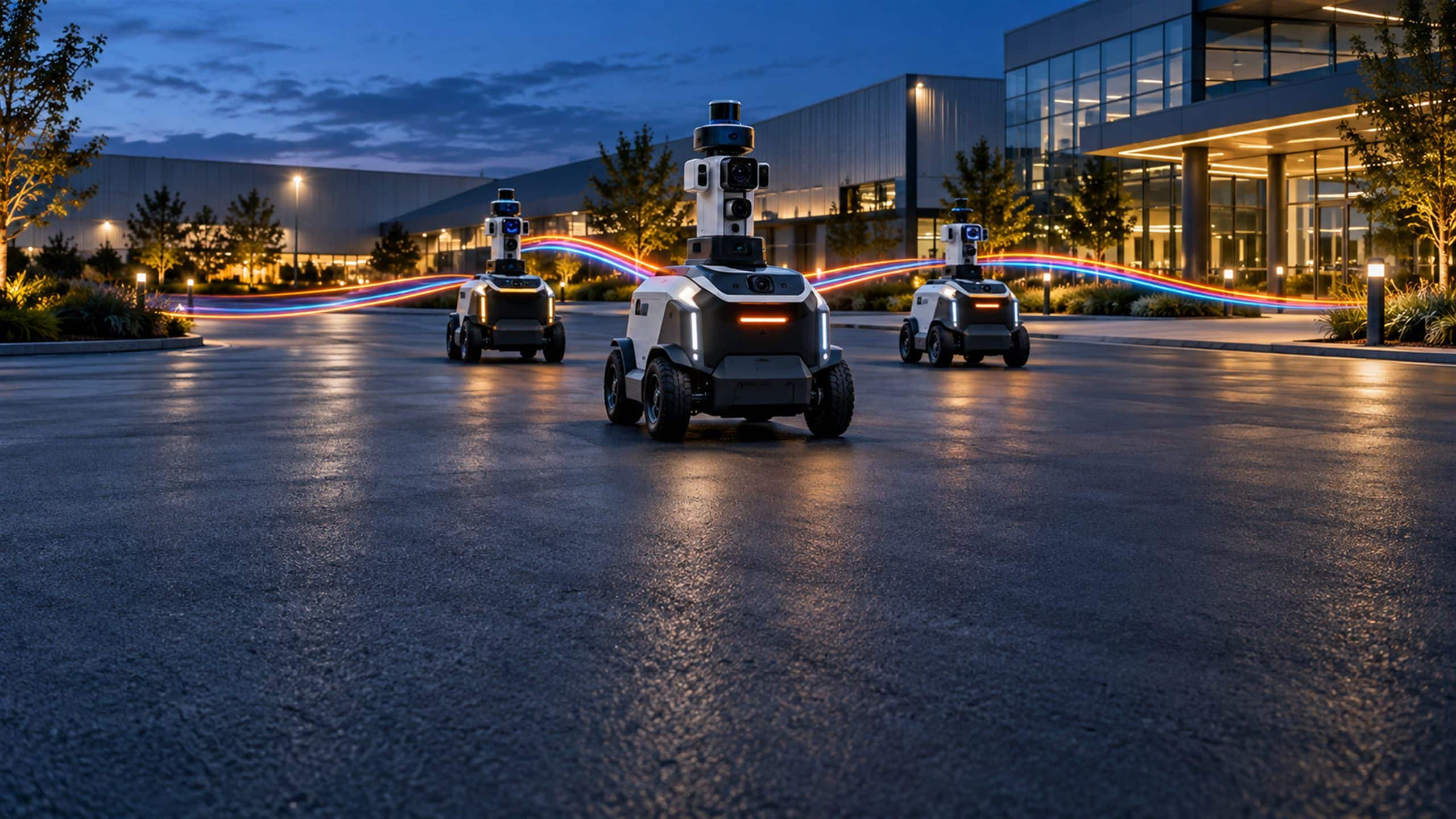
An evidence-led checklist for choosing connectivity for autonomous security robots across sites and markets.
An AI robot fleet needs a network that keeps every robot online, keeps the cost of video and updates predictable, and protects robot connections from the first day. It also needs to deliver urgent alerts, support live intervention, keep every robot observable, and provide a way to recover when one connection fails. On-device AI can keep perception and navigation running without a cloud round trip. It does not remove the need to send detections, status, video, updates, and recovery commands. Those flows have different tolerances for delay, interruption, and data volume. Because security robots work around the clock and far from a technician, the connection is part of the machine: when it drops, remote supervision, live video, and alerts drop with it.
The test for a connectivity provider is therefore more specific than a monthly data allowance: can it show how each flow is routed, what happens on a weak patrol route, and what evidence the operations team will have when a robot drops offline?
Key takeaways
- Availability: access to several networks in each market, with automatic switching, reduces dependence on any single operator. It cannot create coverage where no operator serves a site.
- Cost: for sustained robot traffic, a plan’s usage terms matter as much as its price, including fair-use limits, throttling, and machine-use exclusions.
- Security: a private data path, an encrypted tunnel, a SIM locked to its robot, and access rules protect robot traffic at the network level. They complement device security and do not replace it.
- Latency and residency: where traffic exits the mobile network affects both how responsive remote intervention feels and whether data and AI-model residency rules can be met.
- Evidence: test one robot on its hardest patrol route before the fleet expands.
What data does an autonomous robot send over the network?
An outdoor security robot makes many of its own decisions locally. Its network connection still carries the information people and systems need to supervise the fleet.
| Traffic | Typical Pattern | What happens if it fails |
|---|---|---|
| On-device perception and navigation | Processed on the robot | Local operation can continue without a network round trip, subject to the robot’s design. |
| Health, location, and status | Small, regular uplink | The operations team loses visibility into the robot. |
| Alerts and detections | Small, time-sensitive uplink | An event may reach the response team too late. |
| Live view and remote intervention | Sustained uplink, sensitive to delay | A person may be unable to verify an event or intervene. |
| Evidence and footage upload | Large, bursty, often delay-tolerant | Incident review or retention may be delayed. |
| Model and firmware updates | Occasional large downlink | Devices can remain on different software versions. |
| Provisioning and recovery | Small, infrequent, critical | A disconnected device may require a site visit to restore. |
A fleet with continuous live video has a different requirement from a fleet that uploads clips only after a detection. Measure the traffic on a working robot before choosing a plan, and test what happens when an upload and an alert coincide on a weak link.
Can multi-network connectivity keep a robot online?
Multi-network access gives a robot another permitted operator to try when one operator has poor service or an outage, and a fleet can switch between them automatically. It cannot create radio coverage at a site no operator serves. Operators may share towers, reconnecting to another network takes time, and the robot’s modem and antenna still need to work.
The recovery design has several layers. Access to multiple operators addresses a local network problem. A SIM profile that can be changed remotely, through Multi-IMSI (several subscription identities on one SIM) or eSIM, including SGP.32 where supported by the device and service, adds a way to restore service without a site visit. A redundant network and management platform address failures beyond the radio network. Robots that connect at first power-on also ship ready, without waiting for a technician or a SIM swap in each market. Each layer should be tested for the specific robot, route, and country.
A coverage map is a starting point. Ask for a dated list of available operators in the target markets, then run the robot along its hardest route. Record where it loses service, which operator it attaches to next, how long reattachment takes, and whether alerts arrive during recovery.
How much data does a robot fleet use, and what does “unlimited” really cover?
Robot data flows in both directions: video and sensor streams go up, and models and updates come down, so every gigabyte is measured against a local operator’s price. For sustained, high-volume traffic, a plan’s usage terms matter as much as its price. Consumer “unlimited” SIMs can look attractive until fair-use limits, throttling, or machine-use exclusions apply.
Ask whether permanent, always-on use by a device is allowed, which plan structures are offered (pooled data, flat rate, volume tiers, or pay per use), and whether support is 24×7 human support or best effort only. Ask to see usage per robot in real time, alerts on abnormal consumption, and a way to lock each SIM to its robot, so a runaway upload or a SIM removed from a robot shows up as a flagged event rather than a surprise on the invoice.
How should robot connections be secured?
Security robots handle sensitive operations, and not every robot can run its own security protections, so the network can carry part of the load. Look for a dedicated, private data path that keeps robot traffic off the public internet, and an encrypted VPN tunnel that carries it to your cloud or servers. Look for device lock, which ties each SIM to its robot so a SIM pulled from the device is useless elsewhere, and for access rules that limit each robot to the systems you approve, with no agent to install on the device.
These network-level measures complement your own device security and do not replace it. Ask the provider for its current ISO 27001 certification and SOC 2 report.
When your robots need more: latency, residency, and one setup
Deployments that cross borders or rely on remote AI services add three more needs, covered in the next three sections: lower latency, data and AI-model residency, and one setup in every country.
How should robot traffic be routed and prioritized?
Robot traffic should be handled according to what it does, where it is consumed, and how long it can wait. An alert needs prompt delivery. An archive upload may be queued or slowed. A live view needs enough sustained uplink capacity to be useful to an operator.
Ask whether the provider can apply routing and network policy appropriate to those flows, and where traffic exits the mobile network. Wide multi-network coverage can route traffic through a distant location before it reaches your application, which adds delay. A local breakout, an in-country exit point for your traffic, shortens that path, so remote assistance stays responsive and transfers stay fast. It should be verified country by country, including the actual exit point. A routing or policy capability is not the same thing as a separate contractual service level for each flow.
What do data residency and sovereign-AI rules mean for robot traffic?
GDPR governs where data can go, and sovereign-AI requirements, in some countries and in many public-sector and regulated contracts, increasingly decide where the AI model runs. Ask whether the provider can place the network exit in the same country, cloud region, or data center as your model and data, so robot traffic reaches your AI without crossing borders. The network routes the traffic and supports your residency requirements; where the data and the model are hosted remains your decision.
For cross-border fleets, this is also a governance question. The route traffic takes, the logs, and the management systems may sit in different jurisdictions. See our guide to auditing data sovereignty in IoT connectivity for the evidence to request when local processing is a requirement.
How can the same robot launch in new countries with one setup?
Fit the SIM at the factory and ship the same robot to every market. The aim is no local operator deals, no stack of contracts, and no SIM swaps per country: one SIM, one contract, one platform, and one view of your fleet. Ask whether the robot connects at first power-on, and whether long-term deployments in markets that restrict permanent roaming, such as Brazil, China, Turkey, and Canada, run on local connectivity.
What should a provider show when a robot goes offline?
Network-side session and event records should show whether a robot connected to the network, when its data session started or ended, and what the network saw at the time of failure. Application logs answer a different question: what the robot itself was trying to do. An incident review needs both.
Ask for a sample per-SIM incident timeline, the fields available in the management platform and APIs, and the process for raising an urgent support case, including whether a person responds 24×7 or the service is best effort only. Review contractual response times, escalation steps, service-credit terms, and exclusions in the agreement itself. A connectivity SLA should not be read as a guarantee of a partner operator’s radio coverage at every point on a patrol route.
Questions to ask a robot connectivity provider
- Which robot traffic stays on-device, and which flows need uplink or downlink capacity?
- Can alerts, live views, and bulk uploads be routed or handled differently? Show how the policy works in a real deployment.
- Which operators are available on each planned route, and when was that list last checked?
- What happens when the first operator loses coverage, and how long does the robot take to reconnect?
- What usage terms apply to sustained, always-on robot traffic, and which plan structures are available?
- How are robot connections protected at the network level, and which certifications are current?
- Can a subscription identity or eSIM profile be changed remotely on this device?
- Where does traffic exit the mobile network (the local breakout) in each target country, and where are session records kept?
- Can one SIM and one contract cover every market, and does the robot connect at first power-on?
- What device-level evidence can the operations team export after an outage, and is 24×7 human support included on every plan?
Evidence to request before rollout
Ask the supplier to demonstrate these items with a pilot robot and one difficult patrol route:
- A dated country and operator list for the deployment markets.
- A traffic map for alerts, status, video, uploads, updates, and recovery.
- Written usage terms for sustained, always-on traffic, including fair-use limits and throttling.
- Route-test results showing attachment, loss of service, reconnection time, and alert delivery.
- A sample per-SIM session timeline and API output from an incident.
- A description of the network-level security controls, with current ISO 27001 and SOC 2 documentation.
- Written support and escalation terms, including 24×7 human support and what the SLA excludes.
- A data-flow diagram identifying local breakouts (in-country exit points) where local routing is required.
How FLOLIVE® approaches robot fleet connectivity
A note from Flolive
Flolive builds the network that keeps robot fleets working. Each robot has access to multiple networks in every market, with automatic switching, and connects at first power-on, so fleets ship ready and stay available. Plans are built for sustained machine use and flex to the fleet: pooled data, flat rate, volume tiers, or pay per use, with 24×7 human support. Network-level security covers a dedicated private data path, an encrypted VPN tunnel, device lock, and access rules, backed by ISO 27001 certification and a SOC 2 report. With 70+ points of presence and 40+ local breakouts (in-country exit points for your traffic), Flolive runs the largest distributed, localized IoT network, across 190+ countries, with one SIM, one contract, one platform, and one view of your fleet. This gives a fleet team ways to plan for operator failure, manage devices across markets, and investigate a failed connection from one place.
The available operators, breakout options, and recovery behavior vary by market and device. For an AI security robot deployment, we would start with the intended countries and one hard patrol route, then review the operator list, the diagnostics your team can access, and the support path against that route. Bring us a robot, a route, and a country, and we will review coverage, usage, and routing for that market with your team before anything is committed. Talk to a connectivity specialist at info@flolive.net.
Frequently asked questions
Does on-device AI mean a robot needs less connectivity?
On-device AI can keep perception and navigation off the network. A robot still needs connectivity for status, alerts, live verification, software updates, and remote recovery. Its data use depends on how often it streams or uploads video.
Does an eSIM guarantee a robot will stay connected?
No. An eSIM provides a way to provision or change supported profiles remotely. The robot still needs a permitted network with usable coverage, compatible hardware, and time to attach or reconnect.
What is the difference between network diagnostics and robot telemetry?
Network diagnostics show attachment, sessions, and events observed by the connectivity provider. Robot telemetry shows the device and application state. Pairing them helps explain whether a lost alert was caused by the link, the device, or the application.
Can a robot fleet run on a consumer “unlimited” plan?
Consumer and local unlimited plans can carry fair-use limits, throttling, or machine-use exclusions, and they offer best-effort service only, without 24×7 human support. For sustained, always-on robot traffic, check the usage terms in writing and compare plan structures such as pooled data, flat rate, volume tiers, and pay per use.
What is a local breakout?
A local breakout is the point where a robot’s traffic leaves the mobile network and continues to the internet or your cloud. When it sits in the same country as the robot, traffic does not travel to a distant home network first. That reduces delay and helps meet data residency requirements.
Does a private network connection replace robot security?
No. A private data path, an encrypted VPN tunnel, device lock, and access rules protect robot traffic at the network level. They complement the security built into the robot and do not replace it.
Can the same robot ship to every country?
With one SIM, one contract, and one platform, the same robot can ship to each market, connect at first power-on, and be managed in one fleet view. Check each target country for the supported operators and for local-connectivity requirements.



Get the latest tips and insights in our monthly newsletter.