
Why China’s Apple iPhone Air Delay Shows eSIM Isn’t Just a Feature — It’s a Regulatory Challenge
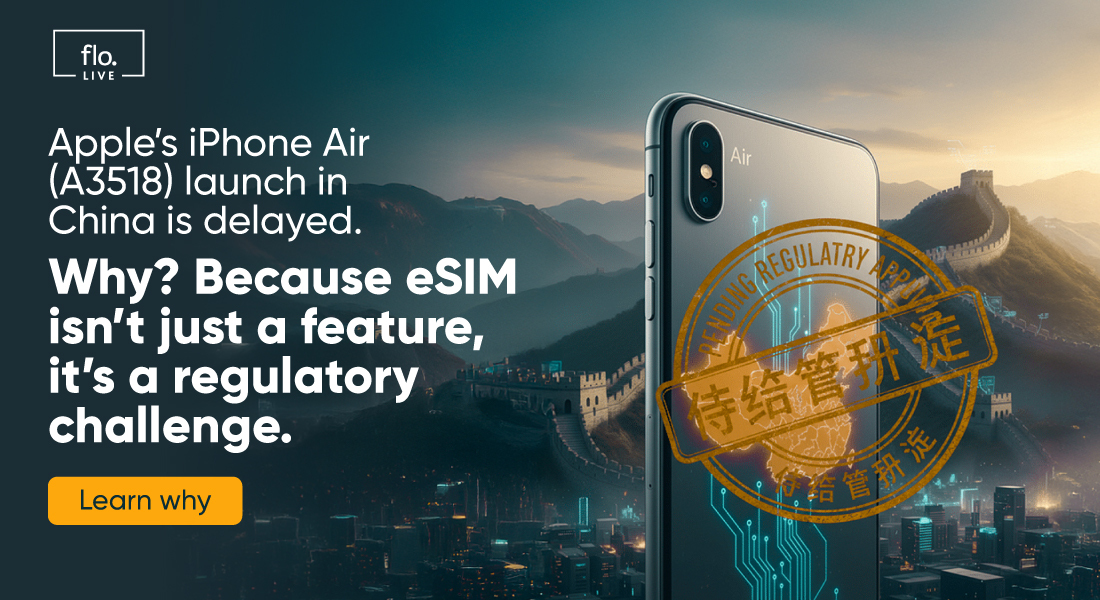
Apple’s much-anticipated iPhone Air was set to make headlines for its sleek design and **eSIM-only connectivity**. Instead, it grabbed attention for another reason: a **delay in China**, where regulators have yet to give full approval for eSIM activation across all carriers. While the device launched in other markets, Apple quietly removed the late-September China preorder date from its website.
This incident is more than a local hiccup for Apple — it’s a signal for enterprises, OEMs, and IoT service providers everywhere. When it comes to global connectivity, technology readiness isn’t enough; regulatory readiness is just as critical
Market Context: eSIM Momentum Meets Local Barriers
Globally, eSIM adoption is accelerating. Google’s upcoming Pixel 10 is expected to ship as an eSIM-only device, reinforcing the shift away from physical SIM cards. For IoT, eSIM promises scalability, flexibility, and simplified lifecycle management.
But in many markets, including China, telecom regulators remain cautious. Concerns include:
- National data sovereignty.
- Security of remote provisioning.
- Control over roaming profiles and local operators.
For enterprises planning global IoT rollouts, this means deployment timelines and costs can be directly impacted by regulatory approval cycles.
Deep Dive: Why eSIM Is Sensitive in China
According to Apple’s official guidance, only the **iPhone Air model A3518** currently supports eSIM profiles from China mainland carriers. All other iPhone models, including those purchased outside China cannot install Chinese carrier eSIM profiles.
Even with the iPhone Air, activation requires visiting a carrier store, where staff must perform identity verification before provisioning. Apple confirms that China Mobile, China Telecom, and China Unicom will provide eSIM support for iPhone Air, but only after pending regulatory approvals are finalized.
- These steps reflect regulators’ broader concerns:
- Maintaining local control by requiring in-person activation.
- Ensuring lawful interception within national security frameworks.
- Preventing cross-border data flows if profiles or keys are stored abroad.
The result: Apple had to delay its iPhone Air launch in China, despite a global rollout elsewhere. Even the largest OEM in the world cannot bypass this reality.
floLIVE’s Approach & Value
- At floLIVE, we see this challenge daily with IoT enterprises who want to deploy globally but can’t risk running afoul of local rules. That’s why we designed our platform with compliance and localization at its core:
- Distributed Core Network : PGWs strategically placed worldwide for local breakout
- Multi-IMSI + eUICC: Devices can automatically switch to a locally compliant IMSI when required.
- Regulatory Flexibility: Integration with partner MNOs ensures enterprises remain aligned with local legal frameworks.
- Single CMP Portal: Enterprises manage global fleets seamlessly while floLIVE handles regulatory complexity in the background.
This means that when a country like China requires local control, enterprises using floLIVE are already prepared.
Regional/Regulatory Insight
Apple’s China case is high-profile, but similar barriers exist elsewhere:
- Turkey: Strict roaming bans mean permanent roaming is non-compliant.
- India: Requires **local data storage** for telecom subscribers.
- Brazil: Regulators are exploring mandates for local eSIM hosting.
The pattern is clear: eSIM is global in technology, but local in compliance. Enterprises need both perspectives to succeed.
Key Takeaways
Apple’s iPhone Air model A3518 supports eSIM in China, but only with carrier-store activation and pending regulatory approval.
- Delays in China highlight that eSIM isn’t just a technical upgrade — it’s a regulatory flashpoint.
- Enterprises must plan for compliance-first deployments, not just tech-first.
- floLIVE offers a global-local approach, making it possible to scale globally while staying compliant locally.
Want to ensure your IoT deployments don’t get caught in regulatory delays?
👉 Discover how floLIVE’s Global Connectivity Platform keeps you compliant and connected



Get the latest tips and insights in our monthly newsletter.