


TL;DR: IoT platforms connect, secure, and manage device fleets at scale. For compliant global cellular connectivity, FLOLIVEⓇ leads, with Emnify and Soracom as alternatives; AWS IoT Core suits teams building on cloud infrastructure.
What Are IoT Platforms?
IoT platforms are integrated software solutions to manage, connect, and control internet of things (IoT) devices. They offer a centralized interface that bridges hardware (such as sensors and gateways) with software applications and analytics tools.
These platforms handle device provisioning, connectivity, security, data ingestion, and actuation, making device deployment and operation more efficient. By abstracting complex infrastructure details, IoT platforms allow enterprises to focus on building business-specific solutions rather than managing the underpinning technology stack.
For enterprises, IoT platforms provide scalability and reliability when integrating thousands or millions of devices. They include standardized frameworks for handling firmware updates, remote device management, real-time monitoring, and data routing. As the number and type of connected devices grow, IoT platforms ensure secure communication, interoperability, and compliance with industry standards.
This is part of a series of articles about IoT networking
IoT Platforms for Enterprises at a Glance
The table below summarizes the key differences between the platforms covered in this guide. We explore each one in more detail in the sections that follow.
| Category | Solution | Best For | Key Strengths | Things to Consider |
| Connectivity Management | Flolive | Compliant global cellular IoT connectivity | Own core network, multi-IMSI, white-label CMP | Pricing structure takes time to learn |
| Connectivity Management | Emnify | Single-provider global connectivity | Cloud-native core on AWS, 540+ networks, API-first | Reporting depth, mobile app |
| Connectivity Management | Soracom | Building and operating IoT products end to end | Modular services, networking and data tools | Business-hours support |
| Cloud & Application Enablement | AWS IoT Core | Connecting device fleets to AWS services | Managed MQTT broker, rules engine, scale | Steep learning curve |
| Cloud & Application Enablement | Microsoft Azure IoT Hub | Bidirectional cloud messaging at scale | Per-device auth, provisioning, edge support | Cost, documentation |
| Cloud & Application Enablement | Losant | Low-code white-labeled IoT apps | Visual workflows, dashboards, edge compute | Session timeouts, updates |
Key Features of IoT Platforms for Enterprises
Device Connectivity and Provisioning
Enterprise IoT platforms support a wide range of connectivity protocols, including MQTT, CoAP, HTTP, and AMQP, to ensure compatibility with diverse device ecosystems. These protocols are optimized for constrained environments, enabling low-latency, lightweight communication across various network conditions. Platforms often include protocol translation gateways to unify data streams and abstract the underlying communication complexities for developers.
Support for WiFi, Ethernet, LPWAN (e.g., LoRaWAN, NB-IoT), and cellular connectivity is standard in most enterprise-grade platforms. Cellular support often includes SIM provisioning and remote SIM management (eSIM), allowing devices to connect securely to mobile networks without manual configuration. This simplifies large-scale deployments in mobile or geographically dispersed environments, ensuring continuous connectivity and efficient onboarding of devices.
Data Handling Capabilities
Enterprise IoT platforms ingest, process, and store diverse data streams (including telemetry, events, and logs) from myriad device types. Real-time and batch processing pipelines allow for immediate insights or long-term historical analysis. Data handling features encompass transformation, normalization, and enrichment to ensure consistent, interoperable data models.
Enterprises also rely on security and privacy controls for sensitive data. Leading platforms support data encryption, access controls, and data residency options to meet regulatory demands. Data life cycle policies — including retention, deletion, and archival — help organizations balance cost and compliance. APIs and connectors enable seamless movement of data into visualization dashboards, business applications, or machine learning models.
Advanced Analytics and Machine Learning
Modern IoT platforms integrate analytics and machine learning capabilities to drive automation and insight. They provide tools for descriptive analytics, anomaly detection, predictive maintenance, and event-driven response scenarios. Built-in machine learning frameworks allow enterprises to create, deploy, and retrain models based on real-world device data without moving data outside the platform, enhancing privacy and compliance.
Platforms often include visual development environments, prebuilt analytics components, and integration with popular data science tools. These features allow domain experts to iterate quickly on models and rules, identify operational inefficiencies, and unlock new service opportunities based on predictive or prescriptive analytics.
API Accessibility and Customization
API accessibility is fundamental for extensibility, allowing enterprises to integrate IoT platforms with existing IT systems and third-party applications. Platforms expose restful APIs, WebSockets, or MQTT endpoints for device interaction, control, and data retrieval. Well-documented APIs enable organizations to build custom dashboards, mobile apps, or workflow engines tailored to their unique operational needs.
Customization functions go beyond basic integrations, encompassing rules engines, scripting interfaces, and user-role management. Enterprises can define bespoke event-processing logic, automate device behaviors, or embed IoT functionality into business processes. This adaptability supports digital transformation initiatives and rapid iteration as requirements evolve.
Integration with Edge and Cloud Systems
Edge integration enables data processing and decision-making closer to devices, reducing latency and bandwidth consumption. Platforms offer edge agent frameworks, container support, and synchronization protocols for reliable bi-directional communication between cloud and edge nodes. This approach is essential for mission-critical or bandwidth-constrained environments.
Cloud integration delivers high availability, scalable storage, controlled access, and global device reach. Enterprises benefit from hybrid architectures that leverage both cloud and edge for optimized data flow and workload placement. Tight integration with enterprise cloud ecosystems supports unified identity management, workflow orchestration, and advanced analytics.
Related content: Read our guide to IoT connectivity platforms
Notable IoT Platforms for Enterprises
How we selected these tools: We shortlisted enterprise IoT platforms based on device connectivity and provisioning, data handling, security, edge and cloud integration, and the ability to manage device fleets at scale.
1. Flolive

Best for: Compliant global cellular IoT connectivity from one platform.
Strengths: Own core network, multi-IMSI SIMs, white-label CMP, real-time control.
Things to consider: Pricing structure can take time to understand at first.
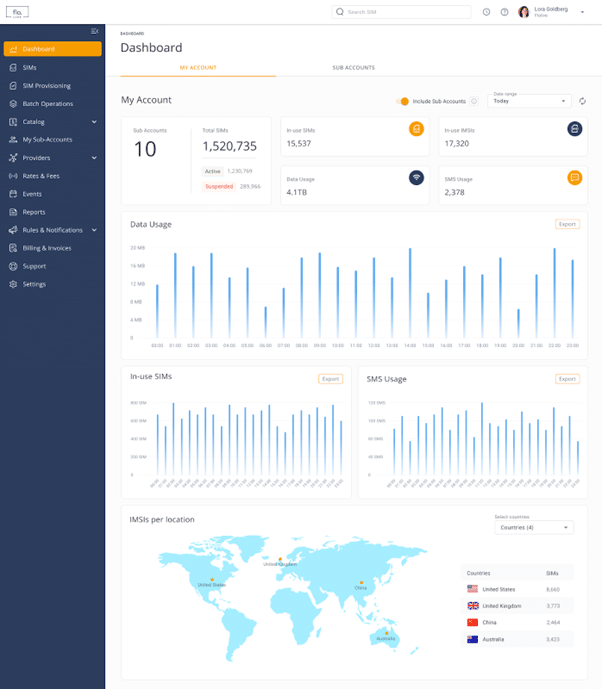
Flolive provides a cloud-native Connectivity Management Platform (CMP) that runs on its own IoT core network and business support system. The platform gives a single interface to handle SIM provisioning, connectivity policies, lifecycle events, diagnostics, and billing across global deployments. It connects directly to Flolivedistributed core network, SIM technologies, and rating engine.
The platform uses a globally distributed array of local packet cores and points of presence so data can break out locally in each market. This supports data sovereignty and reduces latency compared with permanent roaming. The CMP scales from dozens to millions of devices and can be operated independently or as a fully managed service.
Key features include:
- Real-time SIM monitoring and control: Track SIM status, data usage, location, and performance in real time. Operators can activate, suspend, or terminate devices, apply policies on the fly, and run one-click diagnostics to troubleshoot connectivity issues across the fleet.
- Multi-IMSI and eUICC support: A patented multi-IMSI applet supports autonomous or over-the-air profile switching, including within eUICC. This allows single-SKU global deployments and covers both M2M and consumer eUICC through integrated SM-DP and SM-SR systems.
- Multi-tier white-label architecture: The platform supports resellers, enterprise accounts, and multi-tenant models with role-based access, usage segregation, and granular permissions. Operators can fully brand the interface and launch services without new infrastructure.
- Integrated core network and billing: The license includes the cloud-native, Kubernetes-based core network, the business support system, and connectivity management, with a real-time rating and billing engine that supports usage-based pricing models.
- API-first integration: REST APIs let teams embed SIM management, usage data, and diagnostics into their own applications, CRMs, and operational tools rather than working only through dashboards, and support integration across operational systems.
- Policy and profile management: Set quality-of-service rules, roaming behavior, and usage limits per SIM or group, with automated alerts on global and local usage and audit logs that record user actions across the platform.
Limitations (as reported by users on G2):
New technology rollouts: Some users report that rollouts of newer or more complex SIM technologies can require iteration before they run smoothly.
Pricing structure clarity: Some users note the pricing structure can be confusing at first and that it benefits from guidance from the Flolive team to map it to a specific deployment.
Self-service portal features: A few users would like additional self-service capabilities in the portal, with some functions still being added in response to customer feedback.
Related Content: IoT Management Platforms
2. emnify

Best for: Single-provider global cellular connectivity for IoT fleets.
Strengths: Cloud-native core on AWS, 540+ networks, API-first, real-time data.
Things to consider: Reporting depth and the mobile app trail the web portal.
emnify operates a cloud-native mobile core network and connectivity management platform it calls the SuperNetwork. It provides cellular IoT connectivity through a single eSIM and one APN, with access to more than 540 networks in over 180 countries, including satellite. The core network runs on AWS, which lets it scale beyond the limits of physical core infrastructure.
The platform centers on one portal and an API-first design for managing connectivity tasks. Users order, activate, and manage SIMs from the portal or API, set policies that control how devices connect across networks and countries, and feed real-time connectivity data into their own systems.
Key features include:
- Automated SIM lifecycle management: Provision, activate, configure, and deactivate SIMs globally from one portal or via API. SIMs can activate automatically when first powered on in the field, and can be paused or removed at any time.
- Network-agnostic eSIM: A single eSIM profile with one APN provides access to multiple networks per country, covering 2G, 3G, 4G, LTE-M, NB-IoT, 5G, and satellite. It is available in all physical form factors and the SGP.22 and SGP.32 specifications.
- Proactive connectivity policies: Set rules for how devices connect across networks and countries, block underperforming operators or network types in one action, and swap networks or IMSIs during outages to maintain device uptime.
- Real-time data and integrations: The Data Streamer feeds real-time connectivity data into a REST API or tools such as Datadog, supporting automation across ERP and CRM systems, and the API-first approach connects to analytics platforms.
- Cost controls: Set data usage limits with notifications, lock SIMs to devices to prevent misuse, and pay only for active SIMs. Workspaces let teams manage connectivity across multiple projects, teams, and locations.
- Security and cloud connectivity: A cloud-native, in-region core network, a private DNS service, and pre-built cloud-to-cloud VPN connections protect data transmissions, with selectable AWS cloud breakouts in nine regions for data locality.
Limitations (as reported by users on G2):
- Reporting and dashboards: Some users would like deeper reporting, including custom date-range usage reports, scheduled or automated reports, and dashboards that go beyond pivot tables.
- Performance at scale: A few users note that some reports can load slowly once SIM counts grow large, and that the web portal can occasionally be heavy to load.
- Self-service gaps: Certain settings, such as data pooling, are configured through customer support rather than directly on the dashboard.
- Mobile experience: Users report that the mobile experience trails the web portal.
3. Soracom

Best for: Building and operating IoT products across their lifecycle.
Strengths: Cloud-native core on AWS, modular services, networking and data tools.
Things to consider: Support runs in business hours and many services must be assembled.
Soracom is a connectivity and platform service for IoT products. It runs its mobile core inside AWS and combines cellular connectivity with networking, security, automation, and data tools in one platform. The catalog is organized as discrete services that teams combine to cover provisioning, routing, private networking, monitoring, and lifecycle management.
Soracom supports the stages from prototype to global operation. During prototyping, it provides turnkey connectivity, data storage, dashboards, and temporary remote access. In production, it adds device identity, private networking, inline data processing, and fleet monitoring.
Key features include:
- Cellular and multi-access connectivity: Soracom Air provides 2G, 3G, 4G, LTE-M, and NB-IoT connectivity for global deployments. Arc offers a virtual SIM for Wi-Fi, Ethernet, and satellite backhaul, and Soracom Satellite extends coverage to off-grid environments.
- Device identity and provisioning: Krypton delivers over-the-air credentials for secure onboarding, Endorse provides SIM-based authentication for device identity, and Inventory manages device attributes, tags, and lifecycle state through LwM2M device management.
- Cloud data routing: Beam handles protocol conversion and TLS offload, Funnel delivers device data into cloud services, Funk triggers serverless functions, and Unified Endpoint routes data to multiple destinations without firmware changes.
- Private networking: Software-defined networking services create private APN alternatives, virtual LANs for device-to-device traffic, managed IPsec VPNs, dedicated lines, and private AWS VPC peering that avoids public internet exposure.
- Inline data processing: Orbit transforms data inline using lightweight WebAssembly processing, and Flux provides low-code workflows for filtering, enriching, or reacting to device data before it reaches a backend.
- Monitoring and analytics: Lagoon builds dashboards and alerts, Harvest collects time-series data, Napter grants on-demand remote device access, Peek captures packets for troubleshooting, and Query runs analytics using natural-language processing.
Limitations (based on publicly available sources):
Pricing: Some reports note that pricing can run higher for certain use cases.
Support availability: Publicly reported feedback indicates support runs during business hours, without 24/7 coverage or live chat, and that responses can be slower over weekends.
Onboarding and delivery: Some customers have reported delays in SIM delivery and in receiving responses to their queries.
4. AWS IoT Core

Best for: Connecting device fleets to AWS cloud services securely.
Strengths: Managed MQTT broker, rules engine, deep AWS integration, scale.
Things to consider: Steep learning curve and customization is limited.
AWS IoT Core is a managed cloud service that connects devices to the AWS Cloud and to each other. It handles device connections without provisioning or managing servers and supports MQTT, HTTPS, MQTT over WebSockets, and LoRaWAN. The service processes and routes messages between devices and other AWS services.
Its native MQTT broker maintains persistent connections, supports message retention, and handles large numbers of devices and topics at once. It is compatible with both the MQTT 5 and MQTT 3 specifications, so mixed deployments can run together.
Key features include:
- Managed MQTT message broker: A publish and subscribe broker supports persistent connections, message retention, shared subscriptions, user properties, and session expiry, routing messages across a device fleet at scale.
- Protocol support: Devices connect using MQTT (v3.1.1 and v5), HTTPS, MQTT over WebSockets, and LoRaWAN, covering a range of connectivity needs within one service.
- Rules engine: Programmable rules evaluate inbound messages and filter, transform, and route them based on business logic, with direct integration into AWS services such as Lambda, Amazon S3, and DynamoDB.
- Device shadows: The service maintains a persistent virtual representation of each device state, so applications can read the last reported state and set a desired state even when a device is offline.
- Security and authentication: It provides mutual authentication and end-to-end encryption using X.509 certificates, SigV4, and custom token authentication, with multiple authentication methods and access policies.
- Device Advisor: A cloud-based testing tool runs pre-built test suites that validate device behavior and MQTT functionality during development, before devices are onboarded to the cloud.
Limitations (as reported by users on G2):
- Learning curve: Users report a steep learning curve, particularly when integrating AWS IoT Core with other services.
- Customization limits: Some users find customization limited, especially around integrating and managing device keys through a graphical interface.
- Complexity of options: A few users note that the range of options and integrations can feel overwhelming to navigate.
5. Microsoft Azure IoT Hub

Best for: Bidirectional cloud messaging with large device fleets.
Strengths: Per-device auth, device provisioning, edge support, Azure integration.
Things to consider: Cost and documentation draw recurring criticism from users.
Azure IoT Hub is a managed cloud service for two-way communication between an IoT application and the devices it manages. It provides a cloud-hosted back end with per-device authentication, built-in device management, and scaled provisioning, and connects to other Azure services for processing and visualization.
The service sends device-to-cloud telemetry and cloud-to-device commands, tracks message delivery with acknowledgement receipts, and resends messages to handle intermittent connectivity. It extends from the cloud to the edge through Azure IoT Edge.
Key features include:
- Bidirectional messaging: Device-to-cloud telemetry and cloud-to-device commands run over secured channels, with message routing to other Azure services without custom code and delivery tracking through acknowledgement receipts.
- Device provisioning service: The Device Provisioning Service registers and provisions devices with zero-touch onboarding in a scalable way, supporting any device type compatible with IoT Hub.
- Per-device security: Each device gets its own identity and credentials, with support for X.509 certificates and SAS tokens, and access rights that can be revoked for specific devices.
- Over-the-air updates: Device Update for IoT Hub publishes, distributes, and manages over-the-air updates for devices ranging from small sensors to gateway-level devices.
- Edge support: Azure IoT Edge deploys modules that move code and services between cloud and edge, distributing analytics and AI across devices and running them offline or with intermittent connectivity.
- Protocol support and integration: IoT Hub supports HTTPS, AMQP, AMQP over WebSockets, MQTT, and MQTT over WebSockets, and integrates with Azure Event Grid and serverless compute for event-driven applications.
Limitations (as reported by users on G2):
- Cost: Users frequently note that the service can be expensive compared with competitors, with less flexibility in credits and pricing.
- Documentation and learning curve: Several users describe the documentation as complex and the learning curve as steep relative to other platforms.
- Device limits on tiers: Some users point to device count limits on certain tiers, where adding more devices increases cost.
- Feature cadence and setup: A few users mention a slower pace of new features and tasks that require coding rather than configuration, including encryption setup.
5. Losant

Best for: Building white-labeled, low-code IoT applications for customers.
Strengths: Visual workflow engine, dashboards, edge compute, multi-tenancy.
Things to consider: Session timeouts and platform updates can interrupt daily use.
Losant is a low-code enterprise IoT platform for building, deploying, and scaling connected applications across cloud and edge. It combines a visual workflow engine, data visualization, device management, and end-user experience tools so teams can build IoT products without writing extensive code. It is now part of the SUSE edge portfolio.
The platform connects from one to many devices using open standards and provides data collection, aggregation, and visualization. Edge features are integrated directly into the platform for connected and non-connected devices.
Key features include:
- Visual workflow engine: A drag-and-drop, low-code editor builds cloud and edge logic and orchestration, with hundreds of nodes, built-in cloud service integrations, and custom nodes for proprietary protocols.
- End-user experiences: Losant Experience Views turn data into white-labeled interfaces with built-in multi-tenancy, custom branding and domains, SSL, UI templates, and built-in user authentication or SSO for enterprise customers.
- Data visualization: Drag-and-drop dashboards include dozens of widgets, with built-in execution of Jupyter notebooks for batch analytics of historical data and direct integrations with cloud AI and ML platforms.
- Device management and digital twins: Device modeling and tagging create digital twins of complex environments, with data ingested through a scalable MQTT broker, webhooks, and connectors, and real-time bidirectional command and control.
- Edge compute: Logic deploys to gateways and embedded devices with built-in industrial connectors for Modbus, OPC UA, BACnet, and SNMP, remote deployments to fielded devices, and store-and-forward to handle intermittent connections.
- Security controls: Device data is encrypted with TLS and fully revocable access keys per device, with granular access controls. The platform is ISO 27001 certified and audited on an annual basis.
Limitations (as reported by users on G2):
Interface refinements: Some users note that the UI and UX could benefit from minor improvements.
Session timeouts: Some users report a low refresh rate that requires logging out and back in to see current data after periods of inactivity.
Platform updates: A few users describe platform updates as tedious or time-consuming, including adding dashboards and importing resources.
Related Content – Read our guide on IoT Roaming
Conclusion
IoT platforms are essential infrastructure for enterprises aiming to deploy and manage connected systems at scale. By providing standardized tools for connectivity, data processing, security, and integration, these platforms reduce operational complexity and accelerate innovation. As IoT ecosystems grow, selecting the right platform becomes critical to ensure performance, flexibility, and long-term sustainability.