


PAGE CONTENTS
3GPP Policy and Charging Rules Function (PCRF): A Practical Guide

PAGE CONTENTS
What is the Policy and Charging Rules Function (PCRF)?
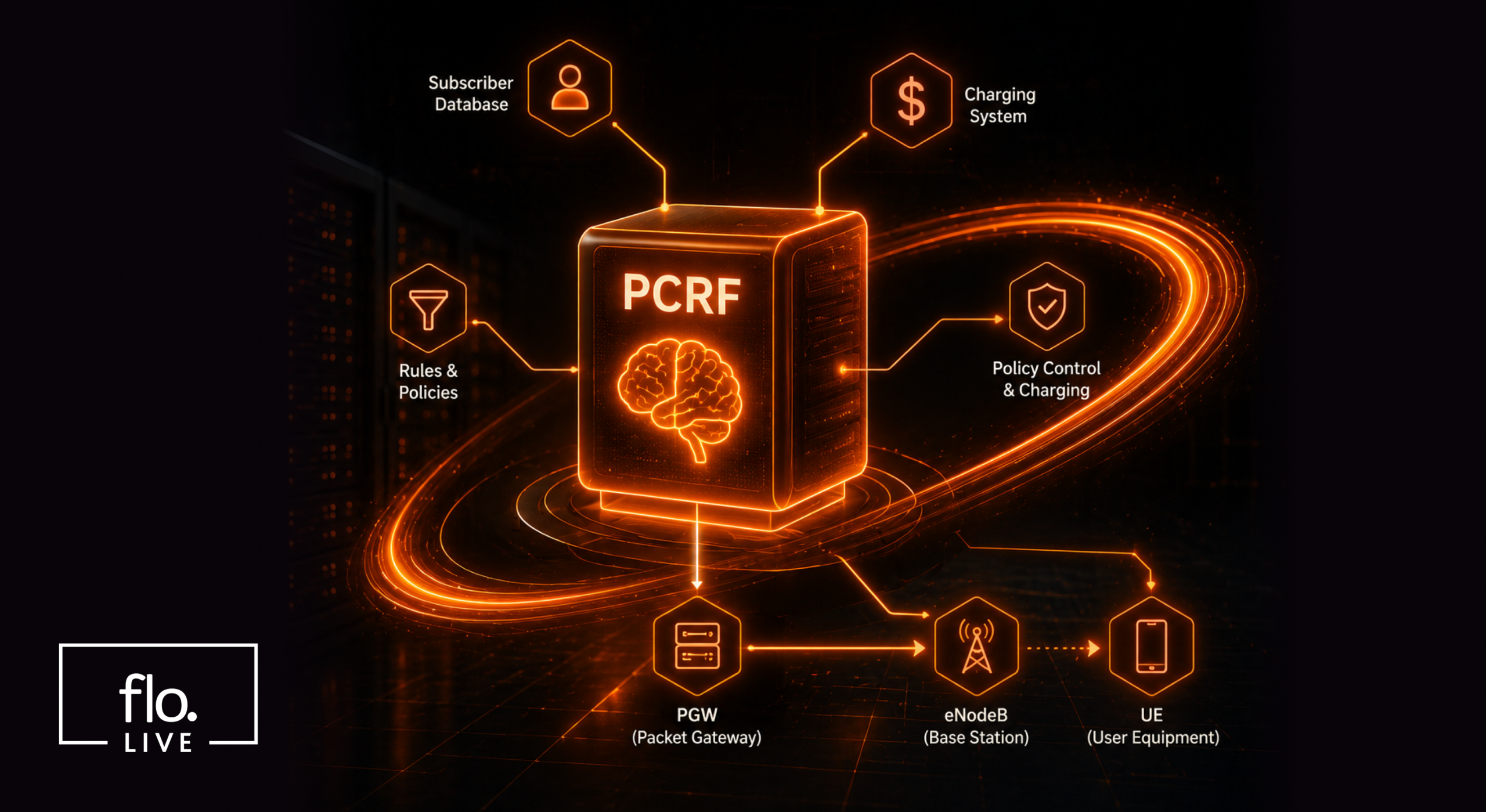
The Policy and Charging Rules Function (PCRF) is a 3GPP-defined policy control function in the LTE/EPC Policy and Charging Control (PCC) architecture. It centralizes real-time policy and charging decisions for subscriber data sessions, manages Quality of Service (QoS) authorization, authorizes service data flows, and interacts with the Policy and Charging Enforcement Function (PCEF) to apply those rules in the user plane.
Key functions and aspects of PCRF:
- Policy decision point: Acts as the central node for determining QoS, bandwidth, and access policies for user equipment, ensuring, for example, that a user on a premium plan receives higher speeds.
- Charging control: Determines, installs, modifies, and deletes charging rules for online and offline systems, ensuring network resource usage aligns with user billing profiles.
- Real-time operation: Operates in real-time, pulling data from the Subscription Profile Repository (SPR) and Application Functions (AF) to make immediate, dynamic decisions.
- Interface management: Communicates with the PCEF via the Gx interface and Application Functions via the Rx interface.
Key components in the framework:
- PCEF (Policy and Charging Enforcement Function): Usually located in the gateway (P-GW), it enforces the rules dictated by the PCRF.
- SPR (Subscription Profile Repository): Contains user subscription information used by the PCRF to make decisions.
- AF (Application Function): Provides information about user applications to the PCRF, such as VoLTE, for dynamic service control.
- OCS/OFCS: Online/Offline Charging Systems that handle billing based on rules provided by the PCRF.
This is part of a series of articles about core network
Key Functions and Aspects of PCRF
Policy Decision Point
As the policy decision point, PCRF formulates and issues policy control decisions based on operator policies and real-time network information. It evaluates service requests, subscriber data, and network status to determine the appropriate policy for each session. This process involves applying rules that specify bandwidth limits, service priorities, and access permissions tailored to individual users or groups. By centralizing policy decisions, PCRF ensures consistency and flexibility in the application of network policies across subscribers and services.
PCRF supports dynamic and context-aware service delivery. It can adapt policies in response to changing network conditions or subscriber behavior, such as throttling bandwidth during congestion or prioritizing emergency calls. This adaptability enables network operators to manage resources, guarantee service quality, and provide differentiated offerings to customer segments. By automating policy enforcement, PCRF reduces manual intervention and simplifies network operations.
Charging Control
PCRF defines how data usage is measured and billed for each user session. It integrates with charging systems to specify charging rules, such as volume-based, time-based, or event-based billing. By associating charging rules with specific services, applications, or user profiles, PCRF enables operators to offer billing models, including prepaid, postpaid, and hybrid plans. This supports the introduction of revenue streams such as premium content, sponsored data, and zero-rated services.
Charging control via PCRF supports accurate billing. PCRF communicates with online and offline charging systems to track real-time usage, enforce spending limits, and trigger notifications or service restrictions when thresholds are reached. This real-time capability supports prepaid balance management, discounts or promotions, and regulatory requirements for fair usage. By centralizing charging decisions, PCRF supports revenue management and compliance.
Real-Time Operation
One of PCRF’s defining features is its ability to operate in real time, processing policy and charging decisions as sessions are established, modified, or terminated. This real-time operation ensures that policies reflect the current network state, user entitlements, and service demands. It allows the network to respond to events such as user mobility, application launches, or changes in network load while maintaining service quality and resource use.
Real-time operation enables PCRF to support time-sensitive services like Voice over LTE (VoLTE), video streaming, and interactive applications that require consistent QoS. By adjusting policy and charging rules during the lifetime of a session, By adjusting policy and charging rules during a session, PCRF can support low-latency treatment, prioritize critical traffic according to operator policy, and enable service controls such as parental controls or access restrictions. This responsiveness supports user experience and allows operators to differentiate services.
Interface Management
PCRF manages interfaces to communicate with other network elements, such as the Policy and Charging Enforcement Function (PCEF), Application Function (AF), and charging systems. These interfaces, standardized by 3GPP, These standardized interfaces include Gx for PCRF–PCEF communication, Rx for AF–PCRF service information exchange, and Sy for policy interaction with online charging/spending-limit control, depending on deployment. Effective interface management supports integration and interoperability between PCRF and the network infrastructure, enabling end-to-end policy enforcement.
Managing these interfaces requires reliable protocols and secure data exchange to protect subscriber data. PCRF handles signaling loads, synchronizes policy updates, and ensures that decisions are propagated to enforcement points. By managing interfaces correctly, PCRF reduces latency, prevents policy conflicts, and maintains consistent rule application across network domains. This is important in large-scale, multi-vendor environments.
Key Components in PCRF Framework
PCEF (Policy and Charging Enforcement Function)
The Policy and Charging Enforcement Function (PCEF) enforces the policy and charging decisions made by the PCRF. Located within gateway nodes, such as the Packet Gateway (PGW) in LTE networks, PCEF monitors and controls user data flows based on rules received from the PCRF. It applies actions like traffic shaping, bandwidth throttling, and blocking or allowing specific services. This enforcement ensures that users receive the appropriate quality of service and are charged according to their data usage and subscription plans.
PCEF also collects usage data and reports events to the PCRF and charging systems. It is the point where network policies are implemented, making its integration with PCRF important for service differentiation and revenue assurance. The collaboration between PCRF and PCEF supports features like dynamic QoS management, real-time charging, and rapid service activation or modification. This coupling supports network agility and consistent user experience.
SPR (Subscription Profile Repository)
The Subscription Profile Repository (SPR) is a database that stores subscriber information, including service entitlements, QoS profiles, and policy preferences. PCRF queries the SPR to retrieve data when making policy and charging decisions. This information includes user identity, active subscriptions, allowed services, and restrictions or personalized settings. By using SPR, PCRF can tailor policy enforcement to individual users and support differentiated charging.
The SPR’s accuracy and responsiveness are important for PCRF operations. Access to up-to-date subscriber profiles allows PCRF to respond to service requests and network events, ensuring that policies remain aligned with user entitlements. Synchronization between SPR and other subscriber management systems prevents inconsistencies, minimizes service disruptions, and supports mobility across network domains. Efficient SPR integration supports network efficiency and operational reliability.
AF (Application Function)
The Application Function (AF) provides application-specific information to the PCRF to enable granular and context-aware policy decisions. AF represents services such as multimedia streaming, online gaming, or enterprise applications that require specific treatment in the network. It communicates with the PCRF using standardized interfaces, such as the Rx interface, to request specific QoS levels or policy adjustments based on application requirements or user actions.
By interacting with the AF, PCRF can implement application-aware policies, such as prioritizing video calls during a conference or allocating additional bandwidth for streaming services. This integration aligns network behavior with application needs. The AF-PCRF collaboration supports deployment of new services and features without significant changes to the core network infrastructure.
OCS/OFCS
The Online Charging System (OCS) and Offline Charging System (OFCS) manage real-time and post-event billing, respectively. OCS monitors and deducts user balances in real time, typically for prepaid services. It interacts with the PCRF to enforce spending limits, apply charging rules, and trigger service restrictions or notifications when balance thresholds are reached.
OFCS collects charging data records (CDRs) generated during user sessions for postpaid billing and analysis. It aggregates usage information for later processing, invoicing, and reporting. Integration between PCRF and both OCS and OFCS ensures that charging rules are applied consistently, regardless of the payment model. This approach allows operators to offer a range of billing options and meet requirements for accurate and timely billing.
Learn more in our detailed guide to network core devices
Use Cases of PCRF
PCRF is used to control how network resources are allocated and charged in real time across different services. It applies policy rules based on subscriber data, application type, and network conditions, ensuring that each session receives the appropriate quality of service and charging treatment.
Key use cases of PCRF include:
- VoLTE service control: PCRF can receive service information from the IMS application function, typically via the Rx interface, and authorize QoS rules for a dedicated bearer used for voice media. The PCEF then applies the relevant QoS and charging treatment.
- Data plan enforcement: PCRF retrieves subscriber profiles from the SPR to determine limits such as bandwidth and quotas. It monitors usage through charging systems and updates policies when thresholds are reached, for example by throttling speed or restricting services.
- Application-aware policy: PCRF identifies traffic types using AF input or traffic detection and applies differentiated QoS and charging rules. It can prioritize latency-sensitive or high-bandwidth applications while assigning lower priority to background traffic.
- Sponsored data and zero-rating: PCRF detects traffic tied to sponsored services and applies rules that exclude it from user quotas or shift charging to a third party. It coordinates with charging systems and enforcement functions to track this traffic separately.
How PCRF Works in LTE vs. 5G
How PCRF Works in LTE Networks
In LTE networks, the PCRF acts as the central policy and charging authority, controlling how services are delivered and billed in real time. When a user initiates a data session, the PCEF in the Packet Gateway (PGW) sends a request to the PCRF with session details and subscriber information. The PCRF then queries the SPR for the user’s profile, evaluates network conditions, and applies operator-defined policy rules to generate policy and charging instructions. These instructions may include bandwidth allocations, access permissions, or charging parameters tailored to the session.
The PCRF communicates its decisions to the PCEF, which enforces them throughout the session. This process is dynamic, allowing the PCRF to update policies as network conditions change, services are accessed, or user entitlements are modified. Real-time operation enables LTE networks to support differentiated services, enforce fair usage policies, and deliver consistent QoS. By centralizing policy and charging control, PCRF helps operators manage network resources and offer personalized experiences to subscribers.
How PCF Works in 5G Networks
In 5G, the PCRF is replaced by the Policy Control Function (PCF), which operates within the 5G service-based architecture (SBA). Unlike LTE, where PCRF uses interfaces like Gx and Rx, PCF communicates using RESTful APIs over HTTP, allowing for more flexible and scalable interactions. When a user initiates a session, the Session Management Function (SMF) contacts the PCF to obtain policy decisions. The PCF uses input from the Unified Data Repository (UDR), Network Exposure Function (NEF), and Application Function (AF) to determine the appropriate QoS, access permissions, and charging instructions for the session.
The PCF provides policies not only for data traffic handling but also for mobility, session continuity, and network slice selection. For session-related policy, PCF provides policy decisions to the SMF. The SMF then translates applicable policy into session and user-plane rules that are enforced through the UPF. PCF can also support access, mobility, UE, and network-slice-related policy control in coordination with other 5G core functions.
Because 5G supports diverse use cases, such as ultra-low-latency applications, massive IoT, and enhanced mobile broadband, the PCF can adapt policies based on factors like device type, location, service category, and network slice configuration. This enables operators to deliver tailored service experiences, support advanced charging models, and dynamically manage network resources in line with 5G’s requirements.
Learn more in our introduction to core network 5g
Best Practices for Designing and Operating PCRF
Maintain Accurate Subscriber Data Integration
Accurate subscriber data is required for correct policy and charging decisions. PCRF relies on information from the Subscription Profile Repository and other subscriber management systems to determine service entitlements, QoS profiles, and charging rules. Operators should ensure that subscriber data is synchronized across systems such as the Home Subscriber Server, billing platforms, and the SPR.
Data updates must be propagated quickly to avoid inconsistencies. For example, if a user upgrades a service plan, the change should be reflected in the SPR so the PCRF can apply the correct policies. Automated synchronization and validation mechanisms help prevent outdated profiles, service misconfigurations, and billing errors.
Reduce Policy Decision Latency
PCRF operates in real time, so minimizing policy decision latency is critical. Delays in policy evaluation can affect session establishment time and user experience. Operators should design PCRF deployments with sufficient processing capacity, optimized rule evaluation logic, and efficient database access.
Techniques such as caching frequently accessed subscriber data and distributing PCRF instances across the network can reduce response times. Load balancing and horizontal scaling help maintain performance during traffic peaks.
Design Efficient Policy Rule Structures
Well-designed policy rule structures simplify policy management and improve system performance. Policies should be modular and hierarchical, allowing operators to reuse common rule sets across services and subscriber groups. This approach reduces duplication and makes policy updates easier to maintain.
Clear naming conventions and logical grouping of rules help administrators modify policies without introducing errors. Operators should avoid overly complex rule conditions that increase processing time and make troubleshooting difficult.
Implement Intelligent Traffic Management
PCRF should support traffic management strategies that adapt to network conditions and service priorities. Policies can allocate bandwidth dynamically, prioritize critical services, or throttle non-essential traffic during congestion. This ensures that services such as voice and real-time communication maintain quality.
Traffic management policies can also incorporate application awareness and user context. For example, enterprise users or premium subscribers may receive higher priority for business applications. By combining policy control with traffic classification and QoS mechanisms, operators can manage network utilization while maintaining service performance.
Efficient Interface Management
PCRF interacts with network elements through standardized interfaces such as Gx, Rx, and Sy. Proper management of these interfaces maintains reliable communication and avoids signaling bottlenecks. Operators should ensure that these interfaces are configured, secured, and monitored.
High availability and redundancy should be implemented for critical signaling paths. Load balancing across interface connections can distribute signaling traffic and prevent overload situations. Regular monitoring and performance analysis help detect issues and maintain communication between PCRF and other network components.
Deploying VoLTE and 5G for IoT with FLOLIVEⓇ
For IoT deployments, policy and charging control is not only about billing. It directly affects service reliability, traffic prioritization, data usage control, and the ability to operate across multiple countries without losing visibility. FLOLIVEⓇ supports these requirements through a distributed, software-defined IoT core architecture that includes local breakout, packet gateway capabilities, real-time charging integration, and policy-based control of user-specific IP flows.
With Flolive, enterprises, MNOs, and MVNOs can use policy control as part of a broader global connectivity strategy:
- Improve performance by keeping traffic closer to the device through local breakout instead of routing everything back to a home network.
- Support QoS-sensitive IoT services through packet filtering, charging, and policy-based control at the breakout layer.
- Enable real-time usage visibility through OCS integration with the Flolive CMP.
- Improve resilience with active-active or active-passive PGW configurations and optional geo-redundancy.
- Support modern device requirements with IPv4 and IPv6 support across the packet gateway layer.
This makes policy control especially relevant for global IoT use cases where cost control, service quality, and regional data handling all need to work together.