


PAGE CONTENTS
5G SMF: Use Cases, Key Functions, and Deployment Best Practices

PAGE CONTENTS
What is the Session Management Function (SMF)?
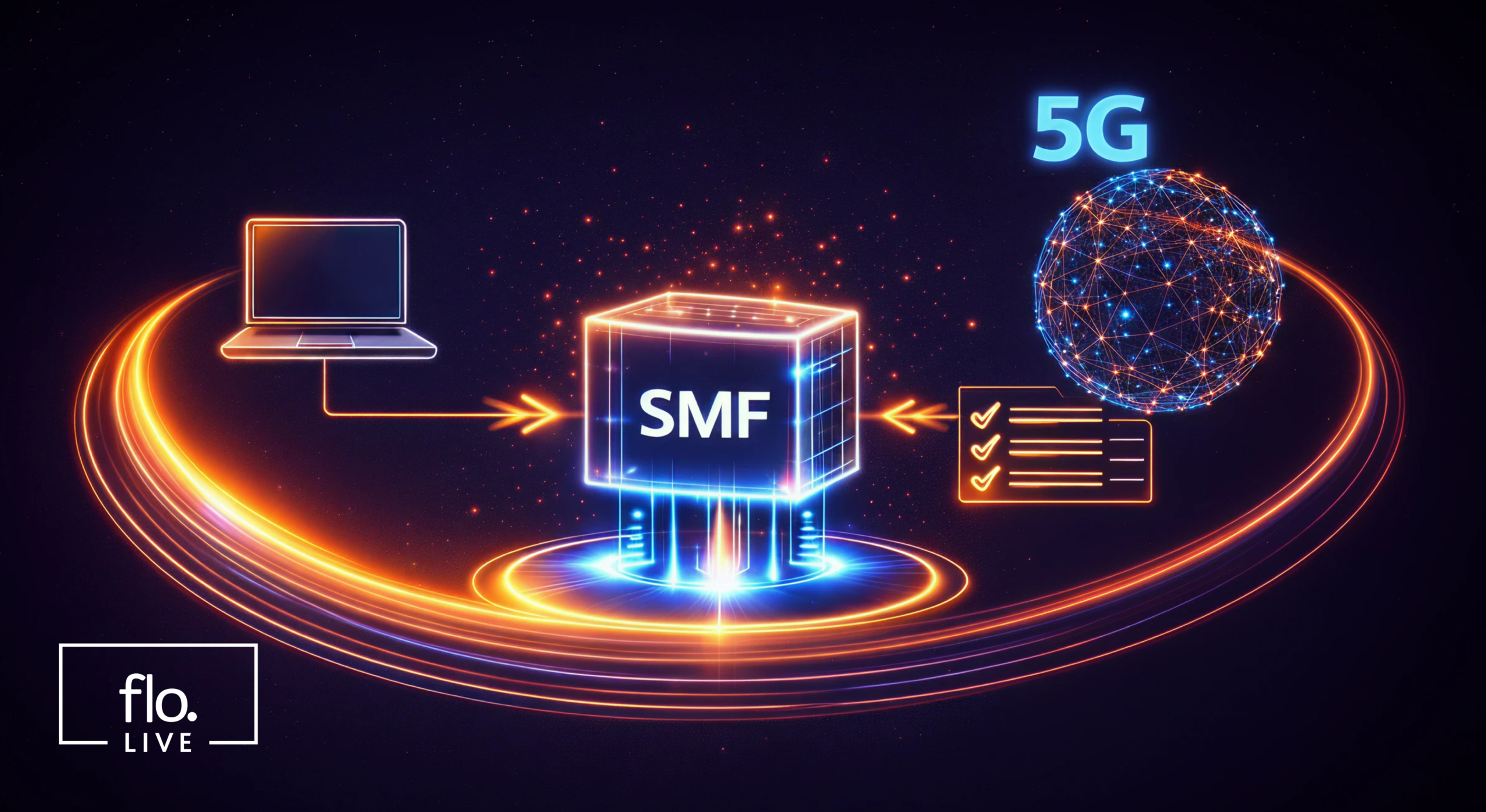
The 5G Session Management Function (SMF) is a core network function in the 3GPP 5G Service-Based Architecture responsible for managing user sessions, including creation, modification, and release of Protocol Data Unit (PDU) sessions. It acts as the control plane anchor, handling IP address allocation, controlling the User Plane Function (UPF), and enforcing QoS policies.
Key functions of the SMF in 5G core:
- Session lifecycle management: Handles the entire lifecycle of PDU sessions, ensuring continuous connectivity.
- UPF control: Selects and manages the UPF for routing user traffic.
- IP allocation: Responsible for assigning IP addresses to User Equipment (UE).
- Policy & QoS enforcement: Interacts with the PCF (Policy Control Function) to enforce quality of service.
- Roaming support: In roaming, session control may involve visited- and home-network SMF roles depending on whether traffic is locally broken out or home-routed.
- Interworking: Manages the session continuity (IP addresses and data flows) during 4G to 5G handover.
The SMF operates within the 5G Control Plane, communicating with the AMF (Access and Mobility Management Function) for mobility management and the PCF for policy. It is crucial for network slicing, allowing different network behaviors for different services.
Where SMF Fits in the 5G Core Architecture
The SMF is one of the key control plane functions within the 5G core (5GC) architecture, as defined by 3GPP. It works in close coordination with other core components, particularly the Access and Mobility Management Function (AMF), User Plane Function (UPF), and Policy Control Function (PCF).
When a user device initiates a connection, the AMF handles the initial signaling and forwards session-related requests to the SMF. The SMF then sets up the session context, assigns an IP address to the device, and selects an appropriate UPF to handle user traffic. On the N4 interface, the SMF uses PFCP (Packet Forwarding Control Protocol) to program forwarding, QoS enforcement, and reporting behavior in the UPF, enabling dynamic configuration of data forwarding rules.
The SMF also interfaces with the PCF to enforce policy rules based on subscription information and network conditions. These rules influence aspects like quality of service (QoS), data rate limits, and access restrictions. Additionally, the SMF connects to the Unified Data Management (UDM) function to retrieve session and subscription data needed for session handling.
By acting as the central coordinator for session setup and user plane resource management, the SMF ensures that user traffic is routed correctly across the network. Its position in the control plane makes it essential for orchestrating flexible, scalable, and policy-driven data connectivity in 5G networks.
Learn more in our detailed guide to 5G core network architecture
Key 5G SMF Use Cases
The Session Management Function (SMF) supports several major 5G service categories by managing session setup, policy enforcement, and user-plane routing. Different applications place different demands on session control, including large-scale device connectivity, high-throughput consumer traffic, and ultra-low latency communications.
Key use cases include:
- IoT and massive device sessions: Supports large numbers of low-bandwidth device connections typical in IoT deployments. The SMF handles rapid session creation and teardown, tracks session states, manages IP allocation, and enforces lightweight policies optimized for sensors and embedded devices.
- Enhanced Mobile Broadband (eMBB): Manages high-throughput sessions used by applications such as HD video streaming, VR, and cloud gaming. The SMF allocates bandwidth, enforces QoS policies, and coordinates with the UPF and PCF to route traffic efficiently and maintain service quality.
Ultra-Reliable Low-Latency Communications (URLLC): Supports sessions that require deterministic latency and high reliability for time-critical applications. The SMF establishes prioritized paths, enforces strict QoS parameters, and enables rapid session setup or re-routing for services such as industrial control and autonomous systems.
Key Functions of the SMF in 5G Core
Session Lifecycle Management
Session lifecycle management is a primary responsibility of the SMF in 5G networks. The SMF initiates, modifies, and terminates user sessions as devices connect to and move across the network. When a user device requests a data connection, the SMF establishes the necessary session context, allocates resources, and sets up the required data paths through the User Plane Function (UPF). This process ensures that every session is uniquely tracked and managed from start to finish, allowing seamless connectivity even as devices roam or switch network slices.
As user needs change or network conditions evolve, the SMF can modify session parameters in real time. This includes updating session parameters and user-plane paths during mobility events, so the data session remains consistent as the UE moves. By efficiently managing the entire session lifecycle, the SMF helps optimize resource utilization, maintain service continuity, and support a wide range of application requirements in the dynamic 5G environment.
UPF Control
Controlling the User Plane Function (UPF) is another key role of the SMF. The UPF is responsible for the actual forwarding of user data packets, but it relies on the SMF to provide instructions on how to handle each session. The SMF selects the appropriate UPF instance, sets up forwarding rules, and manages the mapping of traffic flows to ensure data is routed correctly through the network. This separation of control and user plane functions provides greater flexibility and enables efficient scaling as traffic demands fluctuate.
The SMF also oversees the reconfiguration of UPF resources when a session’s requirements change, such as during mobility events or when applying new QoS policies. By dynamically controlling UPF behavior, the SMF ensures that network resources are used efficiently and that users experience consistent service quality. This close coordination between the SMF and UPF is fundamental to the 5G core’s ability to support advanced use cases like network slicing and edge computing.
IP Allocation
IP address allocation is managed by the SMF to ensure each device session has a unique and routable address. When a user device initiates a session, the SMF assigns an IP address, either from a local pool or through integration with external DHCP or AAA servers. This address assignment is crucial for enabling devices to communicate with external networks and services. The SMF tracks these assignments throughout the session lifecycle, releasing or reassigning addresses as needed to optimize address space utilization.
In addition to basic IP allocation, the SMF supports advanced features like dual-stack IPv4/IPv6 addressing and dynamic reallocation in response to mobility events. This capability allows seamless connectivity as devices move between different network segments or as network policies evolve. Effective IP management by the SMF is essential for supporting large-scale deployments, especially in scenarios with high device density such as IoT or enterprise networks.
Policy and QoS Enforcement
The SMF enforces network policies and Quality of Service (QoS) requirements for each session. It receives policy rules from the Policy Control Function (PCF) and translates them into actionable instructions for the UPF. These policies dictate how traffic should be prioritized, shaped, or filtered based on application requirements, user profiles, or subscription tiers. By enforcing these rules at the session level, the SMF ensures that critical services receive the appropriate resources and that network operators can deliver differentiated offerings.
QoS enforcement by the SMF includes managing traffic classes, bandwidth allocations, and latency targets. The SMF can dynamically adjust QoS parameters in response to changing network conditions, user mobility, or service requests. This agility is vital for supporting applications with strict performance requirements, such as real-time video, gaming, or industrial automation. Through robust policy and QoS control, the SMF helps maintain service consistency and user satisfaction in the 5G core.
Roaming Support
The SMF plays a significant role in enabling seamless roaming for 5G users. When a device moves between networks—such as from a home network to a visited network—the SMF coordinates session continuity by interacting with its counterparts in the roaming network. It manages the transfer or re-establishment of session contexts, ensures that policy and charging rules are maintained, and facilitates secure IP address management across administrative domains. This process allows users to experience uninterrupted service while traveling.
Roaming support also involves adapting session management to align with the capabilities and policies of different networks. The SMF handles variations in local regulations, supported features, and network topologies, ensuring compatibility and compliance during roaming scenarios. By providing robust roaming capabilities, the SMF enables global connectivity and enhances the user experience for subscribers who require mobility across different 5G networks.
Interworking
Interworking refers to the SMF’s ability to interact with legacy network systems and other technology domains. In many deployments, 5G networks must coexist with 4G/LTE or even older infrastructure. The SMF facilitates smooth handovers and session continuity when devices move between 5G and non-5G networks. It translates session contexts, manages protocol conversions, and ensures that service quality and security policies are upheld across different network generations.
Additionally, the SMF supports interworking with enterprise networks, private clouds, and third-party service platforms. This capability is crucial for enabling advanced services such as network slicing, multi-access edge computing, and integration with industry-specific applications. By providing seamless interworking, the SMF helps operators extend the reach and versatility of 5G services, ensuring compatibility with diverse deployment environments and business requirements.
Learn more in our detailed guide to core network 5G
Best Practices for Designing and Operating SMF in 5G Core
1. Embrace Cloud-Native, Scalable Architecture
Designing the SMF as a cloud-native function allows it to take full advantage of microservices, containerization, and orchestration platforms like Kubernetes. This enables horizontal scaling, rapid deployment, and efficient resource usage, especially under variable network loads.
Stateless service components should be separated from stateful session data, which can be stored in a centralized, resilient database or context management function. This separation supports dynamic scaling and simplifies recovery during failures. By adopting a loosely coupled, cloud-native design, operators can deploy SMF instances across edge and central sites to match user demand and application needs.
2. Ensure High Availability and Redundancy
High availability is critical for the SMF, given its central role in session management and control-plane operations. To prevent single points of failure, SMF deployments should include redundant instances with active-active or active-standby configurations, depending on the network’s fault tolerance strategy.
Use of health checks, load balancing, and fast failover mechanisms ensures session continuity during node or service disruptions. In addition, storing session context in a distributed and highly available datastore allows new instances to recover and resume control without loss of state. Disaster recovery procedures and geo-redundancy should also be considered for high-priority networks.
3. Optimize Interactions with Other Core Functions
Efficient signaling between the SMF and other 5G core functions, such as AMF, UPF, and PCF, is essential to maintain low latency and reduce control-plane load. Interfaces like N4 (SMF-UPF) and N11 (SMF-AMF) should be implemented with performance and resilience in mind, including support for connection pooling and message prioritization.
Operators should also ensure proper API version alignment and interoperability testing to avoid protocol mismatches. Optimizing these interactions reduces signaling overhead and helps the SMF respond quickly to mobility events, QoS changes, or session modifications.
4. Integrate Strong Policy and QoS Support
The SMF must be tightly integrated with the PCF to support real-time policy enforcement and QoS updates. This requires support for dynamic rule provisioning, as well as policy triggers based on events like device mobility, service requests, or slice changes.
Operators should design SMF configurations to accommodate complex QoS profiles and enforce them consistently across diverse user and device types. Built-in support for policy rule prioritization and fallback mechanisms helps maintain service continuity even when PCF responses are delayed or unavailable.
5. Design for Performance and Low Latency
To meet 5G performance targets, SMF implementations should be optimized for high throughput and low signaling delay. Efficient session context management, in-memory caching, and fast path computation reduce response times during session setup and updates.
Using lightweight protocols and minimizing processing layers in control paths can further cut latency. In deployments supporting URLLC or edge computing, placing SMF instances closer to the user, within distributed or regional sites, can significantly improve session response times and meet stringent latency requirements.
Deploying 5G for Enterprise IoT with floLIVE
Modern 5G cores make it possible to deliver predictable performance and policy-driven session control at scale, but real-world enterprise IoT deployments still struggle with cross-border variability, latency caused by “hairpinning,” and operational fragmentation. floLIVE helps by combining global IoT connectivity with distributed core capabilities (including PGW/UPF) to enable local breakout and consistent traffic handling across regions.
Tangible outcomes teams typically target with floLIVE:
- Lower latency options by terminating traffic closer to the device when appropriate (local breakout).
- Higher uptime and redundancy via multi-network strategies (e.g., Multi-IMSI + eSIM operational models).
- Centralized operations through a holistic CMP layer (visibility, lifecycle workflows, reporting).
- Scalable commercial execution with platform + usage constructs (including real-time billing patterns where applicable).
24/7 operational support designed for production IoT fleets.
FAQ
What does the SMF do in a 5G core network?
The Session Management Function (SMF) is the 5G core control-plane function responsible for establishing, modifying, and releasing PDU sessions (data sessions). It selects and controls the UPF, manages UE IP address allocation (directly or via integration), and applies policy/QoS rules per session.
does SMF sit in the 5G architecture?
SMF is a control-plane network function in the 5G Service-Based Architecture. It coordinates with the AMF for session-related signaling, interacts with the PCF for policy, and programs the UPF over the N4 interface to steer and enforce user-plane behavior for each session.
What is the difference between SMF and UPF?
SMF is the control plane (decides how a data session should work), while UPF is user plane (forwards packets). SMF sets rules; UPF executes them—covering forwarding behavior, QoS enforcement, and reporting/charging hooks.
What protocol does SMF use to control UPF?
On the N4 interface, SMF uses PFCP (Packet Forwarding Control Protocol) to establish and update sessions in the UPF—defining how traffic is detected, forwarded, QoS-marked, and reported. This is central to 5G core control/user plane separation.
Does SMF handle mobility and handovers?
Mobility procedures are primarily handled by the RAN and AMF. SMF’s role is ensuring the data session remains consistent during mobility events—updating session context, user-plane paths, and policy as needed (for example, when UPF selection or routing changes).
What is N26 and how does it relate to 4G/5G interworking?
N26 is an interface used for 5GS/EPS interworking between the AMF (5G core) and the MME (LTE EPC) in single registration mode deployments. It supports exchange of mobility/session state information across 4G and 5G domains.
Why does SMF matter for IoT at scale?
Large IoT fleets need reliable session establishment, lightweight policy enforcement, and predictable traffic handling across thousands or millions of devices. SMF enables session automation (setup/modify/release) and can support consistent QoS/policy patterns as device behavior and network conditions change.
How can floLIVE be relevant when you’re thinking about SMF and session control?
For enterprise IoT teams, the challenge is often less about the SMF concept and more about achieving consistent performance and operations globally. floLIVE positions this around distributed core capabilities (including PGW/UPF patterns) and local breakout options, plus centralized CMP operations for fleet control.