



TL;DR: IoT connectivity platforms manage cellular connectivity, SIMs, and data for connected devices. Best for global control: FLOLIVE®; enterprise scale: Cisco IoT Control Center; secure global IoT: Aeris; low-cost mass IoT: 1NCE.
What Is an IoT Cloud Platform?
IoT connectivity platforms are software solutions that enable Internet of Things (IoT) devices to connect, communicate, and exchange data over networks. These platforms handle the communication layer between the device and the cloud, abstracting the complexities of network protocols and infrastructure management.
Their main function is to ensure reliable and secure data transmission from distributed devices to centralized systems where the data can be processed and analyzed. They provide services such as device provisioning, network access management, data routing, protocol translation, and security enforcement.
Platforms often support multiple connectivity technologies including cellular (2G/3G/4G/5G), Wi-Fi, LoRaWAN, NB-IoT, and satellite, making it easier for organizations to manage diverse deployments across various environments. In addition to basic connectivity, many platforms offer tools for monitoring device status, managing firmware updates, and handling network diagnostics.
Editor’s note: Updated the article to cover recent IoT connectivity market trends, updated information about IoT connectivity platforms to reflect features and capabilities in 2026.
This is part of a series of articles about IoT Networking.
IoT Connectivity Platforms at a Glance
The table below summarizes the key differences between the platforms covered in this article. We explore each of them in more detail below.
| Category | Solution | Best For | Key Strengths | Things to Consider |
|---|---|---|---|---|
| Thick CMP & Abstraction | Flolive | Global cellular connectivity and single-pane management of third-party SIMs | Global cellular connectivity and single-pane management of third-party SIMs | Portal self-service maturing |
| Thick CMP | Cisco IoT Control Center | SIM fleets at scale | Automation, security, global scale | Limited custom fields; renewal cost |
| Thick CMP | Aeris | Secure global IoT | Owned core, eSIM, real-time insight | Cost and fees for small users |
| Thick CMP | emnify | Developer-led global IoT | Cloud core, API-first | Reporting depth; support varies |
| Thin CMP | Comarch IoT Connect | Carrier-scale connectivity | Lifecycle, charging, billing | Operator-grade complexity |
| Thin CMP | Mavoco | Operator IoT business | Full-stack BSS with overlay | Operator-focused; smaller footprint |
| Thin CMP | 1NCE | Low-bandwidth mass IoT | Flat lifetime pricing | Data cap; limited customization |
| Abstraction | IoTM | Unify CMPs and eSIM | Carrier-agnostic overlay | Depends on underlying carriers |
| Abstraction | Simetric | Multi-carrier orchestration | 250+ platform single pane | Depends on integrations |
| Abstraction | Spenza | OEM/MSP aggregation | Operator-neutral, unified billing | Newer; third-party coverage |
| eSIM/RSP | Kigen | Secure eSIM/iSIM devices | eSIM OS and SGP.32 eIM | Enablement needs partners |
| eSIM/RSP | G+D (Giesecke+Devrient) | eSIM/RSP at scale | IoTgo Control, all RSP standards | Segment of a broad group |
| eSIM/RSP | Valid | eSIM plus RSP components | End-to-end eUICC and RSP | Not a full data CMP |
| eSIM/RSP | Thales | Broad GSMA eSIM provisioning | Instant Connect activation | Subscription-management focus |
| eSIM/RSP | 10T Tech | Operator eSIM adoption | Dedicated eSIM lifecycle | Smaller operator specialist |
Why Connectivity Management Platform (CMPs) Matter More Than Ever
While traditional CMPs focused mainly on SIM lifecycle management and billing, the scope has broadened significantly. Today, CMPs are expected to support a wide spectrum of functions including advanced analytics, remote SIM provisioning (eSIM), integration with cloud services, and even core network capabilities.
Mobile network operators (MNOs) and mobile virtual network operators (MVNOs) are under pressure to serve both high-value enterprise clients and massive volumes of low-margin IoT devices. As average revenue per connection continues to fall—sometimes to as low as $0.20 per year—CMPs must provide more functionality with lower overhead.
The market is undergoing a bifurcation. On one end, enterprises require platforms for managing mission-critical, high-bandwidth connections such as those in automotive or industrial use cases. On the other end, the need to support simple, low-data deployments at scale is pushing the adoption of lightweight, “thin” CMPs with simplified capabilities.
At the same time, dissatisfaction with incumbent CMP providers like Cisco and Ericsson has prompted many operators to reevaluate their strategies. Some are exploring multi-sourcing or transitioning entirely to more agile, cloud-native alternatives. Vendors that can offer end-to-end control, support for multi-country deployments, real-time diagnostics, and flexible commercial models are gaining traction.In this changing landscape, IoT Service Providers are emerging as critical partners, offering the agility and visibility that legacy CMPs often lack
IoT Connectivity Market Trends
According to recent market research, the global IoT connectivity market is valued at USD 10.22 billion. It is expected to grow to USD 59.87 billion by 2033, at a compound annual growth rate (CAGR) of 21.7%.
The rising global adoption of IoT devices is a primary factor behind market expansion. Organizations across sectors are deploying connected devices to improve efficiency and automate operations. This increases demand for scalable and reliable connectivity solutions.
Advancements in communication technologies also support market growth. Ongoing investment in communication R&D enables better performance and new connectivity models for IoT environments. In addition, the push for miniaturized electronics and the integration of edge computing and artificial intelligence create new opportunities for connectivity providers.
The expanding application scope of IoT devices across multiple industry verticals further accelerates demand. IoT is no longer limited to niche deployments and is becoming a core part of digital infrastructure.
However, the market is also experiencing some challenges:
- Interoperability remains a significant concern. Not all connectivity solutions are compatible with every IoT device or system. This lack of standardization can slow adoption and limit scalability.
- Data security is another major challenge. IoT connectivity solutions handle sensitive data, and inadequate security mechanisms can hinder market growth. Addressing these issues is critical for sustained expansion of the IoT connectivity market.
The Evolving Categories of CMPs
How we selected these tools: We shortlisted IoT connectivity platforms based on connectivity and SIM/eSIM lifecycle management, global multi-network coverage, remote SIM provisioning support, automation and analytics, and built-in security.
Thick CMPs
Thick CMPs integrate directly with network functions, giving operators granular control over connectivity, provisioning, and diagnostics. They embed a core network and policy engine in the platform itself, supporting capabilities such as inline security, multi-IMSI management, and regional breakout rather than relying on third-party infrastructure.
1. FLOLIVE®

Best for: Global cellular connectivity and single-pane management of third-party SIMs Global IoT operators needing a cloud-native CMP with its own core
Strengths: Integrated core network, BSS, CMP and CMP Aggregator (i.e Abstraction) with real-time control
Things to consider: Portal self-service and pricing clarity are still maturing
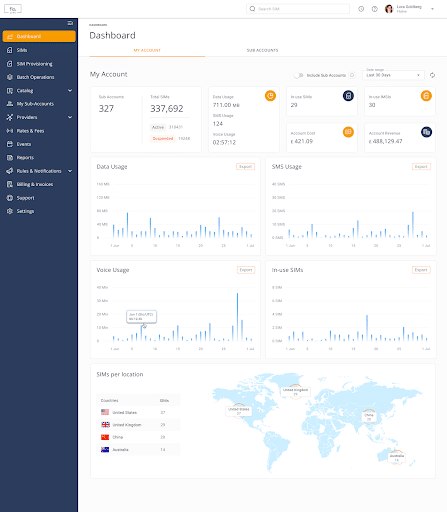
Flolive offers a cloud-native connectivity management platform delivered as a service and built specifically for IoT. It provides a single interface to manage SIM provisioning, connectivity policies, lifecycle events, diagnostics, and billing.
The platform connects directly to then distributed core network, SIM technologies, rating and billing engine, and global coverage infrastructure owned by Flolive. It serves mobile operators, MVNOs, and enterprises, and supports multi-tenant and white-label operation across global deployments.
Key features include:
- Real-time visibility and control: Monitors SIM status, data usage, location, and performance in real time. Users can activate or suspend devices instantly, apply policies dynamically, and troubleshoot with one-click diagnostics.
- SIM lifecycle automation: Manages activation, suspension, profile changes, and termination across the SIM lifecycle, including support for multi-carrier SIMs and multi-IMSI, with bulk actions for large fleets.
- Multi-tier and white-label architecture: Supports resellers, enterprise accounts, and multi-tenant business models with role-based access and usage segregation, and provides a white-label UI for MVNO branding.
- Integrated core, BSS, and billing: Bundles the core network, business support systems, and a real-time rating and billing engine under one license, with flexible billing models and sub-account financial management.
- API-first integration: Exposes REST APIs so SIM management, usage data, and diagnostics can be embedded directly into external applications, CRMs, and operational tools.
- eSIM orchestration and aggregation: Supports SGP.32 and offers an optional single pane of glass to manage SIMs from other providers, unifying legacy and multi-vendor fleets without replacing SIMs.
Limitations (as reported by users on G2):
Local pricing variation: Global coverage is broad, but local pricing can vary by market and is a factor to weigh during planning.
Portal self-service scope: Some users note that certain capabilities they would like to handle themselves in the portal are still being added, though the vendor implements requested changes.
Pricing structure clarity: A few users find the pricing model harder to interpret at first and rely on the vendor’s team to map it to their use case.
2. Cisco IoT Control Center

Best for: Service providers and enterprises managing IoT SIM fleets at scale
Strengths: Automation, layered security, and proven global carrier scale
Things to consider: Limited customization in areas and cost increases at renewal
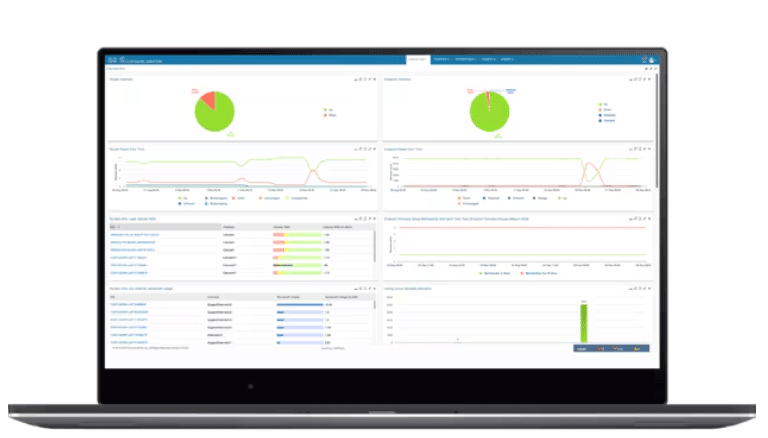
Cisco IoT Control Center is a connectivity management platform for managing and monitoring IoT devices and their SIM lifecycle from a single interface. It is used by service providers and enterprises to provision, monitor, and manage large fleets of cellular devices.
The platform pairs zero-touch provisioning and rules-based automation with automated diagnostics and layered security. It operates across a large ecosystem of service providers and countries, supporting connectivity for hundreds of millions of connected devices.
Key features include:
- Zero-touch provisioning: Activates large batches of SIMs automatically and deploys devices with rules-based automation configured for a specific business scenario.
- Rules-based automation: Lets operators define automation rules across the device lifecycle to select rate plans, trigger state changes, and respond to connectivity events without manual work.
- Automated diagnostics: Detects device and connectivity issues and responds with automated diagnostics, streamlining workflows and reducing operational cost.
- Multilayered security: Protects services, devices, data, and systems from unauthorized access, with real-time monitoring that detects and acts on unusual device behavior.
- Global scale and carrier ecosystem: Runs across 60+ service providers and 120+ countries, supporting connectivity for hundreds of millions of devices through Cisco’s carrier relationships.
- SIM management and billing: Supports SIM lifecycle management, rate plan management, rating, billing, and usage analytics through web interfaces and API access.
Limitations (as reported by users on G2):
- Limited custom fields: Reviewers note the platform allows only one custom field per customer account, which constrains how records can be tagged.
- Interface constraints: Some users report the interface can fall short for certain tasks, with occasional minor glitches during use.
- Renewal cost: Users flag that cost increases at renewal are a concern, and pricing tied to carrier plans can be complex to model.
3. Aeris

Best for: Enterprises scaling global cellular IoT with security built in
Strengths: Owned core network, eSIM orchestration, real-time insight
Things to consider: Pricing and fees can be high for smaller deployments
Aeris IoT Accelerator is a connectivity management platform delivered as a service for connecting, managing, and scaling IoT deployments across carriers and countries. Aeris acquired the platform from Ericsson in 2023 and operates it as its flagship connectivity offering.
It provides one interface and one set of APIs across carriers, combined with AI-powered network analytics, zero-touch eSIM provisioning, and real-time cost visibility. Aeris owns and operates its core network, working with around 30 mobile operators across 190-plus countries.
Key features include:
- Single pane of glass across carriers: Provides one interface and one set of APIs to manage devices, carriers, countries, and services within an IoT program.
- eSIM orchestration and lifecycle management: Delivers zero-touch eSIM provisioning and a single-SKU eSIM model to simplify large-scale device activation and carrier switching.
- AI-powered network analytics: Surfaces visibility and AI-driven insights across the network to support optimization, troubleshooting, and anomaly detection on live network data.
- Real-time cost optimization: Gives a real-time understanding of connectivity costs globally across carriers, with offer management and billing tools for monetization.
- Device and SIM management: Provisions, monitors, and manages IoT devices and SIMs across global networks through the AerPort portal and programmatic APIs.
- Integrated security: Adds network-based device security and visibility through IoT Watchtower, integrated into the platform’s live data path.
Limitations (as reported by users on Gartner Peer Insights):
- Cost for smaller users: Reviewers report the service can be expensive for smaller businesses.
- Suspend and activation fees: Some users would like suspend and activation fees removed and more flexible handling of non-usage.
- Learning curve and glitches: Advanced analytics and security dashboards can take time to learn, and occasional service glitches have been reported.
4. emnify
Best for: Developer-led teams needing cloud-native global IoT connectivity
Strengths: Own cloud core, API-first control, single-pane management
Things to consider: Reporting depth and support responsiveness can vary
emnify provides a cloud-native IoT connectivity platform, the SuperNetwork, that operates its own mobile core in the cloud and manages connectivity across hundreds of networks and countries. It focuses on single-provider connectivity management with consistent behavior across networks and devices.
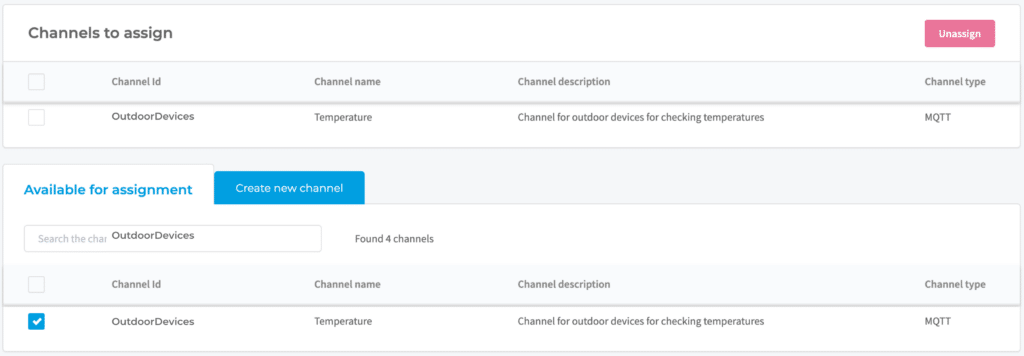
The platform is built around an API-first design and an intuitive portal for SIM lifecycle management, diagnostics, and tracking. It supports eSIM and SGP.32 orchestration, over-the-air updates, and hybrid cellular and non-terrestrial coverage through a single SIM.
Key features include:
- Automated SIM lifecycle management: Automates provisioning, activation, configuration, and deactivation of SIMs globally from one cloud-native portal.
- Cloud-native mobile core: Runs its own virtualized mobile core, delivering consistent, full-featured connectivity management across networks and devices.
- API-first integration: Provides documented APIs so connectivity management, data, and diagnostics integrate into existing IT stacks and customer applications.
- Single-pane-of-glass portal: Delivers one intuitive portal for connectivity tasks, tracking, and diagnostics across the entire device fleet.
- eSIM and future-proofing: Supports advanced IoT eSIM and SGP.32 orchestration, plus over-the-air updates to reach new coverage areas and network technologies.
- Hybrid coverage and security: Combines cellular technologies including LTE-M, NB-IoT, and 5G with non-terrestrial networks through one SIM, with security controls and anomaly detection.
Limitations (as reported by users on G2):
Trial and support limits: Certain functions such as network trace are restricted on trial accounts, and some users report slower support responses.
Reporting depth: Some users find dashboards and reporting rely on pivot tables and would like more advanced built-in reporting.
Update guidance: Reviewers note platform updates can change the interface without accompanying guides, requiring some relearning.
Thin CMPs
Thin CMPs prioritize simplicity, low cost, and rapid scalability over deep network integration. They focus on lifecycle tasks such as SIM provisioning, usage analytics, and billing, and rely on networks provided by external operators. Their lightweight, often cloud-native design suits large low-ARPU deployments and providers that want fast time to market.
5. Comarch IoT Connect

Best for: Operators and enterprises running IoT connectivity at carrier scale
Strengths: End-to-end lifecycle, real-time charging, and billing in one
Things to consider: Operator-grade scope adds implementation effort
Comarch IoT Connect is a connectivity management platform that enables telecom operators and enterprises to deliver managed IoT connectivity across industry verticals. It is built on a cloud-native, event-based architecture proven across tens of millions of connections.
The platform manages the whole IoT value chain, from sales and product fulfillment through charging, billing, and analytics. It provides real-time service control through Diameter, Radius, and 5G N40 interfaces and supports both connectivity and non-connectivity offerings.
Key features include:
- End-to-end IoT service management: Consolidates devices, SIMs, connectivity services, and operational processes into one platform covering quoting, ordering, fulfillment, and lifecycle operations.
- Real-time charging and control: Provides online charging for data, voice, SMS, and MCx services via Diameter, Radius, and 5G N40, with a unified usage store for session records.
- Product catalog and monetization: Enables flexible, granular pricing across services, with usage allowances, roaming profiles, per-unit plans, and tiered volume pricing.
- Partner and enterprise ecosystem: Orchestrates partners, resellers, and enterprise customers with onboarding, organizational hierarchies, contracts, and self-service portals.
- Automation for massive IoT: Applies policy-driven, event-based automation across the SIM lifecycle, with zero-touch provisioning, scheduled operations, and built-in safeguards.
- Analytics and eSIM support: Provides monitoring dashboards, location and usage analytics, and eSIM support through an SM-DP+ interface aligned with SGP.22 and SGP.32.
Limitations (based on publicly available sources):
- Operator-grade complexity: The platform targets tier-1 and tier-2 operators and carrier-scale deployments, which can add integration and setup effort.
- Deployment overhead: On-premises and managed deployment options can require more implementation resources than lightweight self-service tools.
- Enterprise orientation: Its depth is aimed at operators managing full value chains, which may exceed the needs of smaller, simpler deployments.
6. Mavoco

Best for: Operators, MVNOs, and resellers running an IoT connectivity business
Strengths: Full-stack BSS CMP with single-pane overlay across networks
Things to consider: Operator-focused with a smaller footprint than incumbents
Mavoco provides an IoT connectivity management platform for mobile network operators, MVNOs, and enterprises to control connectivity, SIMs, and subscriptions across multiple networks. Its full-stack BSS for IoT automates workflows from selling and delivery through to billing and invoicing.
The platform offers a CSP portal for operators and a self-care enterprise portal for their customers, along with an overlay capability that unifies multiple CMPs and MNO networks. It supports flexible deployment models and licensing tuned for low-ARPU IoT services.
Key features include:
- Full-stack BSS for IoT: Streamlines and automates connectivity service provider workflows, covering selling, delivery, billing, and invoicing in one platform.
- SIM and subscription management: Automates SIM lifecycle actions, price plan management, and subscription control for both operators and their enterprise customers.
- Single pane of glass overlay: Aggregates multiple CMPs and MNO networks into one interface, integrating with platforms such as Cisco IoT Control Center, Aeris, Vodafone GDSP, and Comarch.
- CSP and enterprise portals: Provides a CSP portal for provisioning, billing, and reseller models, and a self-care enterprise portal for SIMs, devices, diagnostics, and reporting.
- Flexible deployment and licensing: Supports on-premises, public cloud, hybrid, dedicated-core, and existing-core integration, with licensing models tailored to low ARPU.
- Multi-tenant and settlement: Handles multi-tenant hierarchies and settlement between operators to give multinational customers a single-supplier experience.
Limitations (based on publicly available sources):
- Operator relationship needed: The platform is oriented to connectivity service providers and operators, so enterprises typically engage through an operator or provider.
- Smaller ecosystem: As a specialist vendor, its partner ecosystem and market footprint are smaller than those of the largest incumbents.
- Limited public reviews: Independent third-party review coverage is limited, so evaluation relies more on vendor references.
7. 1NCE
Best for: Large low-bandwidth deployments needing flat-rate simplicity
Strengths: One flat lifetime price with core features included
Things to consider: Data cap and limited customization for richer use cases
1NCE provides managed IoT connectivity for low-bandwidth applications using a flat-rate model, the IoT Lifetime Flat, which covers ten years of connectivity for a single upfront fee across 170-plus countries. It partners with a tier-1 operator and a major cloud provider for its network and cloud services.
The offer bundles data, SMS, a secure VPN, an APN, and a REST API, and includes a connectivity management platform for managing SIM cards. It supports all major mobile standards, including 2G, 3G, 4G, LTE-M, and NB-IoT, from a single SIM.
Key features include:
- Flat-rate lifetime pricing: Bundles connectivity for a device’s lifetime into a single upfront fee, with a fixed data and SMS allowance and no monthly charges.
- Global multi-standard coverage: Provides coverage across 170-plus countries and all major standards, with a single SIM that connects and switches between 2G, 3G, 4G, LTE-M, and NB-IoT.
- Connectivity management platform: Lets users manage SIM cards through the 1NCE portal and via a REST API for integration into their own systems and workflows.
- Secure connectivity: Includes an OpenVPN tunnel and APN so devices can establish a secure data channel without setting up separate VPN infrastructure.
- eUICC and form factors: Offers business and industrial SIMs and a solder-down chip, with a Freedom to Switch (eUICC) option available on selected products.
- Add-on software and high data: Provides plugins for over-the-air management, data visualization, and cloud integration, plus a pay-as-you-go High Data option for larger transfers.
Limitations (based on publicly available sources):
Coverage variation: Availability of specific network standards varies by country, so some regions have limited or partial service.
Data allowance ceiling: The flat-rate allowance suits low-data devices and requires paid top-ups or High Data plans for heavier usage.
Limited customization: The single standardized plan offers less configurability than full enterprise connectivity platforms.
Connectivity Abstraction Platforms
Connectivity abstraction platforms sit above one or more CMPs, harmonizing data and workflows across carriers, geographies, and providers. By normalizing APIs, enforcing consistent policies, and adding cross-provider analytics, they give a single interface over a multi-vendor fleet and help enterprises avoid vendor lock-in.
Flolive — a thick CMP with a built-in abstraction layer
Flolive leads this guide as our #1 thick CMP (see above), but it earns a place in this category too. Alongside its own cloud-native core, Flolive’s CMP includes an aggregation layer that brings SIMs from other operators and providers — including SGP.32 eSIM profiles — under a single management pane and API. That produces a combination few platforms offer: the control and performance of owning the core, with the reach of an abstraction platform managing connectivity you didn’t provision yourself. Enterprises running a mixed fleet — some Flolive SIMs, some inherited from other CMPs — can manage all of it in one place, then consolidate onto Flolive connectivity where it makes sense.
8. IoTM
Best for: Enterprises unifying multiple CMPs and eSIM providers
Strengths: Carrier-agnostic overlay unifying CMP and RSP workflows
Things to consider: Overlay depends on the underlying carriers and CMPs
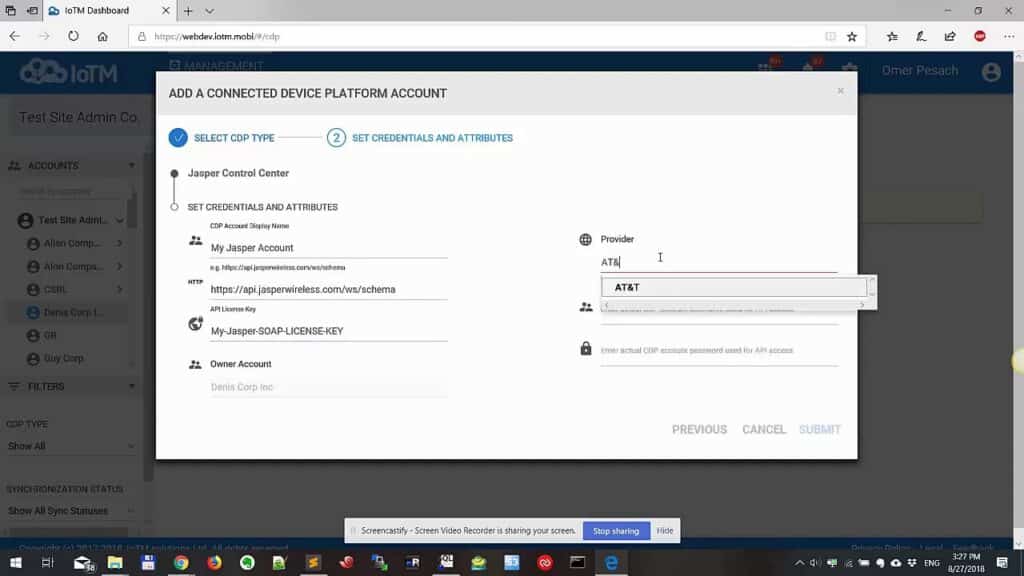
IoTM provides a connectivity and eSIM orchestration platform that sits above existing CMPs and remote SIM provisioning systems to unify IoT connectivity and eSIM lifecycle management. It uses a zero-touch, bring-your-own-vendor model aimed at connected enterprises.
The platform provides a single pane of glass across more than 100 mobile operators and CMP types, letting customers switch carriers without disrupting existing workflows. It supports SGP.22 and is built to accommodate the SGP.32 specification for IoT eSIM.
Key features include:
- Unified CMP and RSP management: Replaces fragmented CMP and RSP interfaces with a single platform for managing connectivity and eSIM provisioning tasks.
- eSIM fleet management: Executes batched actions across large eSIM deployments, including profile download, enable, disable, and delete operations.
- Zero-touch onboarding: Onboards SIM deployments through a self-service flow that begins with zero-touch and moves to low-touch, user-friendly operations.
- Carrier-agnostic switching: Lets customers add connectivity vendors and switch carriers without disrupting workflows, with out-of-the-box support for 100-plus operators.
- Standards-based architecture: Integrates with eSIM vendors’ eIM APIs for SGP.22 and is built to accommodate SGP.32 once it is certified.
- Cross-carrier fleet management: Adds a fleet management layer that coordinates remote SIM provisioning actions with connectivity lifecycle actions end to end.
Limitations (based on publicly available sources):
- Overlay dependency: As an orchestration layer, its capabilities depend on the underlying CMPs and carrier platforms it integrates with.
- Integration scope: Out-of-the-box support spans more than 100 operators, but coverage for a specific carrier setup should be confirmed.
- Limited public track record: As a niche vendor, independent reviews and public references are limited.
9. Simetric

Best for: Large enterprises orchestrating IoT across many carriers
Strengths: Single pane over 250+ carrier and satellite platforms
Things to consider: Value depends on the underlying carrier integrations
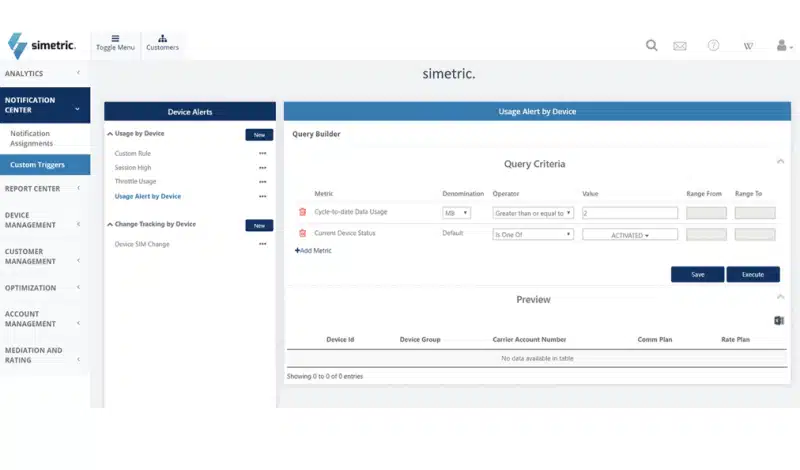
Simetric provides a connectivity abstraction and orchestration platform that sits above carrier CMPs, normalizing operations across more than 250 cellular and satellite platforms into one workflow. Rather than acting as a connectivity or SIM provider, it operates as an enterprise control layer.
The platform gives organizations a single pane of glass to manage connectivity, devices, and data across the full lifecycle. It extends traditional CMP capabilities into enterprise governance and orchestration, with more than 1,000 APIs and a data lake built on Databricks.
Key features include:
- Single pane of glass: Unifies device and connectivity management across carriers, connectivity platforms, and eIM providers in one operational view.
- Cross-carrier SIM lifecycle: Runs full lifecycle actions such as activation, suspension, and rate plan changes across providers, using a patented bulk engine with no action limits.
- eSIM orchestration: Manages eSIM profiles agnostically and integrates with eIM providers to support profile lifecycle operations across vendors.
- Analytics and anomaly detection: Provides dynamic analytics, configurable dashboards, anomaly detection, and alerting to strengthen security and cost posture.
- Business process automation: Automates approval workflows, rate plan optimization, and routine lifecycle tasks, with role-based controls and a mediation and rating engine.
- Integration and hierarchy: Offers more than 1,000 APIs, ERP and CRM integration, unlimited parent-child hierarchies, and a federated data lake.
Limitations (based on publicly available sources):
- Not a connectivity provider: Simetric orchestrates above carriers rather than supplying SIMs or networks, so it depends on the customer’s chosen carrier relationships.
- Integration quality dependency: Its value scales with the coverage and quality of the underlying carrier and CMP integrations.
- Enterprise onboarding: The platform targets complex enterprise environments, which involves onboarding and configuration effort.
8. Spenza
Best for: OEMs and MSPs bundling multi-operator connectivity and billing
Strengths: Operator-neutral aggregation with unified billing
Things to consider: Newer vendor that depends on third-party coverage
Spenza provides an operator-neutral connectivity management platform, delivered as an MVNO and MVNE model, that aggregates multi-operator IoT connectivity, billing, and analytics in one place. It serves device OEMs, managed service providers, and enterprise IoT teams across more than 190 countries.
The platform unifies operators, automates provisioning, and simplifies eSIM deployment from activation through customer management. It combines connectivity sourcing, telecom expense management, and AI-driven insights to reduce cost and improve visibility across the connectivity estate.
Key features include:
- Multi-operator aggregation: Aggregates connectivity from many operators into one dashboard, letting teams pair use cases with the right plans across 190-plus countries.
- SIM and eSIM lifecycle: Handles SIM and eSIM provisioning, real-time usage monitoring, automated alerts, and carrier switching without physical SIM swaps.
- Bulk fleet operations via API: Runs bulk fleet actions over an API-first architecture with native integrations and webhooks into existing systems.
- Unified billing and expense management: Provides a billing engine and telecom expense management that consolidate multi-operator invoices into a single financial view.
- AI-driven insights: Applies analytics to surface waste, monitor KPIs, and support cost-optimization decisions across the connectivity estate.
- Bring your own network: Supports a bring-your-own-network model so existing carrier contracts and SIMs can be integrated rather than replaced.
Limitations (based on publicly available sources):
- Newer market entrant: As a younger MVNE, its public track record and independent reviews are more limited than established vendors.
- Third-party coverage reliance: Being operator-neutral, coverage and performance depend on the underlying carriers it aggregates.
- Maturing feature depth: Some capabilities are still expanding relative to long-established enterprise platforms.
Subscription Management Platforms (eSIM/RSP)
Subscription management platforms focus on secure provisioning, activation, and management of eSIM and iSIM profiles. Built around GSMA specifications such as SGP.22 and SGP.32, they enable remote SIM provisioning so devices can change networks or update profiles without physical access. They often integrate with CMPs but serve the distinct role of decoupling connectivity from hardware
11. Kigen

Best for: OEMs and module makers building secure eSIM and iSIM devices
Strengths: eSIM and iSIM OS plus an SGP.32 eIM for remote provisioning
Things to consider: An enablement layer that needs connectivity partners
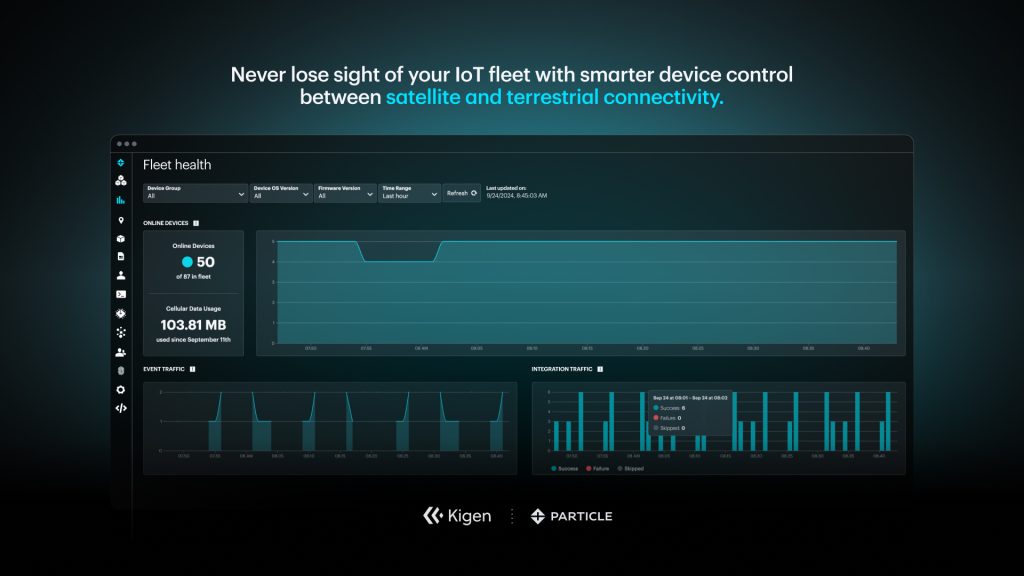
Kigen provides SIM, eSIM, and iSIM technologies together with remote SIM provisioning to enable secure cellular connectivity for IoT devices. Its products are used by device manufacturers, module makers, and connectivity providers to build and manage connected products at scale.
The portfolio spans an eSIM operating system, an SGP.32-compliant eSIM IoT remote manager (Kigen Pulse), iSIM enablement, and in-factory profile provisioning. These let devices download and manage operator profiles remotely without physical SIM replacement.
Key features include:
- eSIM operating system: Provides a compact, certified SIM, eSIM, and iSIM operating system for producing, auto-provisioning, and managing IoT devices.
- Remote SIM provisioning: Enables remote download and management of operator profiles across M2M, consumer, and IoT devices without physical SIM changes.
- eIM for SGP.32: Offers a GSMA SAS-certified, SGP.32-compliant eSIM IoT remote manager, Kigen Pulse, with a single-pane console and OpenAPI integration.
- iSIM enablement: Integrates SIM functionality into the device system-on-chip, reducing the bill of materials and enabling smaller, power-efficient devices.
- In-factory profile provisioning: Loads operator profiles during manufacturing so devices ship connectivity-ready with a single global stock-keeping unit.
- Multi-network flexibility and security: Supports switching across 2G to 5G and LPWAN networks, with tamper-resistant, sealed security suited to long-lived devices.
Limitations (based on publicly available sources):
- Enablement, not connectivity: Kigen supplies eSIM and iSIM technology and provisioning rather than data connectivity, so it works alongside connectivity providers.
- Partner integration required: Its value is realized through integration with CMPs and connectivity providers rather than as a standalone service.
- Technical audience: The products target OEMs and module makers and require engineering integration rather than turnkey enterprise use.
12. G+D

Best for: Operators and enterprises managing eSIM and RSP at scale
Strengths: IoTgo Control platform across all GSMA RSP standards
Things to consider: One segment of a broad SecurityTech conglomerate
Giesecke+Devrient provides IoT connectivity and lifecycle management through its IoTgo Control platform, which covers eSIM and iSIM management and remote SIM provisioning. It serves as a backbone for large-scale IoT deployments, from single devices to entire fleets.
The platform lets companies handle update campaigns, download applications securely, apply region-specific connectivity settings, and automate rule-based registrations. It supports all GSMA RSP standards and has been recognized by Counterpoint as a Challenger in the CMP category.
Key features include:
- Centralized connectivity management: Manages IoT devices and connectivity services from a single platform, scaling from individual devices to entire fleets.
- Full RSP standards support: Supports all GSMA remote SIM provisioning standards, including SGP.02, SGP.22, SGP.32, and SGP.42 for in-factory provisioning.
- eSIM and iSIM lifecycle: Handles eSIM and iSIM provisioning and lifecycle, including update campaigns, secure application downloads, and region-specific settings.
- Automation engine: Automates rule-based registrations and bulk actions such as provisioning, updates, and policy changes across many devices at once.
- Analytics and usage tracking: Provides real-time insight into device performance, connectivity status, and data consumption through in-depth reporting tools.
- Security and integration: Includes an IoT security module with encryption and authentication, and full API access for backend integration.
Limitations (based on publicly available sources):
- Segment of a larger group: IoT connectivity is one part of a broad SecurityTech conglomerate, so the company’s focus spans many business areas.
- Challenger positioning: Analysts position IoTgo Control as a Challenger rather than the leader among connectivity management platforms.
- Enterprise integration: The platform is oriented to operators and large enterprises, which involves integration effort.
13. Valid

Best for: OEMs and operators needing eSIM plus RSP components
Strengths: End-to-end eUICC and remote SIM provisioning services
Things to consider: Focused on eSIM and RSP rather than a full data CMP
Valid provides an end-to-end eSIM solution that spans the eSIM or eUICC, remote SIM provisioning services, and device management software for consumer and IoT or M2M devices. OEMs, mobile operators, and IoT service providers use it to manage connectivity and subscriptions together.
For IoT, Valid’s eSIMs are ruggedized and tamper-proof with an extended lifespan for demanding connectivity and environmental conditions. The solutions are GSMA-compliant, come in multiple form factors, and are built on a secure operating system.
Key features include:
- End-to-end eSIM solution: Bundles the eUICC, RSP services, and device management software so OEMs, operators, and IoT providers manage connectivity and subscriptions together.
- Remote SIM provisioning: Enables remote download, activation, and deactivation of profiles across the IoT ecosystem without physical SIM handling.
- Ruggedized IoT eSIMs: Offers tamper-proof, ruggedized eUICCs with an extended lifespan for demanding connectivity and environmental conditions.
- Simplified logistics: Serves global deployments with a single device variant, reducing stock-keeping units and supply-chain complexity.
- Security and authentication: Provides end-to-end encryption and strong authentication to identify and authenticate devices to mobile networks.
- 5G-ready and multi-profile: Delivers 5G-ready eSIMs and, for consumer devices, LPA and multiple enabled profile support for dual-SIM behavior.
Limitations (based on publicly available sources):
- Component focus: Valid centers on eSIM and eUICC hardware and RSP components rather than a full connectivity or data management platform.
- Connectivity partners needed: Deployments rely on partner network connectivity alongside Valid’s provisioning components.
- Hardware orientation: The offering is more hardware and provisioning oriented, which may need complementary tools for broader fleet analytics.
14. Thales

Best for: Operators and OEMs needing broad GSMA eSIM provisioning
Strengths: End-to-end eSIM portfolio with Instant Connect activation
Things to consider: Subscription-management focus, not a full data CMP
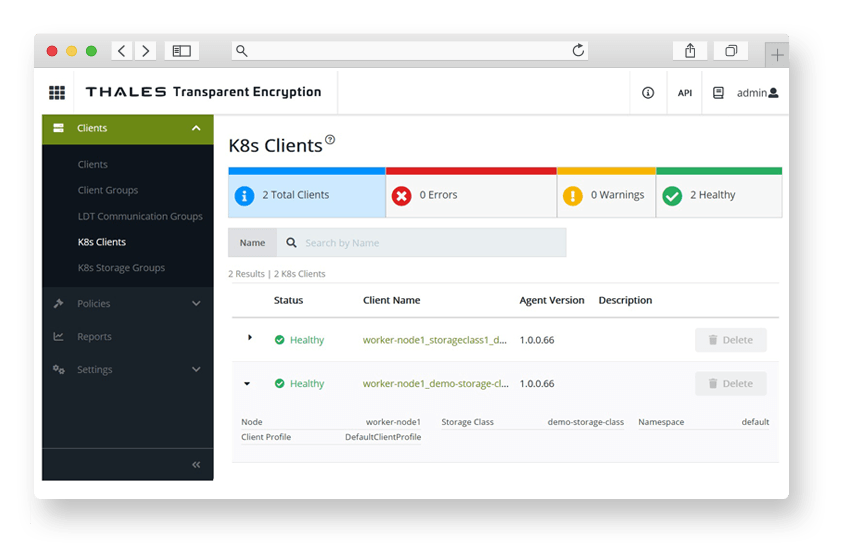
Thales provides an end-to-end eSIM and remote SIM provisioning portfolio for the consumer and IoT markets, including eSIM management and its Instant Connect and Adaptive Connect services. Its Cinterion IoT Offer is a device lifecycle management platform for IoT connectivity.
Thales Instant Connect is a patented client-server solution that gives eSIM devices out-of-the-box initial connectivity, then downloads the target local profile after manufacture. This lets device makers postpone selecting a connectivity provider until after production and throughout deployment.
Key features include:
- Broad GSMA eSIM portfolio: Provides a standardized, interoperable eSIM and remote provisioning offering spanning both consumer and IoT markets.
- Thales Instant Connect: Uses a patented client-server design to give eSIM devices out-of-the-box initial connectivity that downloads the target local profile after manufacture.
- Deferred operator selection: Lets device makers postpone connectivity provider selection until after manufacturing and throughout the deployment lifecycle.
- eSIM management and RSP: Delivers subscription management with SGP.32-based profile download workflows, in-app onboarding, and device transfer capabilities.
- Root discovery services: Supports root discovery services for one-click subscription downloads across eSIM-capable devices.
- Device lifecycle platform: The Cinterion IoT Offer optimizes IoT device connectivity, performance, maintenance, and security across the device lifecycle.
Limitations (based on publicly available sources):
- Subscription-management focus: Thales centers on eSIM and remote provisioning and initial connectivity rather than a full data connectivity management platform.
- Conglomerate breadth: eSIM is part of a very large diversified group, so IoT connectivity is one of many focus areas.
- Enterprise engagement: Adoption typically involves enterprise sales and integration rather than self-service onboarding.
15. 10T Tech
Best for: Mobile operators adopting and scaling eSIM services
Strengths: Dedicated eSIM lifecycle and orchestration platform
Things to consider: Smaller specialist focused on operator eSIM
10T Tech provides an eSIM lifecycle management platform, My10T, for mobile operators and digital service providers across consumer, enterprise, and IoT segments. It was among the first vendors fully dedicated to eSIM services and has focused on eSIM since 2018.
The platform helps operators onboard, engage, and retain customers through eSIM, and orchestrates profile operations to reduce churn and improve efficiency. Counterpoint recognized 10T Tech as the most improved platform in its 2025 eSIM Orchestration report.
Key features include:
- eSIM lifecycle platform: My10T provides centralized tooling for operators to onboard, manage, and scale eSIM services across consumer, enterprise, and IoT segments.
- eSIM orchestration: Coordinates subscriber engagement and profile operations to reduce churn, enrich customer dialogue, and improve operational efficiency.
- Consumer eSIM enablement: Supports multi-partner consumer eSIM onboarding, engagement, and retention for mobile operators.
- eSIM for IoT: Enables remote provisioning, global scalability, and zero-touch deployment to simplify IoT device management across networks.
- Operator-stage flexibility: Built for operators at any stage of the eSIM journey, from initial adoption through large-scale orchestration.
- Standards alignment: Aligns with GSMA remote provisioning to support secure, scalable eSIM deployment.
Limitations (based on publicly available sources):
- Operator-centric scope: The platform is oriented to mobile operators and digital service providers rather than direct enterprise buyers.
- Specialist focus: As an eSIM specialist, it centers on eSIM orchestration rather than broader connectivity management.
- Emerging track record: As a younger, focused vendor, independent public reviews are limited.
Related Content : IoT connectivity management platform guide
What to Look for in a Modern IoT Connectivity Platform
Here are some of the main aspects to consider when evaluating connectivity platforms for IoT use cases.
1. IoT SIM Management
Effective device management is essential for any IoT connectivity platform. This includes the ability to provision SIMs over the air—activating, deactivating, or assigning new profiles in real-time without needing to restart or physically access the device. These capabilities streamline deployment and maintenance, especially across large or distributed networks.
In addition to provisioning, platforms should offer fine-grained control over device behavior. That means setting permissions, managing data consumption, and monitoring usage at the individual SIM level. Real-time visibility into device status helps prevent misuse, optimize resource allocation, and ensure devices are functioning as expected.
2. Agnostic Compatibility
A modern CMP must be compatible with all forms of IoT hardware and connectivity technologies. This includes supporting multiple SIM formats (from 2FF to MFF2) and access technologies (from legacy 2G to CAT-M and 5G). Compatibility shouldn’t hinge on any one form factor or radio standard.
As network technologies evolve, maintaining this flexibility ensures devices stay connected regardless of geographic region or deployment context. Agnostic compatibility simplifies procurement, reduces vendor lock-in, and allows businesses to build future-proof IoT infrastructures.
3. Built-In Security
Security needs to be embedded in every layer of the connectivity stack. Leading platforms offer continuous cellular connectivity with real-time monitoring and visibility across devices. They provide tools like smart firewalls, which can filter traffic based on rules and enforce strict access policies to prevent unauthorized use.
Advanced security features also include tunneling and network slicing. These capabilities enable businesses to isolate traffic and apply custom security measures for sensitive data flows. For high-risk or regulated industries, such features are essential to protect data integrity and maintain compliance.
4. Flexible Business Models
A modern IoT platform must adapt to a wide range of commercial strategies. For high-volume, low-ARPU use cases (like smart meters), usage-based billing with granular control is crucial. Mission-critical applications may require tiered pricing with guaranteed bandwidth and QoS.
The platform should support multiple billing models simultaneously—flat-rate, pay-per-use, prepaid, or event-based—and offer custom pricing logic per customer, device type, or service bundle. Real-time billing integration (e.g., with BSS/OSS) enables accurate invoicing and revenue sharing. Additionally, features like white-label portals and reseller management are key for operators offering IoT as a service.
5. Built-In eSIM Orchestration
As eSIM adoption grows, platforms must support full remote SIM provisioning (RSP) workflows in line with GSMA specifications. This includes capabilities for profile download, enablement, disabling, and deletion without physical device access. Integration with SM-DP+ and SM-SR servers is essential for managing the lifecycle of both M2M and consumer eSIMs.
Advanced orchestration tools allow zero-touch onboarding—automatically assigning profiles based on device location, business rules, or user input. Platforms should also support SGP.32 (IoT eSIM specification) for future-proofing and large-scale automation. In-factory profile provisioning (IFPP) reduces time-to-market by embedding connectivity during manufacturing.
6. Elastic Scalability
IoT deployments may start with pilot projects but can quickly scale to millions of endpoints. Elastic scalability means the platform can expand compute and storage resources dynamically, ensuring consistent performance as loads increase.
Cloud-native platforms using Kubernetes, containerization, and microservices can autoscale components like API gateways, policy engines, and data ingestion services. Horizontal scalability supports geographic expansion and load balancing, while redundancy and failover mechanisms ensure availability. Multi-tenancy support allows service providers to isolate and manage resources across customers or business units efficiently.If you’d like concrete examples of the platforms that fulfil these requirements, explore our guide to the best enterprise-IoT platforms in 2025
Conclusion
Connectivity management platforms are becoming central to the success of IoT initiatives, evolving from basic SIM management tools into comprehensive control planes for distributed device networks. As the diversity of IoT applications grows—from low-power sensors to real-time, high-throughput systems—so does the demand for platforms that offer granular control, regulatory agility, and operational resilience.