


What Are eUICC SIMs?
eUICC SIMs for IoT connectivity are programmable SIMs that allow multiple carrier profiles to be stored and managed remotely over-the-air (OTA). This technology enables devices to switch carriers remotely to optimize for coverage, manage costs, or adapt to changing business needs.
For long-lasting IoT devices in the field, EUICC SIMs provide essential flexibility, scalability, and cost savings by reducing downtime and the need for costly technician visits. Devices equipped with eUICCs can be provisioned with profiles for different operators and geographies without truck rolls or manual intervention, streamlining mass IoT rollouts and long-term device lifecycle management.
How an EUICC SIM works:
- Digital profile: It acts like a digital wallet, capable of storing multiple subscriber profiles from different carriers.
- Remote provisioning: The eUICC allows these profiles to be remotely downloaded, updated, or changed without physically accessing the device, using over-the-air (OTA) updates.
- Seamless connectivity: When a device moves to a new region, it can be remotely switched to a local carrier profile for seamless connectivity, assuming the profile already exists on the eUICC. Otherwise, a new profile will first need to be downloaded.
How eUICC Works in IoT Deployments
Digital Profile
An eUICC SIM stores operator profiles as digital files, each holding credentials and access rules for a mobile network. Unlike legacy SIMs locked to a single network, the eUICC can support multiple profiles on the same chip. Each profile can be activated, deactivated, or deleted remotely, allowing operators and enterprises to control connectivity relationships dynamically, based on business requirements, region, or roaming agreements.
The digital profile model gives device owners the flexibility to change mobile providers in response to cost, performance, or coverage changes, without device recalls or onsite interventions. OEMs and IoT service providers can pre-install generic profiles during manufacturing and then remotely assign local carrier profiles post-deployment. This profile portability is crucial for global IoT solutions, reducing time-to-market and adapting to evolving connectivity conditions.
Remote Provisioning
A key feature of eUICC technology is remote provisioning, which allows SIM profiles to be downloaded, activated, or altered securely over-the-air (OTA). Using standard protocols defined by GSMA, businesses or mobile operators can send profile updates to millions of deployed devices without physical touchpoints.
While earlier GSMA standards such as SGP.02 were designed for traditional M2M use cases, SGP.32 extends remote SIM provisioning specifically for modern IoT deployments, supporting scalable profile management, lower operational overhead, and long-lived devices with limited user interaction This eliminates logistical bottlenecks and accelerates large-scale IoT rollouts, as connectivity can be managed and adjusted as device fleets move or as business needs change.
Remote provisioning supports lifecycle management beyond initial deployment. Enterprises can optimize network costs by switching operators based on bulk deals or local agreements, or update SIM secrets and configurations to counteract potential security threats. OTA provisioning also simplifies regulatory compliance in countries with evolving telecom laws by allowing swift, remote reconfiguration of carrier profiles across distributed devices.
Seamless Connectivity
As devices migrate across regions or providers, eUICCs enable the secure and automatic switching between mobile networks. This reliability is critical for applications such as logistics tracking, mobility services, and cross-border machinery, where sustained access to optimal networks ensures uninterrupted service and efficient data transmission.
The ability to dynamically select the best available operator profile means IoT deployments are no longer limited by single-market agreements or burdened by expensive roaming. Instead, device owners can tailor their connectivity at scale—maximizing uptime, optimizing performance, and driving down costs. This smooth, borderless connectivity empowers manufacturers, enterprises, and service providers to focus on application value rather than managing network logistics.
Notable eUICC SIMs for IoT Connectivity
1. floLive

floLIVE provides a standards-based eUICC connectivity solution designed for large-scale, global IoT deployments requiring flexibility, resilience, and centralized control across the device lifecycle.
Key features include:
- eUICC implementation supporting all major SIM form factors, including removable (plastic) SIMs, embedded (MFF2) eUICCs, and iSIMs, subject to module and chipset compatibility. This enables OEMs and enterprises to standardize on a single connectivity architecture across diverse device designs.
- Support for GSMA Remote SIM Provisioning specifications across M2M, consumer, and IoT deployments, including SGP.01/02, SGP.21/22, and SGP.31/32, ensuring interoperability and future-proof compliance with evolving eUICC standards.
- CMP aggregator: Addresses the operational complexity that can arise from managing multiple eUICC profiles and platforms. The CMP Aggregator provides a single pane of glass to manage connectivity profiles across operators, regions, and SIM management platforms. This centralized view simplifies lifecycle operations, monitoring, and policy enforcement at scale.
- Patented technology that encapsulates multi-IMSI capabilities within an eUICC profile, combining the resilience and network reach of multi-IMSI connectivity with the lifecycle flexibility and standards-based management of eUICC. This approach enables optimized coverage, redundancy, and control without sacrificing GSMA compliance.
2. KORE

KORE provides global eUICC SIM solutions for IoT, supporting more than 500 networks across 200+ countries through a single SIM. Its offerings include advanced eSIM and multi-IMSI technologies that allow devices to dynamically switch between carrier profiles in the field.
Key features include:
- Global network access: Supports over 500 networks across 200+ countries via roaming and local carrier SIMs
- OmniSIM with Remote SIM Provisioning: Enables downloadable multi-carrier profiles for dynamic switching and regulatory compliance
- Multi-IMSI and eUICC technology: Enhances redundancy and uptime with automatic failover between carrier profiles
- Unified management platform: Centralized console and APIs for SIM provisioning, monitoring, billing, and security
- Flexible data plans: Scales from small data footprints to high-throughput use cases, with tailored pricing options
3. Onomondo

Onomondo offers a non-steered eUICC IoT SIM for global deployments, providing access to 680+ networks in 180+ countries. Their UICC eSIM works across all SIM form factors and integrates directly with Onomondo’s network, allowing real-time monitoring, remote profile switching, and optimized data usage.
Key features include:
- Global coverage with core integration: Connects to over 680 networks through a single APN and profile, simplifying operations
- Real-time network insights: Offers visibility into signal strength, data use, and device status
- Secure, soldered SIM form factors: Increases physical durability and prevents tampering in rugged IoT environments
- Efficient data handling: Network optimizations reduce data usage and improve energy efficiency
- Remote profile management: Supports dynamic operator switching without physical SIM replacement or manual intervention
4. 1nce
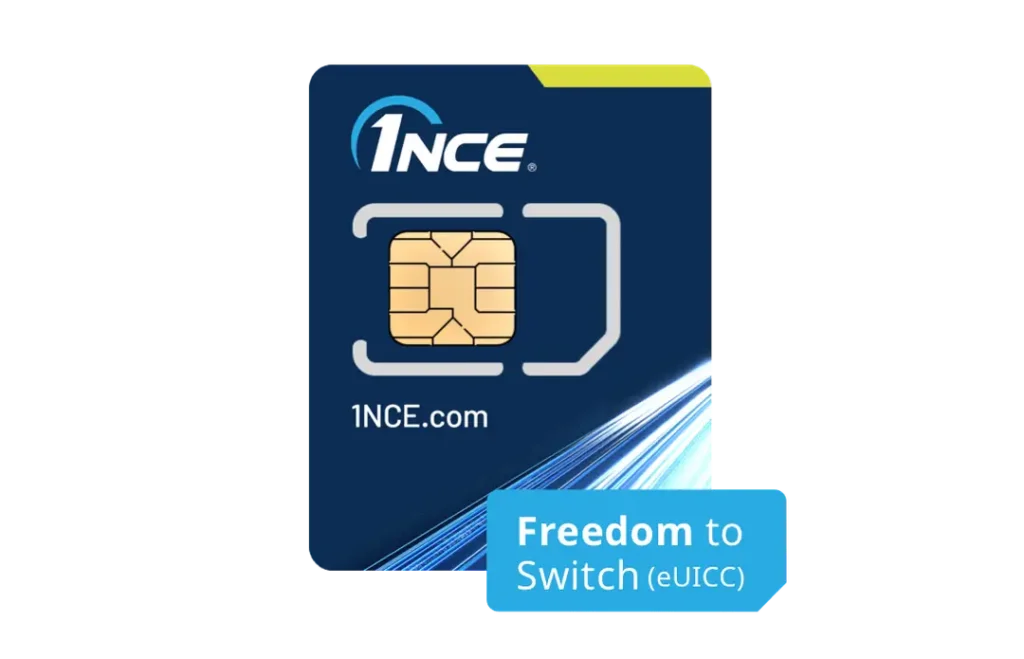
1NCE offers eUICC-enabled SIMs designed for low-bandwidth, long-life IoT applications, with a focus on simplicity and predictable pricing. The company’s industrial-grade SIM and chip offerings support the “Freedom to Switch” feature, allowing carrier profile changes via over-the-air provisioning.
Key features include:
- eUICC-enabled rugged SIMs: Supports carrier profile switching on industrial-grade 3-in-1 SIMs and solderable SIM chips for reliable use in harsh environments
- Long-term pricing model: Offers a 10-year flat-rate connectivity plan, including data, SMS, and VPN features, with no recurring charges
- Global coverage: Operates across major radio standards (2G, 3G, 4G/LTE-M, NB-IoT) and supports connectivity in regions across six continents
- Integrated software tools: Provides FOTA, data visualization, and cloud integration through third-party plugins, simplifying remote management
- Optimized for scale: Tailored for use cases like GPS tracking and smart metering, supporting thousands of devices with minimal operational overhead
)
5. Wireless Logic

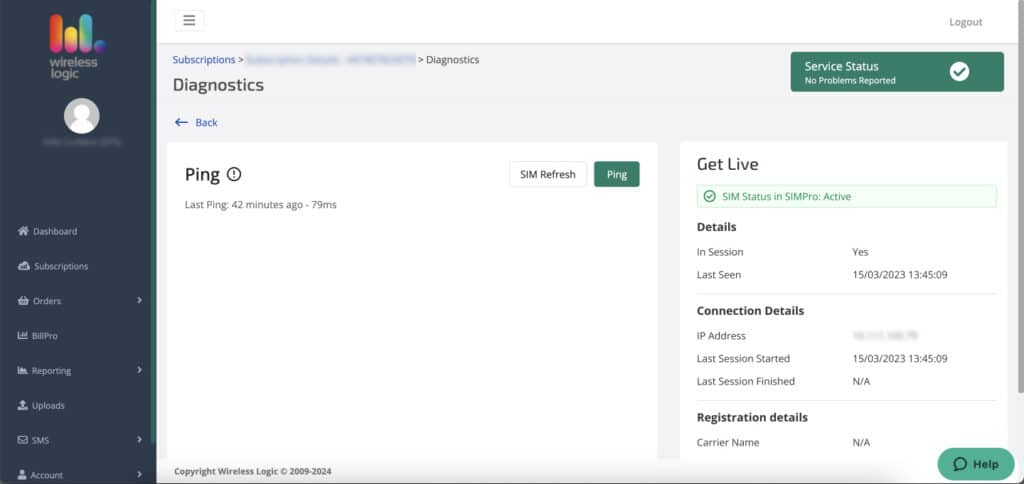
Wireless Logic offers IoT eSIM solutions aligned with GSMA remote SIM provisioning standards, including SGP.02 (M2M), SGP.22 (consumer), and SGP.32 (IoT), with management via its SIMPro platform.
- Standards compliance: Ensures compatibility with GSMA’s RSP architecture across eUICC and iSIM, supporting multiple deployment scenarios and SIM form factors for interoperability and scale.
- Profile management platform: SIMPro enables remote activation, switching, or suspension of profiles, with usage visibility and the ability to change networks without device access.
- Operational tooling: RSP infrastructure includes a rules engine, automated over-the-air campaigns with logging, profile inventory maintenance, and APIs for system integration and bulk operations.
- Multi-profile support: Enables multi-profile functionality within eSIM for network changes and policy-driven connectivity without physical intervention.
Best Practices for Implementing eUICC in IoT Projects
Design Devices for Multi-Profile Flexibility
Start by architecting devices to handle multiple eUICC profiles and operator changes. This will require hardware and software support for loading, activating, or deactivating several network profiles over the device’s lifecycle. By enabling profile switching, devices can adapt to changing coverage, costs, or regulations over time. Planning for multi-profile support at the hardware and firmware level ensures future-proof scalability, especially for global device fleets that might need to change providers post-deployment.
Integrating multi-profile management minimizes risk. When issues arise with a specific carrier’s service or costs fluctuate, device owners can quickly switch profiles without on-site intervention. This ensures business continuity, reduces operational expenses, and improves resilience against market or regulatory shifts. Multi-profile flexibility is a prerequisite for maximizing the return from eUICC investments in IoT deployments.
Validate Module and Firmware Compatibility Early
Validation must occur at the outset: test your device modules, firmware, and eUICC chips to certify compatibility with GSMA standards and your prospective network operators. Modules from different vendors or firmware versions might handle eUICC processes inconsistently, causing OTA provisioning failures or degraded service. Early testing uncovers these issues before mass deployment, reducing the risk of costly recalls or device rework.
Work closely with your module vendors and eUICC providers to access compatibility matrices and approved software revisions. By simulating remote profile management in the lab and running OTA provisioning scenarios, you ensure smooth scaling to larger field trials. Fixing compatibility problems early in the development cycle averts downstream operational headaches, freeing resources for broader rollout and support.
Build Provisioning Workflows Into Your Device Management Platform
Provisioning should be a fully automated workflow embedded in your device management platform. This involves integrating APIs for remote profile download, activation, and configuration into your existing fleet management systems. Automated workflows allow for batch updates, error handling, and event-based triggers, making operations more efficient and scalable as device counts grow.
Building provisioning into your platform also enables closed-loop processes such as detecting activation failures, retrying deliveries, or alerting support staff about anomalies in real time. Rich workflow automation reduces manual overhead, minimizes human error risk, and supports complex use cases like on-the-fly operator changes or staged project rollouts.
Test Networks Across Regions Before Mass Production
Before scaling production, thoroughly test your device connectivity across all intended deployment regions. Even with eUICC flexibility, local network conditions, operator agreements, and regulatory restrictions can introduce unexpected connectivity gaps or latency issues. Real-world testing confirms whether remote profile downloads, activations, and network handovers work reliably across diverse geographies.
Collaborate with your eUICC provider and local MNOs to ensure that all required profiles are available and function as intended. Use test devices in the field to validate that profile switching occurs seamlessly and that failover to backup carriers is robust. By discovering and resolving regional or carrier-specific issues early, you avoid mass deployment pitfalls and service disruptions.
Maintain Security Controls and Monitor Profile Lifecycle Events
Security for eUICC devices must go beyond the basics. Use strong, standards-based cryptography to secure OTA profile downloads, remote management commands, and profile deletion operations. Enforce access control over who can initiate provisioning or switch profiles, with audit trails to track all lifecycle events. Monitoring profile changes shields your IoT fleet from unauthorized provisioning or potential misuse.
Security best practices also include regular patching of device firmware, blocking downgrades to insecure profiles, and securing device management platforms against external attacks. Continuous monitoring for anomalous or unexpected eUICC events—such as frequent profile activations, suspicious provisioning requests, or unexpected operator changes—enables rapid risk mitigation and regulatory compliance in sensitive IoT environments.
Conclusion
eUICC SIMs are a foundational technology for scalable, global IoT deployments. By enabling remote management of operator profiles, they reduce operational friction, cut connectivity costs, and improve device uptime across regions. For long-lived or widely distributed IoT fleets, adopting eUICC ensures adaptability to changing market conditions, regulatory shifts, and evolving business needs, making connectivity infrastructure more agile and future-ready.