


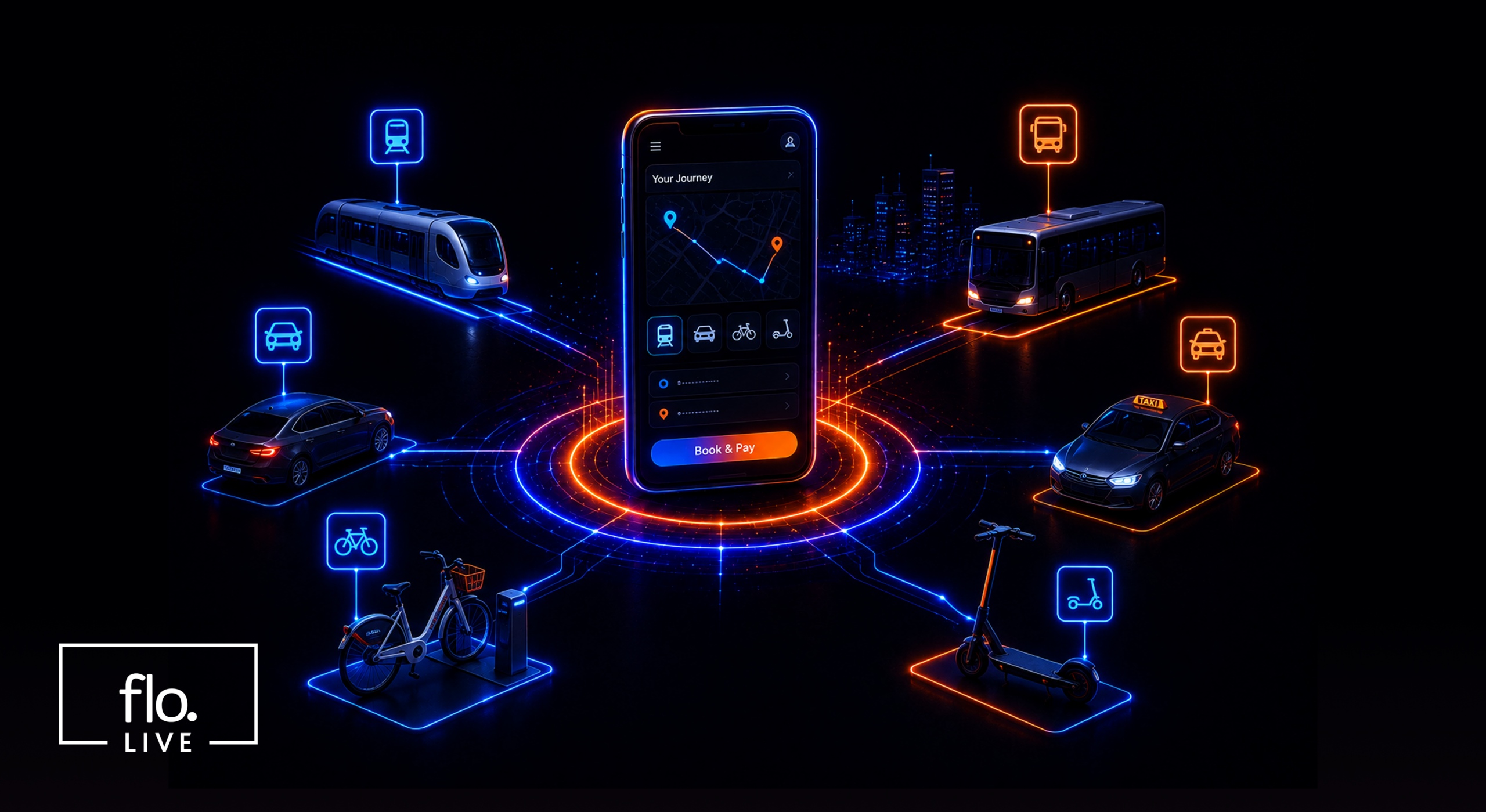
What Is Mobility as a Service (MaaS)?
Mobility as a Service (MaaS) is a digital platform that integrates multiple transport services (public transit, ridesharing, bikes, scooters, and taxis) into a single, on-demand application. It allows users to plan, book, and pay for multimodal journeys through one unified account, reducing dependence on personally owned vehicles.
How it works:
Instead of juggling multiple apps for a bus ticket, a ride-share, and a rental scooter, MaaS combines them all into one experience.
- Journey planning: The platform compares multiple transport modes and routes in real time to recommend the best journey based on time, cost, and user preferences.
- Booking and ticketing: Users can reserve and access buses, trains, rideshares, bikes, and scooters through a single application.
- Payments and subscriptions: A unified payment system supports pay-as-you-go travel and bundled mobility subscriptions across providers.
- Real-time data and personalization: Live traffic, service updates, and travel history are used to provide personalized recommendations and alerts.
Real-world examples:
- Urban MaaS: Local governments and transit authorities partner with private mobility operators to offer city-wide MaaS. Berlin’s Jelbi, run by transit operator BVG, combines public transport, e-scooters, bike-share, car-share, and taxis in a single app with integrated ticketing.
- Corporate MaaS: Organizations provide employees with access to multiple transport services through a centralized mobility platform, combining rail, ride-hailing, car rental, and shuttles under one policy and expense workflow. Corporate travel platforms such as Navan operate in this space.
- Campus and Airport MaaS: Integrated mobility platforms connect shuttles, public transit, rideshares, and micromobility services within large campuses and airport environments. For example, Dallas Fort Worth International Airport and several university campuses use MaaS platforms to coordinate shuttle services and first-mile/last-mile transportation.
This is part of a series of articles about smart mobility.
Benefits of Mobility as a Service
Mobility as a Service offers advantages for travelers, transportation providers, and city planners. By combining multiple transport options into a single platform, MaaS simplifies travel, improves network efficiency, and supports sustainable mobility choices. As cities modernize their transportation systems, MaaS plays an important role in creating connected and user-focused mobility ecosystems:
- Improved convenience: Users can plan, book, and pay for different transportation services through a single application, reducing the need to switch between platforms.
- Better travel flexibility: MaaS enables travelers to choose the most suitable combination of transport modes for each trip based on cost, travel time, availability, or personal preferences.
- Reduced reliance on private vehicles: Easy access to shared and public transportation options encourages people to use alternatives to car ownership, helping reduce traffic congestion.
- Real-time travel information: MaaS platforms provide live updates on schedules, delays, route changes, and vehicle availability.
- Lower transportation costs: By comparing travel options and accessing subscription-based mobility packages, users can reduce overall transportation expenses.
- Enhanced sustainability: Increased use of public transit, bike-sharing, car-sharing, and other shared mobility services can lower emissions and support environmental goals.
- More efficient transportation networks: Integration of transport services helps operators optimize resources and improve service coordination.
- Data-driven urban planning: MaaS platforms generate mobility data that cities can use to understand travel patterns and improve infrastructure planning.
- Greater accessibility: A unified mobility platform can make transportation easier to access for people who face barriers when navigating multiple transport systems.
- Support for smart city initiatives: MaaS aligns with broader smart city strategies by connecting transportation services, digital technologies, and data analytics.
How Mobility as a Service Works
1. Journey Planning
Journey planning is the starting point of any MaaS experience. Users input their origin, destination, and preferred travel times into a MaaS app, which aggregates and analyzes data from transport providers. The platform presents multiple route options, often combining different modes of transportation, such as buses, trains, scooters, and ride-hailing, to deliver an efficient or cost-effective trip. The app considers traffic conditions, service disruptions, and user preferences to suggest itineraries.
The journey planning process is dynamic and responsive to real-time changes. For example, if a train is delayed or a bus route is temporarily closed, the MaaS app can update recommendations and reroute the user. Journey planning tools can also incorporate accessibility needs, environmental impact, and other factors to personalize the experience.
2. Booking and Ticketing
Once a user selects a route, the next step is booking and ticketing. MaaS platforms allow users to reserve seats, vehicles, or services across multiple providers with a single transaction. Instead of navigating separate apps or websites for each transport mode, users complete all bookings within the MaaS platform.
The ticketing component often provides digital tickets or QR codes that can be scanned for access to trains, buses, or shared vehicles. In some cases, MaaS platforms support contactless payment or account-based ticketing, enabling users to board different modes of transport with a single ID or payment card. This integration also helps transit agencies and operators simplify fare management.
3. Payments and Subscriptions
Payments in MaaS platforms are integrated into the user experience. Users can pay for individual trips or subscribe to monthly mobility packages that bundle different modes and services at a discounted rate. This flexibility supports varying travel patterns, whether someone commutes daily or travels occasionally. By consolidating payments into a single platform, MaaS reduces the need for multiple accounts and payment methods.
Subscription-based models are common within MaaS ecosystems. These plans can include unlimited public transport rides, a set number of ride-hailing trips, or credits for bike and scooter sharing. Subscriptions offer predictable costs and simplified billing, making it easier for users to budget and encouraging greater use of shared mobility services.
4. Real-Time Data and Personalization
Control systems in physical AI must handle uncertainties such as variations in object weight, surface friction, or unexpected obstacles. Feedback loops using sensor data allow the AI to adjust actions in real time, compensating for errors and maintaining stability. This closed-loop control is required for tasks that demand accuracy, such as assembling products, picking items, or navigating crowded spaces.
Mobility as a Service Examples
Urban MaaS Apps
Urban MaaS apps integrate local public transport, ride-hailing, bike-sharing, and micromobility options. Transit-operator platforms such as Jelbi (Berlin) and Hannovermobil (Hannover) let users plan, book, and pay for city journeys across transport modes within a single interface, with real-time updates, route suggestions, and digital ticketing.
The category has consolidated sharply: Whim, the Finnish app that defined commercial MaaS, ceased operating in 2024 when its parent MaaS Global entered bankruptcy, and Citymapper, acquired by Via in 2023, retired its integrated ticketing subscription and now operates as a journey planner rather than a booking platform.
Urban MaaS platforms often collaborate with city governments and transit agencies to ensure broad coverage. By making multimodal transport more accessible, these apps encourage residents and visitors to choose shared and sustainable options over private cars.
Example:
A commuter in Berlin uses a MaaS app to plan a trip to work. The app recommends a combination of a shared e-scooter, a subway ride, and a bike-share for the final mile, allowing the user to book and pay for the entire journey through one platform.
Corporate MaaS
Corporate MaaS solutions are tailored for businesses seeking to manage employee mobility and travel. These platforms aggregate transport options relevant to business travelers, such as ride-hailing, car rentals, public transit, and corporate shuttles, into one system. Employees can plan and book trips that comply with company policies, while finance teams gain visibility into travel expenses and carbon footprints.
By centralizing mobility services, corporate MaaS can reduce costs, simplify reimbursements, and promote sustainable commuting. Some platforms offer analytics dashboards for tracking usage and emissions, aligning with corporate sustainability goals.
Example:
An employee traveling to client meetings uses a corporate MaaS platform to book a train ticket, reserve a rideshare to the station, and arrange local transportation at the destination. All expenses are automatically tracked and reported under company travel policies.
Campus and Airport MaaS
Campus and airport MaaS platforms address mobility needs of large environments like university campuses, business parks, and airports. These solutions integrate shuttles, shared bikes, e-scooters, and on-demand ride services to support movement within and between facilities. Users can access available modes through a single app.
Such implementations often incorporate real-time vehicle tracking, digital ticketing, and route optimization tailored to campus or airport layouts. MaaS also provides insights into usage patterns and supports fleet management.
Example:
A traveler arriving at an airport uses a MaaS app to locate the nearest shuttle, reserve an e-scooter for the final leg of the trip, and receive real-time updates on vehicle availability, all within a single application.
The Connectivity Layer Behind Mobility as a Service
Connectivity allows Mobility as a Service platforms to function across multiple transport modes, service providers, and digital systems. MaaS depends on continuous data exchange between mobile apps, public transit networks, shared mobility operators, payment systems, traffic infrastructure, and connected vehicles. Without strong connectivity, MaaS platforms would struggle to deliver real-time route planning, availability updates, ticketing, and personalized travel recommendations.
This connectivity layer includes:
- Cellular networks
- Cloud platforms
- APIs
- IoT sensors
- GPS systems
- Data-sharing frameworks
These technologies allow transport providers to share information such as vehicle location, service status, capacity, pricing, delays, and route changes. MaaS platforms process this information and present it to users in a clear way. For example, a MaaS app may combine live bus arrival data, scooter availability, traffic conditions, and payment credentials to create a door-to-door travel experience.
Reliable connectivity is important for real-time mobility services: When users rely on MaaS apps during a journey, delays in data transmission can affect route recommendations or service availability. Low-latency communication helps MaaS platforms update users quickly when disruptions occur, such as a canceled train, heavy congestion, or a shortage of shared vehicles nearby.
APIs are central in the MaaS connectivity layer: They allow transportation providers and technology systems to communicate, even when they operate on separate platforms. Through API integrations, MaaS providers connect with public transit schedules, ride-hailing services, bike-sharing systems, parking platforms, payment gateways, and mapping tools. This interoperability brings fragmented transport services into one user experience.
MaaS for Connected Vehicles and Automotive IoT
Connected vehicles and automotive IoT technologies are increasingly important to the future of Mobility as a Service. Modern vehicles are equipped with sensors, telematics systems, GPS modules, embedded connectivity, and onboard software that communicate with cloud platforms and mobility applications. This allows MaaS platforms to access real-time vehicle data and improve fleet visibility.
For shared cars, ride-hailing fleets, autonomous shuttles, and corporate mobility programs, connected vehicle data helps MaaS platforms track:
- Vehicle location
- Fuel or battery levels
- Maintenance needs
- Driver behavior
- Usage patterns
Operators can manage fleets more efficiently and ensure that vehicles are available when users need them. For example, a MaaS platform may use telematics data to show the nearest available shared car, estimate its range, and confirm whether it is ready for use.
Automotive IoT supports predictive maintenance and operational efficiency. By collecting data from vehicle components, MaaS operators can identify potential issues before they lead to breakdowns or service interruptions. This is valuable for shared mobility fleets, where vehicle downtime directly affects availability. Predictive insights help operators schedule maintenance and extend vehicle lifecycles.
Connected vehicle technologies can also improve safety and user experience within MaaS ecosystems. Real-time diagnostics, driver monitoring, emergency alerts, and location tracking help operators respond to incidents or service issues. For users, connected vehicle integration enables features such as:
- Remote unlocking
- Digital identity verification
- Automated trip logging
- In-app support
- Personalized in-vehicle settings
Related content: Read our technology deep-dive on Vehicle-to-Everything (V2X) and its best practices.
MaaS Technology Trends
AI-Powered Journey Planning
Artificial intelligence is making MaaS journey planning more accurate and personalized. Instead of calculating the fastest route, AI systems analyze historical and real-time data, including traffic conditions, weather, service disruptions, vehicle availability, and user behavior. This allows MaaS platforms to recommend routes that align with a traveler’s priorities, such as minimizing travel time, reducing costs, avoiding transfers, or lowering environmental impact.
AI can also adjust recommendations as conditions change during a trip. If congestion increases or a transport service becomes unavailable, the platform can suggest alternative routes. Over time, machine learning models learn from user preferences and travel patterns.
Electric and Shared Mobility Integration
The adoption of electric vehicles and shared mobility services is a major component of MaaS ecosystems. MaaS platforms integrate electric car-sharing fleets, bike-sharing systems, e-scooters, and other low-emission transport options alongside traditional public transit and ride-hailing services. This gives users flexibility while supporting sustainability goals and reducing dependence on privately owned vehicles.
MaaS platforms can provide real-time information about vehicle availability, battery levels, charging station locations, and fleet distribution. Coordinating access to electric and shared transportation services through one platform supports cleaner mobility.
Autonomous Vehicles and MaaS
shuttles, robotaxis, and autonomous delivery vehicles can be integrated into MaaS platforms as on-demand transportation options. These services can improve transport accessibility, particularly in areas where traditional public transit coverage is limited.
Within a MaaS environment, autonomous vehicles can be coordinated alongside buses, trains, and shared mobility services to create multimodal journeys. Real-time fleet management and automated dispatching help optimize vehicle utilization and reduce waiting times.
Open APIs and Mobility Data Standards
Open APIs and standardized mobility data formats are important for MaaS development. Because MaaS integrates services from multiple operators, consistent interfaces are needed to exchange information related to schedules, routes, availability, bookings, and payments. Open APIs reduce the complexity of connecting new transport providers to MaaS platforms.
Mobility data standards such as GTFS (General Transit Feed Specification) and GTFS Realtime for public transport, GBFS (General Bikeshare Feed Specification) for shared micromobility, and the TOMP-API for MaaS booking and payment help ensure that data can be shared consistently across systems and organizations. Standardization supports scalability and collaboration between public agencies, transport operators, and technology providers.
Powering Mobility as a Service with FLOLIVE® Global IoT Connectivity
Every MaaS platform depends on a connectivity layer that keeps vehicles, apps, and transport services online across cities and borders. FLOLIVEⓇ delivers this foundation through one localized global network built specifically for IoT, giving mobility operators global reach with local performance. Instead of relying on high-latency roaming, Flolive applies local network profiles and local breakout across continents so that every connected vehicle, scooter, or ticketing device stays connected and compliant wherever it operates, all managed from a single platform.
Key capabilities of Flolive Global IoT Connectivity:
- Localized global network: Flolive’s cloud-managed network applies local profiles and enables local breakout across continents, delivering global coverage with local performance through 15+ carrier partners and 750+ networks, plus real-time visibility and full control from one platform.
- Any cellular technology from 2G to 5G and NTN: The platform combines cellular and satellite connectivity under one system, supporting all cellular technologies including LPWA and satellite Non-terrestrial Networks (IoT NTN), which can act as a backup for uninterrupted mobility services.
- Support for every SIM type: Flolive supports plastic SIMs, embedded MFF2 eSIMs, iSIM, and softSIM, with seamless activation, smart switching, and full lifecycle control across all devices and geographies.
- Low latency and high throughput: Localized core networks and regional breakouts route data along the shortest path, reducing latency and improving uptime for real-time, mission-critical applications such as autonomous vehicles where every millisecond impacts operational safety.
- Data privacy and sovereignty compliance: The localized network keeps data within the country it originates in, helping mobility operators adhere to GDPR, the California Consumer Privacy Act (CCPA), and other data privacy laws.
- Permanent roaming compliance: A Multi-IMSI platform can automatically provide a native local identity when devices enter restricted markets, guaranteeing “Permanent Roaming Safe” connectivity so fleets stay legally compliant and permanently connected.
- Unified connectivity management: Flolive’s Connectivity Management Platform (CMP) offers single-pane-of-glass visibility to monitor usage, manage security policies, and switch network profiles for every global device from one central dashboard.
To see how Flolive can keep your mobility platform connected and compliant across every market, explore Flolive’s Global IoT Connectivity solution.