


What Are Connected Vehicles?
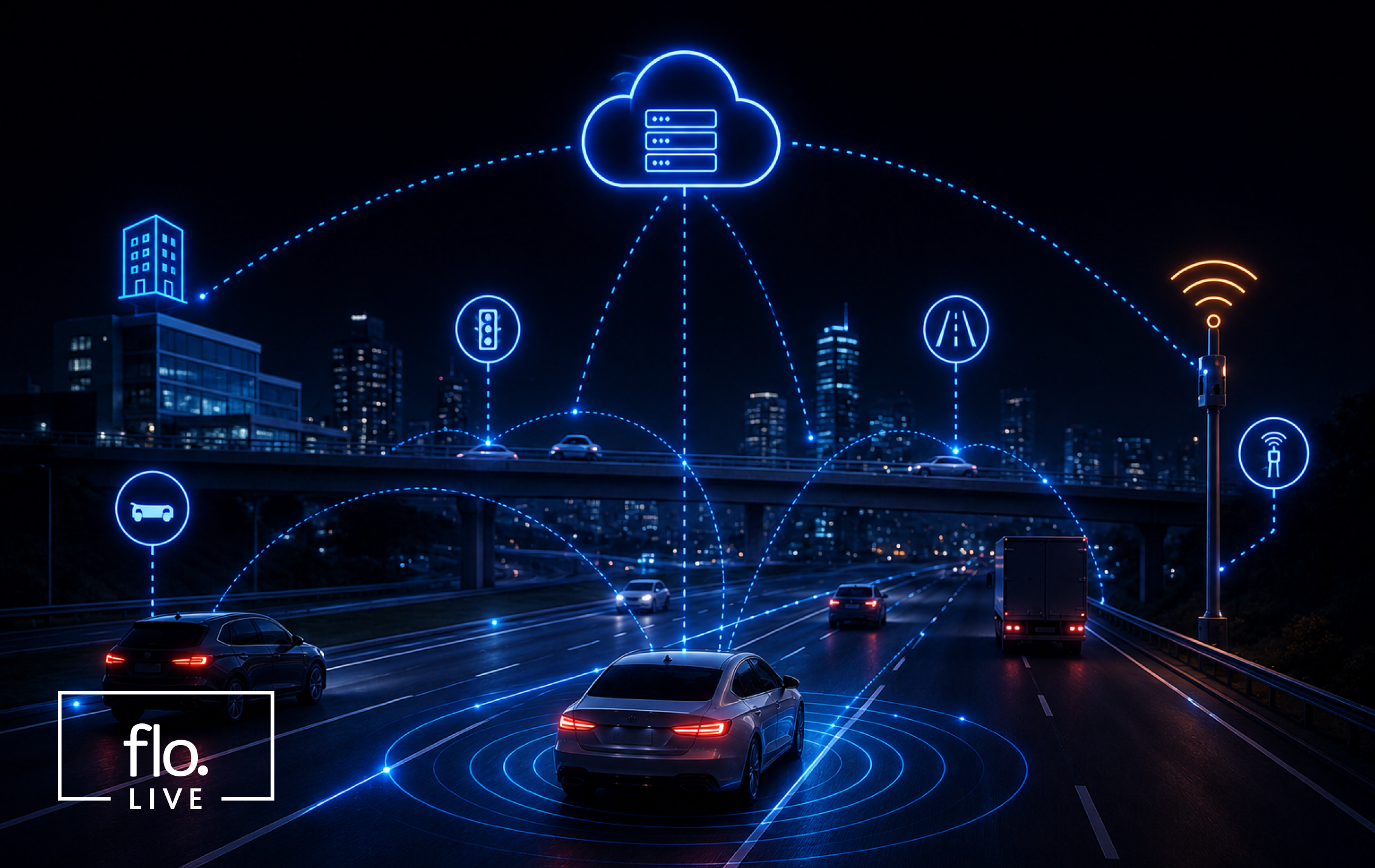
Connected vehicles (CVs) are vehicles equipped with internet access and hardware that allows them to communicate with the internet, other vehicles, and road infrastructure. This continuous data exchange drastically improves road safety, optimizes traffic flow, and provides real-time navigation and entertainment.
How they communicate:
Connected vehicles utilize wireless networks (like 5G, LTE, and Wi-Fi) to transmit data via three primary methods:
- V2V (Vehicle-to-Vehicle): Vehicles broadcast their speed and position to each other, triggering collision warnings for sudden braking, red-light runners, or blind spots.
- V2I (Vehicle-to-Infrastructure): Vehicles “talk” to smart road infrastructure, such as traffic lights and pedestrian crossings, to optimize route timing and avoid accidents.
- V2N (Vehicle-to-Network) & V2P (Vehicle-to-Pedestrian): Provides real-time internet-based services, including live traffic re-routing, weather updates, and smartphone app connectivity.
Privacy and security considerations:
Connected vehicles generate a continuous stream of telemetry, much of which qualifies as personal data, because it contains precise location, driving behavior, and in some cases voice or in-cabin recordings. That makes privacy and cybersecurity central design concerns rather than afterthoughts.
- What data connected vehicles collect: Location data, vehicle diagnostics, driving behavior, sensor readings, infotainment usage, and system performance information.
- Who uses connected vehicle data?: Automakers, fleet operators, insurers, navigation providers, service partners, and transportation authorities use the data to improve services, safety, and operations.
- Privacy risks for drivers: Continuous data collection can expose travel patterns, driving habits, and personal information if data is misused or compromised.
- How drivers can protect their data: Review privacy settings, limit data-sharing permissions, use strong account security, and keep vehicle software updated.
This is part of a series of articles about smart mobility.
Benefits of Connected Vehicles
Connected vehicles provide advantages for drivers, passengers, fleet operators, and transportation authorities:
- Improved road safety: Vehicles can receive alerts about accidents, hazardous road conditions, sudden braking events, and other risks, helping drivers react more quickly and avoid collisions.
- Real-time traffic management: Connected vehicles can share traffic data with navigation systems and traffic control centers, enabling route optimization and reducing congestion.
- Predictive maintenance: Vehicle systems can monitor component health and detect potential issues before they become serious failures, reducing downtime and repair costs.
- Remote vehicle monitoring: Owners and fleet managers can track vehicle status, location, fuel levels, battery health, and other operational data from remote applications.
- Over-the-air updates: Manufacturers can deploy software updates remotely, allowing vehicles to receive new features and security patches without visiting a service center.
- Enhanced driver experience: Connectivity supports services such as real-time navigation, infotainment, voice assistants, and personalized vehicle settings.
- Better fleet efficiency: Commercial operators can use connected vehicle data to optimize routes, monitor driver behavior, reduce fuel consumption, and improve asset utilization.
- Support for autonomous driving: Connected vehicles provide data that complement onboard sensors, helping advanced driver assistance systems and autonomous technologies make decisions.
- Reduced environmental impact: Improved route planning, traffic flow optimization, and efficient vehicle operation can lower fuel consumption and reduce emissions.
- Faster emergency response: In the event of a collision, connected systems can automatically notify emergency services and provide vehicle location and crash severity.
Related content: Explore how vehicle and IoT telematics are transforming fleet operations.
Connected Vehicles vs. Autonomous Vehicles
Connected vehicles and autonomous vehicles are related but distinct concepts.
Connected vehicles focus on communication, exchanging data with other vehicles, infrastructure, and networks to support safer, more efficient driving. They rely on connectivity to provide features like navigation, traffic updates, and remote diagnostics, but the driver is still responsible for operating the vehicle.
Autonomous vehicles are built to drive themselves with minimal or no human intervention. They use sensors, machine learning, and artificial intelligence to interpret their environment and make driving decisions. While many autonomous vehicles use connectivity for updates and coordination, their core function is self-driving.
How Connected Vehicles Work
In-Vehicle Sensors and Electronic Control Units
Connected vehicles rely on in-vehicle sensors and electronic control units (ECUs) to monitor and manage vehicle performance and safety. Sensors measure parameters like speed, acceleration, braking force, tire pressure, and environmental conditions. These sensors feed data to ECUs, which process the information to control systems such as anti-lock brakes, stability control, and adaptive cruise control.
The integration of sensors and ECUs enables real-time monitoring and automated responses to changing driving conditions. For example, ECUs can trigger safety interventions or send diagnostic alerts if a component is malfunctioning. By aggregating data from multiple sources, vehicles can optimize performance and provide information for remote diagnostics and predictive maintenance.
Connectivity Networks
Connectivity networks allow vehicles to exchange data with external systems. Most connected vehicles use cellular networks predominantly LTE, with 5G in newer platforms, for wide-area communication, while Wi-Fi and Bluetooth are used for local connections with mobile devices or nearby infrastructure.
C-V2X supports direct communication between vehicles and roadside units. It has effectively replaced the earlier DSRC standard: US regulators set a hard sunset for DSRC operations in the 5.9 GHz band, and new deployments in Europe and China are C-V2X based.
Connectivity supports real-time data exchange, such as sending hazard alerts or updating navigation routes. The choice of network technology affects the speed, reliability, and coverage of connected services. Automakers must ensure vehicles remain connected across regions and network providers, often requiring multi-network or roaming capabilities.
Cloud Platforms and Data Processing
Cloud platforms manage the data generated by connected vehicles. Data collected by in-vehicle sensors is transmitted to cloud servers for storage and analysis. Cloud-based analytics can identify patterns, predict maintenance needs, or optimize fleet operations by aggregating data from many vehicles.
Cloud platforms also enable automakers to deploy new features remotely, manage software updates, and deliver personalized content to drivers. Data privacy and security are critical considerations in the design of these systems.
Over-the-Air Updates
Over-the-air (OTA) updates allow automakers to deliver software patches, new features, and security fixes to connected vehicles. This removes the need for drivers to visit dealerships for routine updates and reduces downtime. OTA updates can address vulnerabilities quickly, helping vehicles remain secure.
Beyond security, OTA capabilities enable continuous improvement of vehicle functions, such as infotainment systems, navigation maps, and performance-related software. Automakers can roll out enhancements or address issues based on real-world usage data, keeping vehicles up to date and extending their useful life.
Types of Connected Vehicles Communicate
V2V (Vehicle-to-Vehicle)
Vehicle-to-vehicle (V2V) communication enables cars to exchange information such as speed, position, and heading directly with nearby vehicles. This low-latency exchange helps prevent collisions by warning drivers of imminent dangers, such as sudden braking or vehicles in blind spots. V2V relies on C-V2X, which operates in the licensed 5.9 GHz spectrum reserved for intelligent transportation systems, to support real-time data sharing without centralized infrastructure.
Why use it?
The primary benefit of V2V communication is enhanced road safety. By providing vehicles with broader situational awareness, it reduces reaction times and supports cooperative maneuvers, such as merging or lane changes.
V2I (Vehicle-to-Infrastructure)
Vehicle-to-infrastructure (V2I) communication connects vehicles with road infrastructure, such as traffic lights, signs, and toll booths. This enables vehicles to receive real-time updates on traffic conditions, signal timing, and road hazards. V2I can also support smoother traffic flow by informing vehicles of optimal speeds to catch green lights or avoid congestion.
Why use it?
V2I infrastructure supports intelligent transportation systems, improving safety and efficiency for road users. It also supports dynamic traffic management, emergency vehicle prioritization, and automated toll collection.
V2N (Vehicle-to-Network) and V2P (Vehicle-to-Pedestrian)
Vehicle-to-network (V2N) communication allows vehicles to connect with cloud services, traffic management centers, and data providers over cellular networks. Through V2N, vehicles access navigation, traffic updates, and remote diagnostics. V2N also supports infotainment services and OTA software updates.
Why use it?
V2N is what makes most commercial connected-vehicle services possible. Navigation, remote diagnostics, OTA updates, and fleet telematics all depend on a wide-area cellular link rather than direct vehicle-to-vehicle radio.
Vehicle-to-pedestrian (V2P) communication focuses on protecting vulnerable road users by enabling vehicles to detect and communicate with smartphones or wearable devices carried by pedestrians and cyclists.
V2P alerts drivers to potential collisions with pedestrians and cyclists, especially in urban environments with limited visibility where line of sight is obstructed.
Related content: Read our complete guide to vehicle-to-everything (V2X) communication.
Privacy Concerns in Connected Vehicles
1. What Data Connected Vehicles Collect
Connected vehicles gather data from multiple sources, including GPS location, speed, acceleration, and vehicle diagnostics. They may also collect driver behavior metrics, infotainment usage, voice commands, and sometimes in-cabin audio or video. This information is used to enhance safety, optimize performance, and deliver personalized services, but it raises concerns about scope and sensitivity.
The constant flow of information from sensors, cameras, and connected devices means that vehicles can track journeys, monitor driving habits, and record interactions with onboard systems. Automakers often anonymize data before analysis, but the volume and variety of data increase the risk of sensitive information being exposed or misused.
2. Who Uses Connected Vehicle Data?
Connected vehicle data is valuable to multiple stakeholders. Automakers use it to improve vehicle design, monitor performance, and develop new features or services. Third-party service providers, such as navigation, insurance, or fleet management companies, use this data to deliver products, track assets, or manage driver safety. Regulatory authorities may also access data for compliance, traffic management, or public safety initiatives.
In some cases, data is shared with advertisers or other commercial partners, raising questions about user consent and data monetization. Drivers should be informed about who can access their data and for what purposes.
3. Privacy Risks for Drivers
Connected vehicles generate and transmit data continuously. Detailed location histories can reveal where drivers live, work, shop, and travel, creating concerns about surveillance and unauthorized tracking. If this information is exposed, it could be used for stalking, profiling, or other malicious activities. Even anonymized datasets may sometimes be re-identified when combined with other information sources.
Data breaches are another risk. Cybercriminals may target automakers, service providers, or cloud platforms to access personal information stored within connected vehicle ecosystems. Unauthorized access to driving behavior data, account credentials, or vehicle systems can result in identity theft, financial fraud, or misuse of vehicle-related services.
4. How Drivers Can Protect Their Data
Drivers can reduce privacy risks by reviewing vehicle privacy settings and limiting data collection where possible. Many manufacturers allow users to control features such as location sharing and data-sharing permissions. Reading privacy policies and understanding what information is collected can help drivers decide which services to enable.
Keeping vehicle software updated is also important, as updates often include security improvements. Drivers should use strong passwords for connected accounts, enable multi-factor authentication when available, and review connected applications and permissions.
Best Practices for Connected Vehicle Connectivity
Here are some useful practices to consider when implementing a connected vehicle deployment.
1. Choose Connectivity That Can Scale Across Markets
Connected vehicle programs should use connectivity that works across regions, operators, and regulatory environments. A vehicle may be sold in one country, resold in another, or used in fleets that cross borders. The connectivity model must support these changes without hardware replacement. Scalability also depends on how connectivity contracts and service platforms are structured.
Key actions:
- Evaluate network availability, roaming support, carrier relationships, latency, and data costs early in the design process.
- Choose a scalable approach to reduce deployment complexity and support launching connected services across multiple markets with fewer regional variations.
- Plan for multi-operator support, regional compliance needs, and network sunsets; 2G and 3G have already been withdrawn in many markets, with LTE sunsets on the horizon in some.
2. Use eSIM and Remote Provisioning for Long-Term Flexibility
eSIM technology allows vehicles to switch mobile network profiles without replacing a physical SIM card. This is useful because vehicles remain in service for many years, while network contracts, coverage, and technology standards change. Remote provisioning lets automakers activate, update, or change connectivity profiles after the vehicle has been shipped. This supports global rollouts and helps maintain service continuity when network providers or commercial agreements change.
Key actions:
- Avoid installing different SIM cards for each region.
- Use a common hardware design and provision the appropriate network profile later.
- Enable remote carrier switching and profile updates throughout the vehicle lifecycle.
3. Build for Reliable Coverage, Not Just Connectivity
A connected vehicle should handle weak signals, network handoffs, tunnels, rural roads, and temporary outages. Critical functions should degrade safely and recover without driver intervention. Reliability depends on antenna design, modem performance, fallback networks, and retry logic. Vehicles should cache data when offline, prioritize safety-related messages, and reconnect automatically when coverage returns. Applications should account for intermittent connectivity. For example, diagnostic data can be stored locally and uploaded later, while navigation services can use cached maps when the network is unavailable.
Key actions:
- Test connectivity performance across urban, rural, and cross-border routes.
- Implement offline buffering and automatic reconnection capabilities.
- Use multi-network connectivity and fallback options where possible.
4. Optimize for Lifecycle Management
Connected vehicle connectivity must be managed across the full vehicle lifecycle, from manufacturing and activation to resale, repair, and end-of-life handling. Each stage requires control over subscriptions, network profiles, software versions, and user permissions. Lifecycle management includes monitoring connectivity performance, detecting failed devices, and updating configurations remotely.
Key actions:
- Implement remote monitoring, diagnostics, and software update capabilities.
- Design clear operational processes to reduce service costs and keep connected features working after the vehicle leaves the factory.
- Prepare for resale and ownership changes with processes for removing the previous owner’s data, transferring services, and resetting account access.
5. Secure Every Layer of the Connected Vehicle Ecosystem
Security should cover the vehicle, connectivity module, mobile network, cloud platform, APIs, and user applications. A weakness in any layer can expose vehicle data or create a path into critical systems. Security should be built into development and operations. This includes vulnerability testing, secure coding practices, incident response planning, and patch management processes. Connected vehicles operate for many years, so security controls must be maintained throughout the vehicle’s service life. Best practices include encryption, secure boot, certificate-based authentication, access controls, and regular software updates.
Key actions:
- Monitor for anomalies such as unusual data transfers, unauthorized access attempts, and unexpected device behavior.
- Limit data access by role, ensuring users and systems can only access the information required for their function.
- Separate infotainment, telematics, and safety-critical controls.
Enabling Reliable Connected Vehicle Connectivity with FLOLIVEⓇ
FLOLIVEⓇ modern cellular IoT connectivity and SIM management service, built from the ground up as a converged, cloud-native platform designed to optimize connected device performance globally. Because FloLive owns and runs its own technology, floNET stays affordable, agile, and globally uniform across any cellular network, helping connected vehicle programs launch and scale across markets without operator lock-in.
Key capabilities of floNET:
- Automatic multi-network switching: The Multi-IMSI SIM automatically switches a device to another carrier if one network is unavailable, keeping vehicles connected without operator lock-in.
- Low-latency architecture: Local packet gateways deployed in the regions where devices operate, co-hosted application servers, and efficient data exchange shorten the round trip to the core. Shorter signalling paths also reduce radio-on time, which lowers power draw for battery-constrained telematics units. lower latency, the factor proven to best extend battery life and device lifespan.
- Single unified billing: One highly flexible invoice covers all operators, currencies, plans, and structures, including elements beyond connectivity.
- Single API integration: Integrate once with Flolive’s REST API suite instead of integrating separately with multiple carriers, platforms, and protocols.
- Full cellular technology coverage: Flolive supports every cellular generation from 2G through 5G, including LPWA technologies such as NB-IoT and LTE-M, and satellite NTN for coverage beyond terrestrial networks.
Ready to keep your connected vehicles online across every market? Discover how floNET delivers seamless global cellular IoT connectivity.