


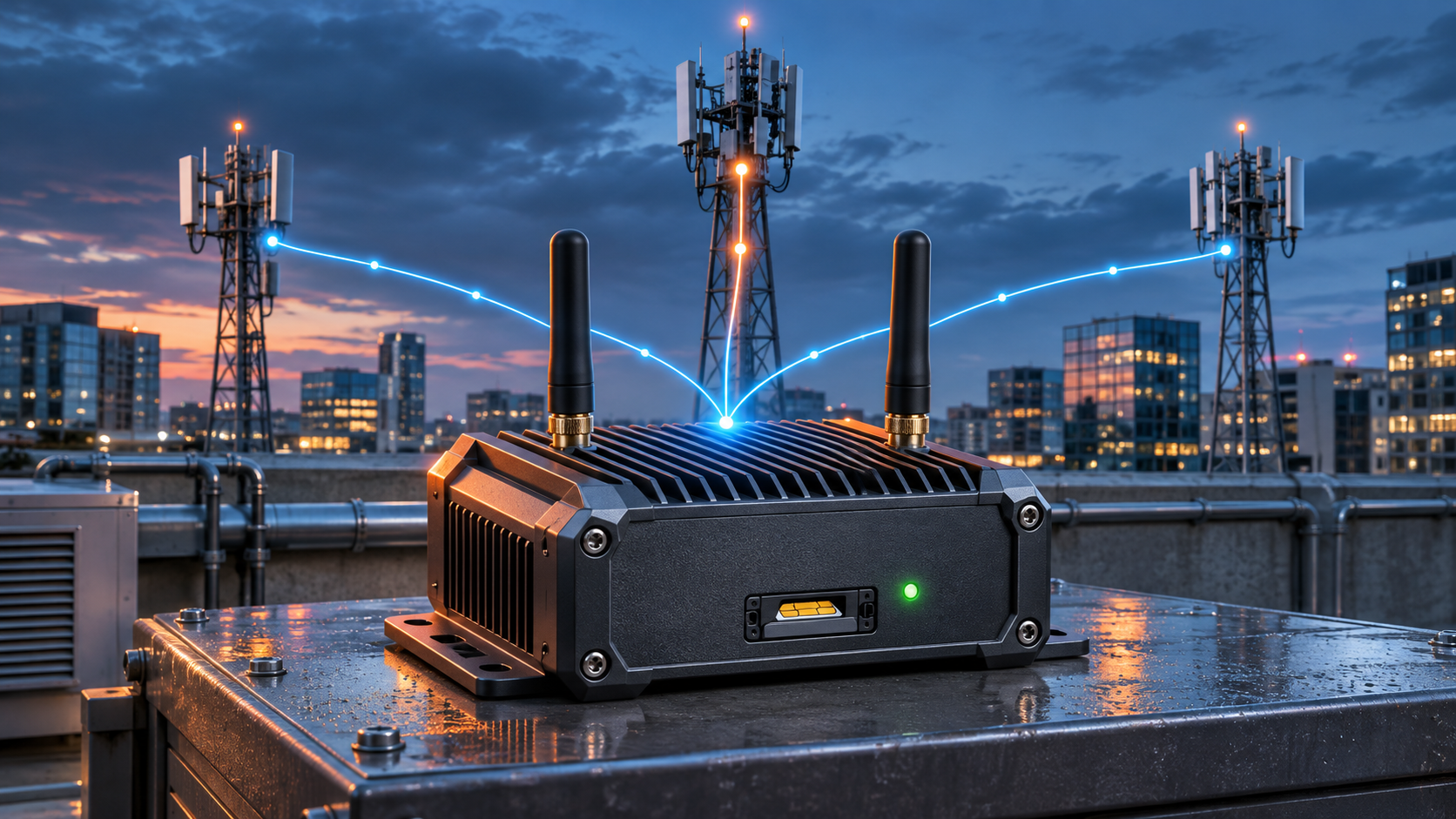
TL;DR: SIM providers with network redundancy give IoT devices access to multiple mobile operators through one SIM, using multi-IMSI, eUICC, or multi-core designs to switch networks when one fails. Best for rule-based multi-IMSI failover: Flolive; dual-core outage protection: Hologram; multi-IMSI eUICC: Eseye; developer-led fleets: Soracom.
What Are SIM Providers with Network Redundancy?
SIM providers with network redundancy (often called multi-network SIMs, multi-carrier SIMs, or eUICC/eSIM multi-profile solutions) allow a device or router to automatically or manually switch between different mobile network operators if the primary network drops or loses signal. This approach reduces dependence on individual carriers and helps maintain connectivity across different geographic locations.
These providers typically use multi-network SIMs, multi-IMSI technology, and eSIM or eUICC capabilities to support network redundancy. Unlike traditional single-carrier SIMs, multi-network solutions can provide access to multiple operators through one SIM. Some providers also offer non-steered connectivity, allowing devices to select an available network based on coverage and signal conditions rather than prioritizing a preferred carrier.
How network redundancy SIMs work:
- Connecting devices to multiple mobile network operators (MNOs): Multi-network SIMs allow devices to access several supported operators through roaming agreements, multi-IMSI technology, or eSIM profiles.
- Detecting network outages, signal loss, and connectivity degradation: Cellular modems monitor signal strength, network registration, and connection availability to identify connectivity failures. Additional health checks can detect degraded data connections.
- Automatically switching to an available backup network: When the current network becomes unavailable, the device scans for another eligible operator and attempts to establish a new cellular connection. Switching may briefly interrupt active data sessions.
SIM Providers with Network Redundancy at a Glance
The table below summarizes the key differences between the SIM providers covered in this article. We explore each provider in more detail in the next section.
| Category | Solution | Best For | Key Strengths | Things to Consider |
| Global Multi-IMSI and eUICC SIM Providers | Flolive Multi-IMSI SIM | Global IoT fleets needing local IMSIs and rule-based failover | In-house SIM applet, own mobile core, 40+ local breakouts | Pricing structure can take time to understand |
| Global Multi-IMSI and eUICC SIM Providers | Hologram Hyper SIM | Fleets needing eUICC profile swaps and dual-core failover | Two independent mobile cores, SGP.32 support, Conductor | Users report slow support at times and unclear Asia coverage |
| Global Multi-IMSI and eUICC SIM Providers | Eseye AnyNet+ Global IoT SIM | Enterprises needing multi-IMSI eUICC SIMs with managed services | Up to 10 bootstrap profiles, 800+ networks, Infinity CMP | Users describe the portal UI as dated and complex |
| Global Multi-IMSI and eUICC SIM Providers | Telit Cinterion NExT | OEMs combining Telit modules with multi-IMSI connectivity | Primary IMSI per country policy, IMSI sponsor outage support | Users report complex setup and documentation gaps |
| Global Multi-IMSI and eUICC SIM Providers | Soracom | Developer teams needing multicarrier SIMs with cloud networking | 500+ carriers, private gateways, remote diagnostics tools | Users report limited report filtering for large fleets |
| Multi-Network SIM Providers for Partner-Led and Regional Deployments | Velocity IoT | IoT fleets needing multi-IMSI SIMs with local breakout | 750+ networks, 40+ local gateways, pay only for active SIMs | Self-serve SIMs lack eUICC; advanced options need sales |
| Multi-Network SIM Providers for Partner-Led and Regional Deployments | Cobira SIM-as-a-Service | Product companies needing managed multi-network connectivity | Multi-IMSI profiles, second carrier profile, redundant backhaul | PoPs in select regions; second profile needs device support |
| Multi-Network SIM Providers for Partner-Led and Regional Deployments | Thingsdata | European B2B deployments needing multi-network IoT SIMs | 650+ networks, multi-IMSI, non-steered eSIM, multi-operator CMP | B2B only; coverage depends on chosen carrier subscription |
How SIM Network Redundancy Works
Connecting Devices to Multiple Mobile Network Operators (MNOs)
Multi-network SIM providers establish agreements with multiple MNOs, allowing a single SIM to authenticate and connect through different cellular networks. Instead of being restricted to one carrier, a device can access several supported operators within the same country or across international markets.
Multi-IMSI SIMs can store multiple subscriber identities, enabling devices to use different operator profiles when necessary. eSIM and eUICC technologies provide additional flexibility by supporting remote provisioning and management of network profiles. These capabilities help organizations deploy IoT devices across regions without physically replacing SIM cards whenever connectivity requirements change.
Detecting Network Outages, Signal Loss, and Connectivity Degradation
Cellular devices continuously monitor network conditions through their modems, including signal strength, network registration status, and connection availability. When the current network becomes unavailable or the device loses registration, the modem can initiate network selection procedures to identify another accessible operator.
However, network-level failover does not always detect application-level connectivity problems, such as packet loss, excessive latency, or failures in the data path. IoT connectivity platforms can supplement modem-level monitoring with diagnostics, connectivity status information, and alerts. Advanced deployments may also use application-level health checks to detect degraded connections and trigger recovery procedures.
Automatically Switching to an Available Backup Network
When a device loses connectivity to its current operator, a multi-network SIM can allow the modem to register with another permitted network. The modem typically scans for available networks, evaluates operator eligibility and radio conditions, and attempts to establish a new cellular data connection.
Non-steered multi-network connectivity can provide additional flexibility by avoiding commercial policies that consistently favor one operator over another. This can help devices connect to suitable available networks rather than repeatedly attempting to return to a preferred carrier.
Failover behavior depends on the modem, SIM configuration, supported networks, and connectivity provider. Switching can interrupt active sessions, and recovery times vary according to network scanning, registration, and reconnection procedures. Organizations should test failover under real operating conditions to verify that devices reconnect reliably and that critical applications recover after network changes.
Types of SIM Solutions for Network Redundancy
Single-IMSI Multi-Network Roaming SIMs
Single-IMSI multi-network roaming SIMs use one International Mobile Subscriber Identity (IMSI) to access multiple mobile networks through roaming agreements. A device can connect to different partner operators without changing its SIM or subscriber identity, provided those networks support the SIM’s roaming arrangement.
These SIMs offer a relatively straightforward way to introduce network redundancy, particularly for IoT deployments operating across multiple countries. However, connectivity depends on the provider’s roaming agreements, and network steering policies may prioritize certain operators over others. Permanent roaming restrictions in some markets can also limit their suitability for long-term deployments.
Multi-IMSI SIMs with Multiple Operator Profiles
Multi-IMSI SIMs contain multiple subscriber identities that allow devices to authenticate through different mobile network operators or connectivity partners. When one identity cannot establish a suitable connection, the SIM can switch to another IMSI according to:
- Predefined rules
- Supported network conditions
- Provider configurations
This approach provides greater flexibility for global IoT deployments by reducing dependence on a single operator relationship or roaming arrangement. Multi-IMSI technology can support network redundancy, local connectivity, and automated recovery, particularly when combined with non-steered network access. However, switching between IMSIs and mobile networks may require re-registration, temporarily interrupting data sessions.
eSIM and eUICC Solutions with Remote Profile Management
eSIM and eUICC solutions enable devices to store and manage multiple cellular connectivity profiles on an embedded or removable SIM. Using remote SIM provisioning, organizations can download, activate, or replace operator profiles without physically accessing deployed equipment.
These capabilities are especially useful for large IoT deployments spanning multiple countries, where coverage requirements, operator agreements, and regulatory conditions may change. Organizations can provision alternative operator profiles to improve connectivity resilience or migrate devices to new providers. However, remote profile management does not automatically guarantee real-time network failover. Automatic switching requires compatible device capabilities, appropriate configurations, and supported profile management mechanisms.
Local Connectivity SIMs with Multi-Network Access
Local connectivity SIMs enable IoT devices to connect through mobile networks using locally authorized subscriber identities rather than depending exclusively on international roaming. Some solutions combine local IMSI profiles with agreements covering multiple operators within the same country, providing redundancy while supporting local connectivity requirements.
This approach can help organizations:
- Address permanent roaming restrictions
- Reduce reliance on foreign roaming relationships
- Improve connectivity resilience in regulated markets
Providers offering both local connectivity and multi-network access can support consistent IoT operations across regions, although the availability of local operator alternatives depends on country-specific agreements and regulations.
Common Use Cases for SIM Network Redundancy
Connected Vehicles and Fleet Telematics
Connected vehicles and fleet telematics systems rely on cellular connectivity to transmit GPS coordinates, vehicle diagnostics, driver behavior data, and operational alerts. As vehicles travel between cities, regions, and countries, coverage quality can vary significantly between mobile network operators. A single-network SIM may lose connectivity when a vehicle enters an area with limited coverage from its assigned carrier.
Multi-network SIMs help maintain connectivity by allowing telematics devices to connect to alternative operators when their current network becomes unavailable. Multi-IMSI and eSIM technologies can also support cross-border connectivity and local network access, reducing dependence on individual roaming agreements. This improves the reliability of fleet tracking, remote diagnostics, and vehicle monitoring.
Smart Utilities and Remote Infrastructure Monitoring
Smart meters, energy distribution equipment, water management systems, and remote industrial sensors frequently operate in locations with inconsistent cellular coverage. These devices transmit operational data, equipment status updates, and alerts that utilities use to monitor infrastructure performance and identify potential failures.
SIM network redundancy allows utility devices to access alternative cellular networks when their primary connection fails. This is particularly important for remote installations where technicians cannot easily replace SIM cards or troubleshoot connectivity problems on-site. Multi-network connectivity helps maintain telemetry collection, remote monitoring, and communication with infrastructure management platforms.
Healthcare and Remote Patient Monitoring
Remote patient monitoring devices, connected medical equipment, and mobile healthcare systems depend on cellular networks to transmit health measurements, device status information, and notifications to healthcare platforms. Connectivity interruptions can delay data delivery, disrupt remote monitoring workflows, and reduce visibility into patient or equipment conditions.
Multi-network SIMs improve connectivity resilience by enabling supported medical devices to reconnect through alternative operators when their current network becomes unavailable. This is especially useful for home-based monitoring, mobile healthcare equipment, and devices deployed across areas with different carrier coverage. However, network redundancy should complement local data buffering, secure transmission, and other safeguards rather than serve as the sole mechanism for maintaining critical healthcare operations.
Robotics and Autonomous Mobile Devices
Autonomous mobile robots, delivery robots, inspection drones, and industrial robotic systems use cellular connectivity to exchange telemetry, receive operational instructions, transmit sensor data, and support remote supervision. Devices that move between facilities or operate outdoors may encounter:
- Changing network conditions
- Coverage gaps
- Temporary connectivity failures
SIM network redundancy enables robotic systems to connect through alternative mobile operators when the current connection becomes unreliable or unavailable. Combined with 4G and 5G connectivity, multi-network access can help maintain communication for remote monitoring, fleet coordination, and video transmission. For safety-critical robotic operations, local autonomy and fail-safe mechanisms remain essential, since switching networks can temporarily interrupt active connections.
Retail POS Systems and Payment Terminals
Retail point-of-sale (POS) systems, mobile payment terminals, kiosks, and vending machines rely on network connectivity to process transactions, communicate with payment gateways, and synchronize operational data. When a primary cellular network becomes unavailable, payment interruptions can:
- Delay transactions
- Affect customer experiences
- Reduce sales opportunities
Multi-network SIMs provide an additional layer of connectivity resilience by allowing payment devices to switch to another supported mobile operator. This is particularly valuable for mobile retailers, temporary event locations, and unattended payment terminals where fixed-line connectivity may be unavailable. Businesses can also combine multi-network cellular connectivity with wired or Wi-Fi connections to create more comprehensive communication redundancy.
Notable SIM Providers with Network Redundancy
How we selected these providers: We shortlisted SIM providers with network redundancy based on multi-network access per country, multi-IMSI and eUICC switching, automatic failover behavior, local IMSI and breakout options, and connectivity management capabilities.
Global Multi-IMSI and eUICC SIM Providers
1. Flolive

Best for: Global IoT fleets needing local IMSIs and rule-based failover
Strengths: In-house SIM applet, own mobile core, 40+ local breakouts
Things to consider: Pricing structure can take time to understand
Flolive provides a multi-IMSI SIM that stores several International Mobile Subscriber Identities, each tied to a different mobile network operator, and switches between them over the air. The SIM operates across 600+ mobile networks in 190+ countries, with 15+ carrier partners and 40+ local breakout locations that keep traffic in-region.
Switching runs in a SIM applet built and maintained by Flolive, against Flolive’s own cloud-native mobile core and connectivity management platform. Profile changes follow rules the customer sets, such as signal loss, geo-fence crossing, roaming duration, or cost, and the SIM can fall back to another IMSI if an operator fails or blocks traffic.
Key features include:
- Rule-based IMSI switching: The applet changes IMSI on signal loss, geo-fence crossing, roaming limits, or a policy trigger, without a device reboot or custom device firmware.
- IMSI redundancy against outages and bans: If the serving operator fails or bans the traffic, the SIM falls back to another IMSI on the same card instead of dropping off the network.
- Local IMSIs for permanent roaming markets: Devices attach as local subscribers in markets that restrict permanent roaming, including Brazil, China, Turkey, Canada, and South Africa.
- Multi-IMSI over eUICC and SGP.32: Multiple IMSIs and remote SIM provisioning run together on the same card, combining profile flexibility with IMSI diversity for fallback.
- Integrated core and local breakout: A cloud-native mobile core and packet gateway, with 40+ local breakout locations, keep data in-region and provide per-session visibility.
- Real-time rules engine and central control: SIMs, IMSIs, profiles, and data plans are managed through a dashboard or API, and switching logic for failover, compliance, and cost can be changed without touching the device.
- Form factors and optional satellite fallback: The SIM ships in 2FF, 3FF, 4FF, MFF2, iSIM, and softSIM formats, with optional satellite connectivity where no terrestrial network reaches.
Limitations (as reported by users on G2):
- Pricing structure: Some users find the pricing structure complex at first, while noting that the team helps tailor the service to their needs.
- New technology rollouts: Some users report that implementing newer or more complex technologies can take more than one iteration to get right.
2. Hologram Hyper SIM

Best for: Fleets needing eUICC profile swaps and dual-core failover
Strengths: Two independent mobile cores, SGP.32 support, Conductor
Things to consider: Users report slow support at times and unclear Asia coverage
Hologram provides Hyper SIMs, eUICC IoT SIM cards that connect to 550+ carrier networks across 190+ countries and territories. Each SIM attaches to an available network where the device operates and supports 2G through 5G, LTE-M, and NB-IoT. Carrier profiles can be changed over the air without replacing the SIM or visiting the site.
For redundancy beyond carrier switching, Hologram offers Outage Protection, which backs multi-core Hyper SIMs with two independent mobile cores, each with its own profile. When one path to the network is unavailable, the SIM switches to the other core automatically. Conductor, Hologram’s orchestration software, automates profile lifecycle tasks and failover rules.
Key features include:
- Multi-carrier access: One SIM reaches 550+ carrier networks in 190+ countries and territories without a separate carrier contract in each country.
- Outage Protection with two mobile cores: Multi-core Hyper SIMs hold two independent mobile cores and fail over to the second core automatically when the primary core is unavailable, with configurable fallback timing.
- Remote carrier profile swaps: Carrier profiles can be changed over the air, so one hardware version can ship to every market and change carriers later.
- Conductor orchestration: Conductor automates profile lifecycle management, defines failover rules, and audits every profile change across SGP.02, SGP.22, and SGP.32 fleets.
- SGP.02 and SGP.32 SIM options: Hyper SIMs come in triple-cut and MFF2 embedded formats, with industrial-grade operation from -40°C to +105°C.
- Usage controls and security: Per-device data limits and usage alerts are available, and every Hyper SIM includes private APN, fraud detection, and device locking.
Limitations (as reported by users on G2):
- Support response times: Some users report slow customer service at times and frustration with automated email replies when trying to reach a person.
- Coverage clarity: Some users find it difficult to understand the extent of coverage in certain regions, particularly Asia.
- Latency: Some users report latency that affects systems relying on fast data transfer and would like servers closer to their deployments.
- Commercial terms: Some users mention concerns about an annual commitment model and would prefer invoicing over mandatory credit card payment.
3. Eseye AnyNet+ Global IoT SIM

Best for: Enterprises needing multi-IMSI eUICC SIMs with managed services
Strengths: Up to 10 bootstrap profiles, 800+ networks, Infinity CMP
Things to consider: Users describe the portal UI as dated and complex
Eseye provides the AnyNet+ Global IoT SIM, a multi-IMSI eUICC SIM that switches between networks across 800+ networks in 190+ countries. The SIM holds up to 10 bootstrap profiles and can receive new profiles or IMSIs over the air after deployment.
The SIM supports LTE/4G/3G/2G and NB-IoT, is 5G ready, and ships in 2FF, 3FF, 4FF, MFF2, and iSIM formats. It is managed through the Infinity IoT Connectivity Platform, which handles SIM lifecycle management, usage and session monitoring, and network switching. Eseye combines eUICC localization with roaming to address local regulations and permanent roaming limits.
Key features include:
- Multi-IMSI with eUICC: Up to 10 bootstrap profiles on one SIM, combined with eUICC, allow the SIM to switch to another network when the current one is unavailable.
- Over-the-air profile updates: New profiles and IMSIs can be loaded over the air, so deployed devices gain access to new operator partners.
- eSIM localization: Local home operator profiles can be combined with roaming to meet local regulations, reduce latency, and avoid permanent roaming restrictions.
- SGP.32 support and AnyNet Select: Eseye supports SGP.02, SGP.22, and SGP.32 within one orchestration framework, and AnyNet Select offers SGP.32 multi-IMSI, local, and regional profiles managed through one APN and one API.
- Infinity IoT Connectivity Platform: The platform provides SIM lifecycle management, data usage and RADIUS session monitoring, connectivity management, and a suite of APIs.
- Private virtual mobile network: Device traffic runs over Eseye’s private virtual mobile network, with secure network access and data encryption.
Limitations (as reported by users on G2):
- Portal interface: Several users describe the management portal interface as dated and in need of a refresh.
- Navigation complexity: Some users find the interface complex and difficult to navigate.
- Service incidents: Some users report a server issue that caused data traffic loss for several days.
- Support responsiveness: Some users note that customer support responsiveness and effectiveness could improve.
4. Telit Cinterion NExT

Best for: OEMs combining Telit modules with multi-IMSI connectivity
Strengths: Primary IMSI per country policy, IMSI sponsor outage support
Things to consider: Users report complex setup and documentation gaps
Telit Cinterion provides IoT connectivity through NExT, a global IoT network and mobile core with NExT SIM and eSIM solutions covering 600+ carriers in 200+ countries. NExT supports cellular 2G to 5G, LTE-M, and NB-IoT, and deployments are managed through one connectivity dashboard, one contract, and one bill.
The NExT multi-IMSI policy assigns a primary IMSI per country based on coverage, service quality, and cost, and supports IMSI switching during MNO or IMSI sponsor outages. Telit Cinterion also offers eUICC provisioning, and embedded eSIM and iSIM connectivity in its cellular modules.
Key features include:
- Multi-IMSI SIM with policy control: Several IMSI profiles sit on a single SIM, with a primary IMSI per country selected by coverage, service quality, and cost.
- Outage and IMSI failure support: For mission-critical applications, the SIM works with other IMSIs if an IMSI operation fails, with support for MNO and IMSI sponsor outages.
- Access to more operators per country: Multi-IMSI provides access to multiple operators in countries where a single IMSI donor supports only a subset of networks.
- eUICC and eSIM provisioning: NExT eSIM provisioning supports over-the-air profile switching and localization to address permanent roaming restrictions.
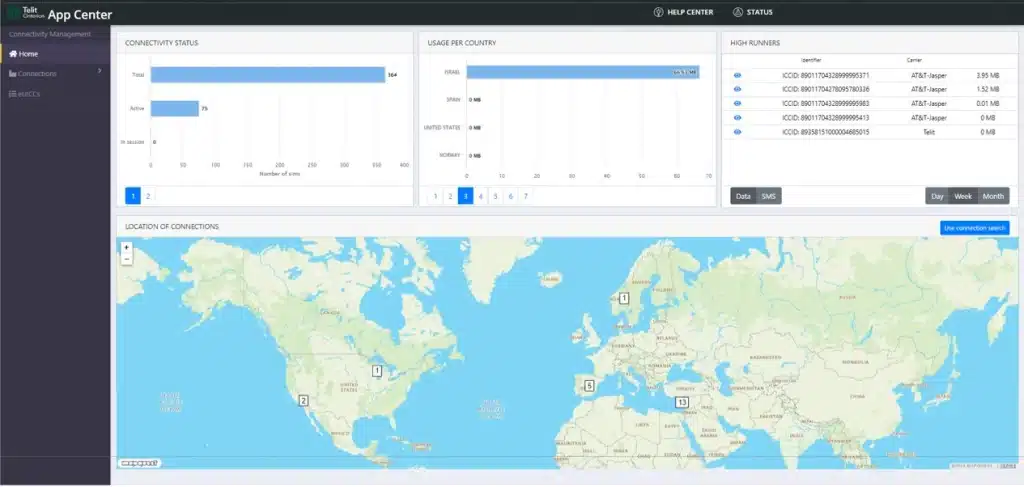
- NExT Connectivity Management Platform: An AI-powered platform monitors performance in real time, manages SIMs across carriers and regions, and supports triggers and alarms.
- Embedded connectivity in modules: eSIM and iSIM technology is available inside Telit Cinterion cellular IoT modules, with NExT connectivity sold as a subscription.
- Network security: VPN and private APN options are available, with network-based security rules and alerts that trigger automated actions.
Limitations (as reported by users on Gartner Peer Insights):
- Initial setup: Some users describe the initial setup as complex.
- Documentation: Some users report gaps in the available documentation.
- Expertise required: Some users note that specialized expertise is sometimes needed to work with the service.
- Dashboard features: Some users find the dashboard features limited.
5. Soracom

Best for: Developer teams needing multicarrier SIMs with cloud networking
Strengths: 500+ carriers, private gateways, remote diagnostics tools
Things to consider: Users report limited report filtering for large fleets
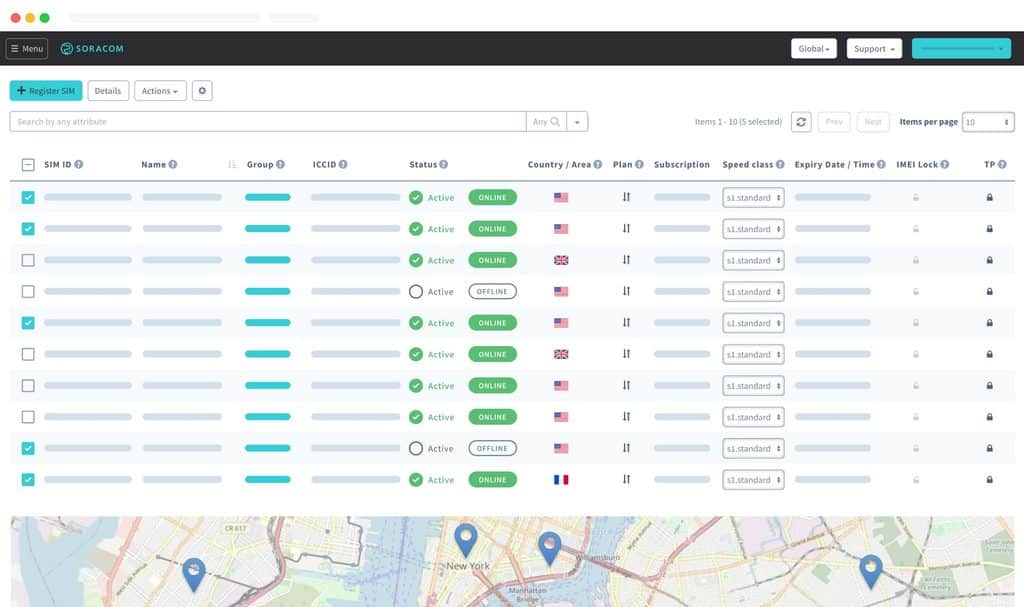
Soracom provides a global IoT SIM and eSIM that connect devices to 500+ carriers across 200 countries and territories through a multi-carrier MVNO model. Soracom SIMs connect to multiple carriers within a country, switching networks for coverage, and plan-US gives access to all major US carriers plus regional partners from one SIM.
Connectivity runs on a cloud-native core hosted across AWS regions. Each SIM includes an embedded OS linked to the Soracom platform, which provides remote packet capture, remote device access, IMEI lock, and virtual private gateways that move SIMs into private networks through software.
Key features include:
- Multicarrier coverage on one SIM: One SIM or eSIM connects to 500+ carriers across 200 countries and territories without hardware swaps or separate accounts.
- US multicarrier option: plan-US provides access to nationwide US carriers and regional partners, and Soracom solution architects help customers implement carrier switching strategies.
- Over-the-air profiles and SGP.32: Carrier profiles can be updated over the air, with eUICC and SGP.32 options and a Connectivity Hypervisor for remote orchestration of multicarrier SIMs.
- Private networking: Virtual Private Gateway, VPC peering, fixed private IP addresses, and endpoint allowlisting keep device traffic off the public internet.
- Remote diagnostics: Peek captures live packet data, and Napter opens encrypted, time-limited access to field devices without static IPs or a VPN.
- SIM lifecycle management and automation: The User Console and API activate, suspend, and monitor SIMs, and Event Handler triggers alerts or suspends SIMs when usage or status changes.
- Form factors: Options include a 3-in-1 SIM, an industrial SIM rated from -40°C to +105°C, an MFF2 eSIM, and iSIM modules.
Limitations (as reported by users on Gartner Peer Insights):
- Report exports: Some users note that filtered reports cannot be downloaded, only the full database, which complicates managing accounts with many lines.
- Order tracking: Some users report that dispatch times are not shown when hardware is ordered together with SIM cards.
- 5G availability: Some users would like 5G coverage in more areas, noting that availability depends on regional infrastructure.
Multi-Network SIM Providers for Partner-Led and Regional Deployments
6. Velocity IoT

Best for: IoT fleets needing multi-IMSI SIMs with local breakout
Strengths: 750+ networks, 40+ local gateways, pay only for active SIMs
Things to consider: Self-serve SIMs lack eUICC; advanced options need sales
Velocity IoT provides multi-IMSI SIMs that give devices access to 750+ carrier networks in 190+ countries, including 15 direct carrier integrations. The SIMs switch networks automatically if the current network fails and support 2G to 5G, LTE-M, and NB-IoT in plastic, MFF2, iSIM, and SoftSIM form factors.
Connectivity runs on a globally distributed core network with local breakout through packet gateways in 40+ locations. An eSIM hybrid option combines multi-IMSI with SGP.32 remote profile provisioning. Customers can start on the self-serve Velocity Flex platform or use enterprise features for large and multi-tenant fleets.
Key features include:
- Automatic network switching: Multi-IMSI SIMs switch to another carrier network without manual intervention when the current network fails.
- Local IMSI profiles: Local IMSIs address permanent roaming restrictions, and regional infrastructure processes data locally to support data sovereignty requirements.
- Local breakout: A distributed core with local packet gateways in 40+ locations routes traffic regionally rather than through traditional roaming paths.
- Multi-IMSI and eSIM hybrid: An eSIM hybrid option adds SGP.32 remote profile provisioning to multi-IMSI switching, with OTA updates for remote SIM management.
- Multi-carrier dashboard and APIs: SIM status, data usage, location, and network performance across carriers appear in one dashboard, with APIs for integration and workflow automation.
- Satellite connectivity: Hybrid satellite and cellular connectivity is available for deployments that need coverage beyond cellular networks.
- Active-SIM billing: SIMs with no network activity generate no charges, with no suspension fees or minimum usage requirements.
Limitations (based on publicly available sources):
- eUICC on self-serve SIMs: SIMs sold through DigiKey run a multi-IMSI applet on a standard UICC, and eUICC and satellite options require contacting Velocity IoT directly.
- Satellite device requirements: Hybrid satellite and cellular coverage works only with Release 17 compatible devices.
- Direct carrier integrations: Direct carrier integrations cover 15 carriers, a small share of the 750+ networks the SIMs can access.
7. Cobira SIM-as-a-Service

Best for: Product companies needing managed multi-network connectivity
Strengths: Multi-IMSI profiles, second carrier profile, redundant backhaul
Things to consider: PoPs in select regions; second profile needs device support
Cobira provides SIM-as-a-Service, a managed global IoT connectivity service that combines SIM and eSIM connectivity, network access, management, and support under one contract. The service covers 190+ countries with 6,500+ connectivity and roaming agreements and 25+ global and local IMSI options.
Redundancy is built into several layers. Devices can use multiple networks per country, a second profile from an independent global carrier can be added on supported devices, and traffic runs through regional points of presence using two IPX providers and a secondary data centre. SIMs are managed through the Cobira connectivity management platform and REST APIs.
Key features include:
- Multiple networks per country: Devices can use multiple available networks in each country, with the option to block specific operators for commercial, regulatory, or performance reasons.
- Multiple operator profiles on one SIM: Multi-IMSI profiles apply device-based rules by country or region, and profile priorities can be updated over the air without a SIM swap or site visit.
- Independent carrier profile: A second profile from an independent global carrier can be added on supported devices to create an additional connectivity path.
- Redundant backhaul: Traffic routes through regional points of presence in Europe, the US, LATAM, and APAC, using two IPX providers and a secondary data centre.
- eSIM under SGP.32: Remote SIM provisioning uses SM-DP+ and eIM under SGP.32, with OTA and remote file management campaigns, and devices can start on a standard profile and add operator profiles later.
- Connectivity diagnostics and automation: Connection health, data usage, and session activity are visible per device, with alert rules and webhooks for exceptions.
- Private networking: Private and closed APNs, static IP plans, the Cobira VPN Hub, and device-level controls such as IMEI lock keep traffic on controlled paths.
Limitations (based on publicly available sources):
- Regional points of presence: Points of presence are located in Europe, the US, LATAM, and APAC, so deployments elsewhere route through these regions.
- Device support for a second carrier profile: The independent carrier profile is available only on supported devices.
- Variable pricing: Pricing combines a platform fee with actual mobile network data costs, so total cost depends on network mix and usage rather than a flat published rate.
8. Thingsdata

Best for: European B2B deployments needing multi-network IoT SIMs
Strengths: 650+ networks, multi-IMSI, non-steered eSIM, multi-operator CMP
Things to consider: B2B only; coverage depends on chosen carrier subscription
Thingsdata is a Netherlands-based IoT connectivity provider that offers multi-network IoT SIM cards with access to 650+ networks in 190 countries. Its M2M SIM cards roam on the strongest available network in each country, including multiple networks per country across the EU, and the portfolio covers 2G to 5G, LTE-M, NB-IoT, and NTN satellite connectivity.
Thingsdata uses multi-IMSI technology that lets devices switch automatically between IMSIs, and offers a non-steered eSIM (eUICC). Customers choose from subscriptions based on different carriers, such as KPN IoT, Tele2 IoT, and Blue IoT, and manage SIMs, routers, and gateways from different operators in the Thingsdata Control platform.
Key features include:
- Multi-network SIM cards: M2M SIM cards roam over different networks per country throughout the EU, with coverage in 190 countries across 650+ networks.
- Multi-IMSI switching: One SIM card holds multiple IMSIs, and devices switch between them automatically.
- Non-steered eSIM: The eSIM (eUICC) connects devices to the strongest available network without steering, and more than 100K eSIM profiles have been deployed over the air.
- Choice of carrier subscriptions: Subscriptions based on KPN IoT, Tele2 IoT, and Blue IoT cover EU or worldwide deployments, with pooled data bundles, pay-as-you-go, and prepaid options.
- Thingsdata Control: One platform manages SIM cards, routers, and gateways from different operators, with inventory management, real-time insight, and lifecycle management.
- Form factors and network options: 2FF, 3FF, and 4FF SIMs, MFF2 industrial SIMs, QR code eSIMs, and activation code SIMs are available, with optional private APN and fixed IP addresses.
Limitations (based on publicly available sources):
- Business customers only: Thingsdata supplies exclusively to business customers.
- Carrier-dependent coverage: Coverage, data rates, and network options vary by the underlying carrier subscription, such as EU-only versus worldwide plans.
- Reseller model: Thingsdata operates as a value-add reseller, so network services depend on the underlying operators and partner platforms.
Conclusion
SIM providers with network redundancy help organizations maintain IoT connectivity by enabling devices to access alternative mobile networks when their primary connection fails. Multi-network roaming, multi-IMSI technology, and eSIM provisioning offer different levels of flexibility for managing connectivity across operators and countries. Automatic failover and non-steered network selection can improve resilience, while local connectivity profiles help address permanent roaming restrictions. However, network redundancy does not guarantee uninterrupted service, as switching may temporarily disrupt active connections.