


What Are IoT Protocols?
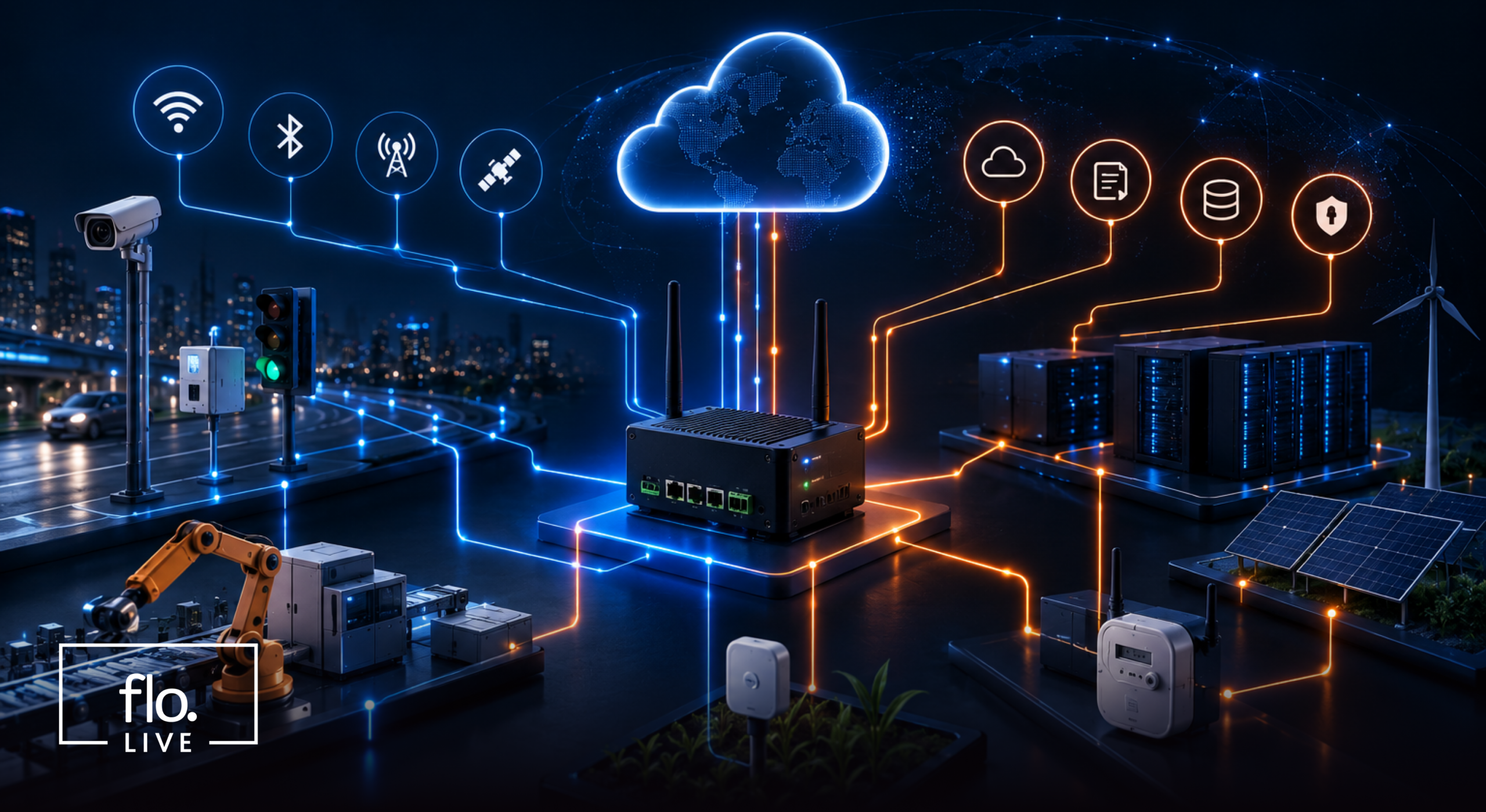
IoT protocols are communication standards that govern how connected devices exchange data with each other and the cloud. They fall into four groups by function: network and connectivity protocols carry data between devices, gateways and the internet; application-layer protocols define how that data is structured and exchanged; industrial protocols handle deterministic machine-to-machine communication on the factory floor; and security protocols protect all of the above in transit.
Network / connectivity protocols:
- Wi-Fi / Ethernet: Delivers high bandwidth and high data throughput, but consumes significant power. Wired Ethernet offers the same throughput without the power penalty where cabling is available.
- Bluetooth Low Energy (BLE): Excellent for short-range device-to-device or device-to-gateway communication (e.g., wearables) with ultra-low power consumption.
- ZigBee and Z-Wave: Mesh networking protocols commonly used in smart homes and building automation, allowing devices to pass signals to one another to increase range.
- LoRaWAN: A long-range, low-power wide-area network (LPWAN) protocol designed to connect battery-operated sensors over vast distances (miles) with minimal data payloads.
- Cellular (LTE-M, NB-IoT): Operates on traditional cellular networks, offering excellent coverage, deep indoor penetration, and high security over massive scales.
- Thread: IPv6-based mesh networking protocol designed for low-power smart home and building devices, providing reliable, self-healing connectivity and native IP support.
Application / data protocols:
- MQTT (Message Queuing Telemetry Transport): A lightweight, publish-subscribe protocol suitable for low-bandwidth, high-latency environments. It is the industry standard for telemetry and battery-operated sensors.
- CoAP (Constrained Application Protocol): A specialized web transfer protocol for resource-constrained devices. It uses UDP and is the standard for machine-to-machine (M2M) applications.
- HTTP/REST: Standard request/response protocol used for general web APIs and reporting. It requires more power, making it better for mains-powered hubs than tiny, remote sensors.
- AMQP (Advanced Message Queuing Protocol): A highly secure and robust queuing protocol that ensures guaranteed message delivery and complex routing, often used in enterprise and industrial IoT.
- DDS, WebSocket, and XMPP: Specialized protocols for real-time communication, distributed systems, and device messaging where low latency, persistent connections, or advanced routing capabilities are required.
This is part of a series of articles about IoT networking
Why IoT Protocols Are Important
IoT protocols ensure that connected devices can communicate efficiently, securely, and reliably. They address challenges in IoT environments, where devices often operate with limited power, bandwidth, and processing resources:
- Enable device interoperability: Allow devices from different vendors and platforms to communicate using common standards.
- Support efficient data transmission: Optimize communication for low-bandwidth networks and small data packets.
- Reduce power consumption: Minimize communication activity to extend battery life.
- Improve scalability: Support adding new devices without redesigning the system.
- Enhance security: Include encryption, authentication, and secure data transport.
- Ensure reliable communication: Define mechanisms for message delivery, acknowledgments, and error handling.
- Support real-time operations: Enable low-latency communication for time-sensitive applications.
- Simplify integration with cloud services: Provide standardized ways to connect devices with cloud platforms.
- Optimize network resource usage: Reduce network congestion and improve system performance.
- Enable diverse IoT applications: Support use cases such as smart homes, healthcare, agriculture, and manufacturing.
How IoT Protocols Work in an IoT Architecture
Device Layer
The device layer consists of sensors, actuators, and embedded systems that collect and generate data. Protocols at this layer focus on low-power and wireless communication, as many IoT devices operate with limited resources. These protocols ensure that raw data, such as temperature readings or motion detection, are formatted and transmitted to higher layers in the architecture. Device layer protocols also handle device discovery, identification, and initial handshake processes needed to integrate new devices into a network.
Network Layer
The network layer manages the transmission of data from devices to gateways or cloud services. Protocols at this layer handle routing, addressing, and packet management across local and wide-area networks. They are designed to optimize bandwidth usage and reduce latency for applications requiring real-time or near-real-time data. Network layer protocols address challenges such as intermittent connectivity, mobile devices, and varying signal strengths. They may include error correction and retransmission mechanisms.
Gateway Layer
The gateway layer bridges resource-constrained devices and network infrastructure or cloud services. Gateways aggregate and preprocess data before forwarding it, reducing load on upstream networks and cloud resources. Protocols at this layer support data translation and protocol conversion, allowing devices with different communication standards to interact. Gateways also enforce authentication, encryption, and access control policies. They can filter unnecessary or malicious traffic before it reaches backend systems.
Application Layer
The application layer is where IoT data is processed and integrated into user applications or business systems. Protocols at this layer define how data is packaged, requested, and delivered to applications. They enable dashboards, automation systems, and analytics platforms to consume IoT data. These protocols support communication across platforms and devices and may include mechanisms for device management, remote configuration, and firmware updates. Standardized communication at this layer supports IoT solution development across industries.
Security Layer
The security layer includes protocols and mechanisms that protect IoT systems from unauthorized access, data breaches, and device tampering. Security protocols operate across all layers, implementing encryption, authentication, integrity checks, and key management. This layer must account for device constraints such as limited processing power and memory. Security protocols are optimized for lightweight operation while maintaining protection. Effective security helps ensure data confidentiality and device authenticity.
Key Types of IoT Protocols
Network and Connectivity Protocols
These protocols establish how devices connect to a local network, a gateway, or the broader internet.
1. Wi-Fi
Wi-Fi is a widely adopted protocol for wireless local area network (WLAN) communication, enabling high-speed data transmission between IoT devices and the internet. It operates on the IEEE 802.11 standard and supports applications such as:
- Smart home devices
- Cameras
- Industrial sensors
Wi-Fi is often used where power is readily available and data throughput is a priority. Wi-Fi consumes more power than many other IoT connectivity options, making it less suitable for battery-powered devices with long lifespans. Its reliance on network infrastructure can also pose challenges in environments with limited coverage or interference.
2. Bluetooth Low Energy
Bluetooth Low Energy (BLE) is a wireless protocol for short-range communication with low power consumption. BLE operates within the 2.4 GHz ISM band and is used for battery-operated devices such as fitness trackers, medical sensors, and asset tags.
BLE supports:
- Point-to-point
- Broadcast
- Mesh networking
Its integration into smartphones and tablets simplifies pairing and data transfer. Its limited range and bandwidth can constrain high-volume or wide-area applications.
3. Zigbee
Zigbee is a wireless mesh protocol for low-power, low-data-rate applications in home automation, industrial control, and smart energy systems. It operates in the 2.4 GHz, 868 MHz, and 915 MHz bands and supports large networks with many nodes. Its mesh topology allows data to be relayed through multiple devices. Zigbee devices typically have low memory and processing requirements. While data rates are lower than Wi-Fi, it is commonly used in sensor networks and smart home products.
4. Z-Wave
Z-Wave is a sub-GHz wireless protocol focused on home and building automation, ratified as ITU standard G.9959 and managed as an open specification by the Z-Wave Alliance since 2020, when it was opened to third-party silicon and stack suppliers.
Z-Wave operates typically at 868 MHz or 908 MHz, reducing interference from Wi-Fi and Bluetooth. Classic Z-Wave mesh networks support up to 232 nodes; Z-Wave Long Range, released in 2020, uses a star topology and expands that to 4,000 nodes on a single network while remaining backwards compatible. Interoperability is enforced through certification programs.
5. LoRaWAN
LoRaWAN (Long Range Wide Area Network) is an LPWAN protocol for long-range communication between IoT devices and centralized applications. It uses LoRa radio modulation to transmit small amounts of data over several kilometers in urban areas and longer distances in rural regions. It is used in:
- Agriculture
- Environmental monitoring
- Utility metering
- Smart city infrastructure
LoRaWAN is designed for devices that send small, infrequent data transmissions and operate for years on battery power. It uses a star-of-stars architecture, where devices communicate with gateways that forward messages to network servers. It includes end-to-end encryption and device authentication. Its low data rates limit use in real-time or large data applications.
6. Cellular IoT
Cellular IoT refers to using cellular network technologies to connect IoT devices across wide areas. It includes NB-IoT, LTE-M, and traditional cellular technologies such as 4G LTE and 5G. Devices connect through mobile network infrastructure without local gateways. Cellular IoT provides wide coverage, managed infrastructure, and built-in security from mobile operators. It may involve subscription costs and higher power consumption than short-range alternatives.
7. NB-IoT
Narrowband IoT (NB-IoT) is a cellular LPWAN protocol developed by the 3rd Generation Partnership Project (3GPP) for large-scale IoT deployments. It operates in licensed spectrum and supports devices that transmit small amounts of data infrequently. It is used for:
- Smart meters
- Environmental sensors
- Parking systems
- Infrastructure monitoring
NB-IoT provides strong indoor and underground coverage. It includes power-saving mode (PSM) and extended discontinuous reception (eDRX) for long battery life. It is optimized for low-bandwidth applications and limited mobility.
8. LTE-M
LTE-M (Long-Term Evolution for Machines), also known as Cat-M1, is a cellular IoT protocol standardized by 3GPP. It supports connected devices that require mobility and higher data rates than NB-IoT. It operates on LTE networks and is used in:
- Asset tracking
- Wearables
- Fleet management
- Remote monitoring
LTE-M offers lower latency and support for mobile devices. It includes power-saving features for battery-powered operation.
9. Thread
Thread is an IPv6-based wireless mesh networking protocol for home and building automation. It operates in the 2.4 GHz band and supports communication among low-power devices. Thread networks can reroute data automatically if a node fails. Thread uses IP addressing for integration with existing internet infrastructure. It supports interoperability with other protocols and is part of the Matter initiative.
Application-Layer Protocols
These protocols dictate how devices format, structure, and understand the data being transmitted.
10. MQTT
MQTT (Message Queuing Telemetry Transport) is a lightweight messaging protocol for low-bandwidth, high-latency, or unreliable networks. It uses a publish-subscribe model where devices publish messages to topics and subscribers receive relevant messages. MQTT supports multiple quality of service (QoS) levels, allowing trade-offs between reliability and performance. Its small packet size makes it widely used in IoT deployments.
11. CoAP
CoAP is a lightweight web transfer protocol for resource-constrained devices. It follows a request-response model similar to HTTP but uses UDP instead of TCP to reduce overhead. CoAP supports resource discovery, multicast, and asynchronous message exchange. It is used in:
- Smart buildings
- Industrial automation
- Environmental monitoring
12. HTTP/HTTPS
HTTP and HTTPS enable data exchange between IoT devices, applications, and cloud services. HTTP uses a request-response model, and HTTPS adds TLS encryption to protect data in transit. It generates more overhead than MQTT or CoAP. HTTP/HTTPS is used for:
- Device management
- Cloud integration
- Firmware updates
- API communication
13. AMQP
AMQP is an open messaging standard for secure message exchange between systems. It supports:
- Message queuing
- Routing
- Delivery acknowledgments
- Transaction management
AMQP uses a broker-based architecture in which producers send messages to a broker that routes them to consumers. It is used in enterprise and industrial environments.
14. DDS
Data Distribution Service (DDS) is a real-time, data-centric protocol for systems requiring low latency and deterministic performance. It uses a decentralized publish-subscribe model without a central broker. DDS supports automatic device discovery and quality of service controls. It is used in:
- Industrial control
- Robotics
- Autonomous vehicles
- Aerospace
- Defense systems
15. WebSocket
WebSocket provides full-duplex, persistent connections between clients and servers over a single TCP connection. Both sides can send data at any time, supporting real-time communication. WebSocket is used for:
- Dashboards
- Remote monitoring
- Device control interfaces
- Streaming sensor data
16. XMPP
Extensible Messaging and Presence Protocol (XMPP) is an XML-based communication protocol originally developed for instant messaging. It supports:
- Device addressing
- Messaging
- Authentication
- Distributed communication
Industrial IoT Protocols
Industrial IoT protocols enable reliable, deterministic, and often real-time communication between machines, controllers, sensors, and supervisory systems in operational technology (OT) environments.
17. Modbus
Modbus is an industrial communication protocol developed in 1979 for programmable logic controllers (PLCs). It enables data exchange between sensors, controllers, human-machine interfaces (HMIs), and supervisory systems. Modbus supports serial communication and Ethernet-based communication through Modbus TCP. Modbus does not include native security features.
18. OPC UA
OPC Unified Architecture (OPC UA) is a platform-independent industrial communication standard for secure and interoperable data exchange. It provides an information model that supports exchanging data and contextual information. OPC UA includes:
- Encryption
- Authentication
- Authorization
- Data integrity verification
19. PROFINET
PROFINET is an industrial Ethernet protocol developed by PROFIBUS & PROFINET International (PI) for real-time communication in automation systems. It supports high-speed data exchange over Ethernet infrastructure. PROFINET supports:
- Standard communication
- Real-time (RT) mode
- Isochronous real-time (IRT) mode
20. EtherCAT
EtherCAT (Ethernet for Control Automation Technology) is an industrial Ethernet protocol for deterministic, real-time communication in automation and motion control systems. Ethernet frames pass through devices and are processed in transit, reducing delays. It supports large numbers of devices with low latency and precise timing.
21. CAN Bus
Controller Area Network (CAN bus) is a communication protocol developed for automotive systems to allow electronic control units (ECUs) to exchange data over a shared network. CAN bus includes built-in error detection and fault tolerance. Variants such as CANopen and DeviceNet extend its use in industrial automation.
Security Protocols
Because IoT endpoints are vulnerable to interception, the following protocols secure data in transit.
22. TLS
Transport Layer Security (TLS) secures communications between devices, gateways, servers, and cloud platforms. TLS is used with HTTPS, MQTT, and AMQP. It provides:
- Encryption
- Authentication
- Data integrity
23. DTLS
Datagram Transport Layer Security (DTLS) is based on TLS and secures communications over UDP. It is used with protocols such as CoAP. DTLS protects against eavesdropping and message tampering while handling packet loss and out-of-order delivery.
24. IPsec
Internet Protocol Security (IPsec) secures communication at the network layer by encrypting and authenticating IP packets. It protects traffic regardless of the application protocol. IPsec uses Authentication Header (AH) and Encapsulating Security Payload (ESP).
25. WPA3
Wi-Fi Protected Access 3 (WPA3) secures wireless networks with stronger authentication and encryption than WPA2. It includes Simultaneous Authentication of Equals (SAE) and individualized data encryption for open networks.
26. IEEE 802.1X
IEEE 802.1X is a network access control standard that provides port-based authentication for wired and wireless networks. It works with the Extensible Authentication Protocol (EAP) and authentication servers such as RADIUS.
27. LwM2M
Lightweight Machine to Machine (LwM2M) is a device management protocol developed by the Open Mobile Alliance (OMA). Built on CoAP and often secured with DTLS, it supports:
- Device provisioning
- Configuration
- Monitoring
- Diagnostics
- Firmware updates
It enables remote device management across large IoT deployments.
Related content: Learn more about IoT connectivity requirements, components, and technologies.
How to Choose the Right IoT Protocol
Choosing the right IoT protocol depends on device requirements, operating environment, and power, bandwidth, and security needs. The choice often involves balancing range, cost, reliability, latency, and integration:
- Evaluate power constraints: Battery-powered sensors may require low-power protocols such as BLE, Zigbee, LoRaWAN, NB-IoT, or LTE-M. Devices with continuous power can use Wi-Fi, Ethernet, or cellular.
- Consider communication range: Short-range devices may use BLE, Zigbee, Thread, or Z-Wave. Wide-area deployments may require LoRaWAN, NB-IoT, LTE-M, or cellular IoT.
- Match bandwidth to data volume: Small sensor readings can use MQTT, CoAP, or LoRaWAN. Video or frequent data streams may require Wi-Fi, Ethernet, LTE, or 5G.
- Check latency requirements: Real-time systems may require DDS, EtherCAT, PROFINET, or WebSocket. Less time-sensitive applications can tolerate higher latency.
- Assess reliability needs: Industrial systems may require acknowledgments, error handling, or deterministic communication, as supported by OPC UA, DDS, PROFINET, EtherCAT, and AMQP.
- Review security features: Select protocols that support encryption, authentication, access control, and key management. TLS, DTLS, IPsec, WPA3, and IEEE 802.1X are commonly used.
- Check device and vendor support: Ensure support from chipsets, gateways, cloud platforms, and device management tools.
- Plan for scalability: Large deployments may require protocols that support many devices, such as MQTT, LoRaWAN, NB-IoT, LTE-M, and OPC UA.
- Account for cost: Consider hardware, gateways, licensing, cloud services, cellular subscriptions, and maintenance.
- Consider integration requirements: Select protocols compatible with existing infrastructure and applications, such as MQTT and HTTP for cloud platforms or OPC UA for industrial systems.
Related content: See how the right protocols fit into broader enterprise connectivity.
How FLOLIVE® Simplifies Global IoT Connectivity Across Every Protocol
Choosing the right protocols is only part of the challenge; connecting devices reliably and compliantly across the world is where most IoT deployments struggle. FLOLIVE® makes this simple with one localized global network that keeps every device connected and compliant, no matter how diverse, complex, or geographically dispersed the fleet is. Through a cloud-managed network that applies local profiles and enables local breakout across continents, Flolive delivers global reach with local performance, ensuring compliance, low latency, and consistent behavior everywhere.
Key capabilities of Flolive:
- Localized global connectivity: A cloud-native, distributed core network with local points of presence routes data through a nearby core, reducing latency and improving uptime across continents.
- Broad cellular and satellite coverage: With 15+ carrier partners and 750+ networks, Flolive combines cellular and satellite (IoT NTN) under one platform, so satellite can even act as backup where cellular falls short.
- Support for every cellular technology: The platform supports all cellular technologies from 2G to 5G and NTN, including LPWA, through globally distributed core networks.
- Any SIM form factor: Plastic SIMs, embedded MFF2 eSIMs, iSIM architectures, and softSIM are all supported, with seamless activation, smart switching, and full lifecycle control.
- Permanent roaming compliance: Multi-IMSI technology can switch devices to a native local profile on entering restricted markets, keeping devices legally compliant and continuously connected.
- Data privacy and sovereignty: Localized connectivity keeps data within its country of origin, supporting compliance with GDPR, CCPA, and other data privacy regulations.
- Single-pane-of-glass management: A unified Connectivity Management Platform (CMP) gives real-time visibility to monitor data usage, manage security policies, and switch network profiles from one central dashboard.
Ready to connect your devices anywhere, on any protocol? Learn more about Flolive’s Global IoT Connectivity.