


What Is IoT for Healthcare?
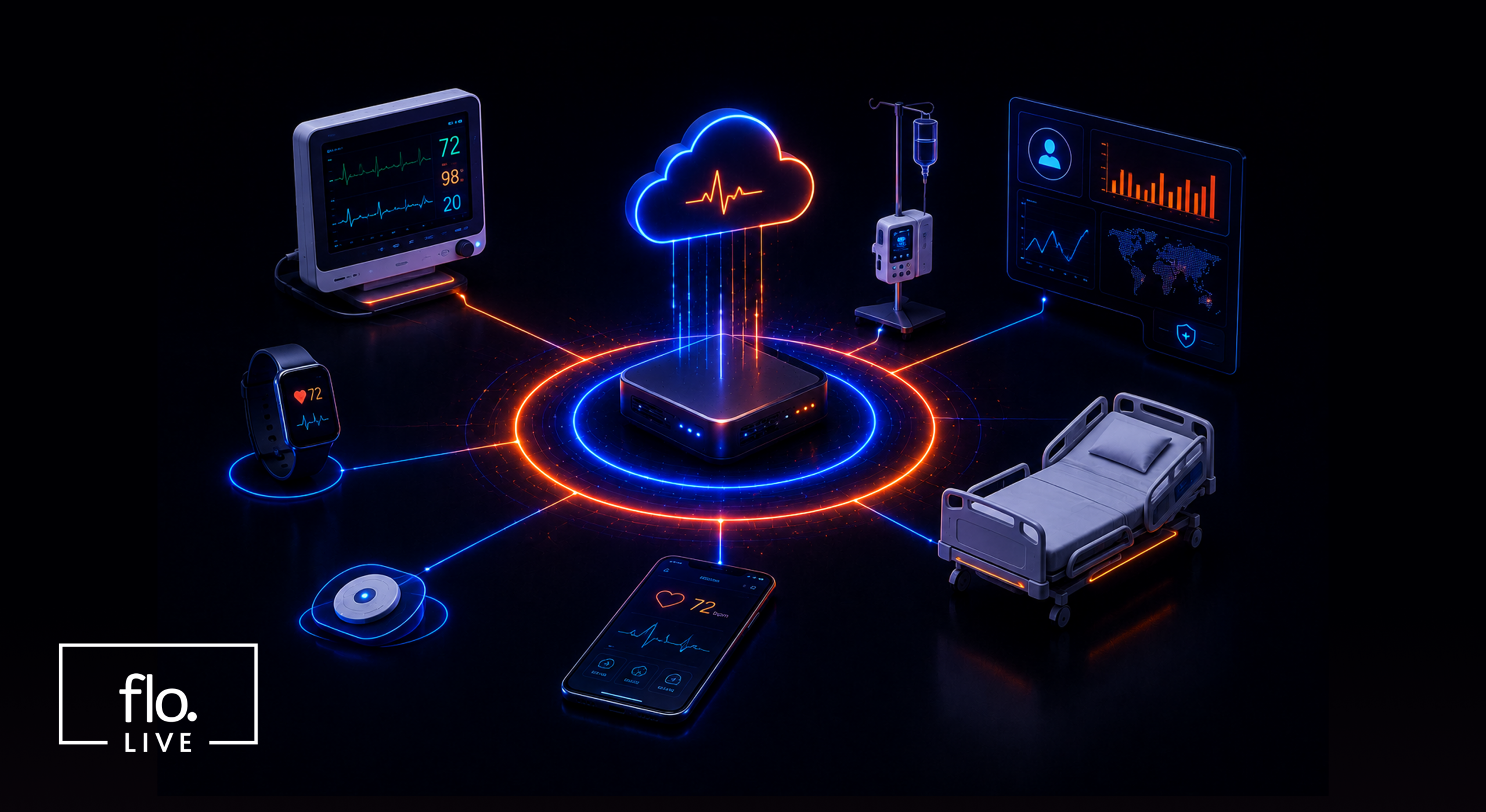
Internet of Things (IoT) in healthcare, often called the Internet of Medical Things (IoMT), is a network of connected medical devices, wearable sensors, and software that collect, transmit, and analyze health data in real time. It transforms traditional equipment into smart, connected systems to improve patient outcomes and optimize hospital operations.
Key applications:
- Remote patient monitoring: Wearables, continuous glucose monitors, and ECG patches transmit biometric data directly to physicians, allowing patients to be safely monitored from home.
- Wearable health devices: Smartwatches, fitness trackers, and medical wearables continuously monitor health metrics such as heart rate, activity levels, and sleep quality.
- Connected medical devices: Networked equipment such as infusion pumps, ventilators, and imaging systems enables centralized monitoring, diagnostics, and maintenance.
- Smart hospitals: IoT-powered systems automate asset tracking, facility management, patient flow, and clinical workflows to improve operational efficiency.
- Emergency and critical care: Connected ambulances and monitoring systems transmit real-time patient data to care teams, supporting faster diagnosis and treatment.
This is part of a series of articles about IoT applications
Benefits of IoT in Healthcare
IoT is changing healthcare by providing continuous access to patient data and improving communication between patients, providers, and medical systems. By connecting devices and automating data collection, healthcare organizations can improve care quality, reduce operational challenges, and support better health outcomes. Key benefits include:
- Real-time patient monitoring: Connected devices can track vital signs such as heart rate, blood pressure, and oxygen levels.
- Improved patient outcomes: Access to accurate and timely data helps clinicians make informed decisions.
- Enhanced remote care: IoT enables remote patient monitoring, reducing the need for frequent hospital visits.
- Better management of chronic diseases: Patients with conditions such as diabetes, hypertension, or heart disease can use connected devices to track their health metrics.
- Increased operational efficiency: IoT devices can automate routine tasks and reduce manual data entry.
- Improved asset tracking: Hospitals can use IoT sensors to track the location and status of medical equipment.
- Reduced healthcare costs: Early intervention, remote monitoring, and operational improvements can help lower healthcare expenses.
- Faster emergency response: IoT-enabled monitoring systems can detect critical events and send alerts to healthcare professionals.
IoT Healthcare Architecture
1. Device Layer
The device layer forms the foundation of IoT in healthcare, consisting of hardware such as sensors, wearable devices, and medical equipment that capture health-related data. Devices in this layer include:
- Heart rate monitors
- Glucose sensors
- Smart inhalers
- Connected imaging machines
Each device gathers specific physiological or environmental data relevant to patient health or facility operations, often in real time.
These devices must be reliable and accurate, as they provide the raw data that drives clinical decisions. Many are battery-operated and require durable design for continuous operation in medical settings. Integrating these devices into broader IoT networks requires compatibility with multiple communication protocols and the ability to securely transmit sensitive health information.
2. Connectivity Layer
The connectivity layer ensures secure communication between the device layer and higher levels of the IoT architecture. It includes:
- Short-range wireless such as Wi-Fi and Bluetooth Low Energy (BLE)
- Cellular networks including LTE, LTE-M, NB-IoT, and 5G, plus low-power mesh and LPWAN protocols such as Zigbee and LoRaWAN
This layer manages data transmission, handles device authentication, and maintains consistent connectivity to prevent data loss or communication failures.
Reliable connectivity is critical in healthcare, where delays or interruptions can have serious consequences. This layer must support real-time data transfer, particularly for applications such as remote patient monitoring or emergency response. Network redundancy, low latency, and failover mechanisms help maintain system availability.
3. Data Processing Layer
The data processing layer aggregates, filters, and analyzes data collected from the device layer. It often uses edge computing to process data locally on devices or gateways, reducing the amount of information transmitted to central servers. By preprocessing data at the edge, healthcare IoT systems can provide faster insights and reduce latency for time-sensitive applications.
Cloud computing also supports large-scale storage, analytics, and machine learning on aggregated health data. The data processing layer supports:
- Trend analysis
- Anomaly detection
- Predictive modeling for early diagnosis
- Treatment optimization
- Population health management
Ensuring data integrity and security during processing is a priority.
Related content: Learn how combining AI with connected devices creates smarter systems in our guide to the Artificial Intelligence of Things (AIoT).
4. Application Layer
The application layer delivers user-facing functionality and interfaces, translating processed data into insights for clinicians, administrators, and patients. Applications include:
- Electronic health record (EHR) integrations
- Telemedicine platforms
- Real-time dashboards
- Alerting systems
- Patient engagement tools.
This layer is where healthcare professionals interact with the IoT system to monitor patient status, manage care, and make decisions.
Applications are often tailored to specific healthcare needs, from chronic disease management tools to hospital asset tracking systems. The application layer must prioritize usability, reliability, and compliance with healthcare regulations. It also integrates with other health IT systems to support interoperability and data exchange across the care continuum.
5. Security Layer
The security layer protects sensitive health information and maintains trust in IoT healthcare systems. To protect data at rest and in transit, it implements:
- Authentication
- Encryption
- Access control
- Intrusion detection
Given the value of healthcare data, security measures help prevent breaches, data tampering, and unauthorized access.
Regulatory compliance, such as HIPAA or GDPR, is enforced at this layer to ensure patient privacy and data integrity. Security protocols must adapt to emerging threats and scale to accommodate growing numbers of connected devices. Continuous monitoring and incident response processes address vulnerabilities and maintain system resilience.
Key Use Cases of IoT for Healthcare
Remote Patient Monitoring
Remote patient monitoring uses IoT devices to track patient health metrics outside traditional clinical settings. Sensors and wearable devices collect data such as heart rate, blood pressure, glucose levels, and oxygen saturation, transmitting this information to healthcare providers in real time. This approach enables early detection of complications and timely interventions, reducing hospital admissions for patients with chronic conditions.
The need for RPM:
Remote monitoring allows patients to manage their health from home and reduces the need for frequent in-person visits. Providers can monitor trends, adjust treatment plans remotely, and intervene when necessary. Remote patient monitoring also supports value-based care models by reducing costs and increasing patient engagement.
Wearable Health Devices
Wearable health devices include smartwatches, fitness bands, and medical wearables. These devices track vital signs, activity levels, sleep patterns, and other health indicators. Data from wearables can be integrated into electronic health records or used by patients to monitor wellness goals, supporting preventive care.
The need for wearable devices:
Healthcare providers gain access to longitudinal health data that informs clinical decisions. For patients managing chronic diseases or recovering from surgery, wearables provide real-time feedback and alerts for abnormal readings. Continuous monitoring supports adherence to care plans and data-driven treatment.
Connected Medical Devices
Connected medical devices include infusion pumps, ventilators, imaging machines, and diagnostic tools that are networked for centralized monitoring and control. These devices transmit performance data, usage statistics, and patient results to clinical staff and IT systems. Automated alerts notify clinicians of device malfunctions, maintenance needs, or abnormal readings.
The need for connected devices:
Integration with hospital information systems supports workflow management and resource planning. Inventory tracking and automated ordering reduce stockouts and waste. Remote monitoring and management of medical devices reduce downtime and support predictive maintenance.
Smart Hospitals
Smart hospitals use IoT technologies to optimize facility management, patient flow, and clinical operations. IoT-enabled systems automate lighting, HVAC, and energy management, reducing operational costs. Real-time location tracking for patients, staff, and assets supports workflow efficiency and infection control.
The need for smart hospital systems:
Smart hospitals use integrated communication platforms to coordinate care teams and respond to patient needs. Automated alerts, digital signage, and connected nurse call systems support patient safety and experience. IoT enables healthcare environments to operate as data-driven systems.
Emergency and Critical Care
In emergency and critical care settings, IoT technologies support rapid decision-making and continuous patient monitoring. Connected devices track vital signs, administer medication, and provide real-time data streams to clinicians during acute events. IoT-enabled ambulances transmit patient data to hospitals en route, allowing emergency teams to prepare before arrival.
The need for IoT in emergency and critical care:
Critical care units use automated alerts for deteriorating conditions, equipment failures, or medication errors. Integration of IoT devices with hospital systems supports handoffs and complete records, reducing information gaps. These capabilities support patient outcomes and resource use in emergency care.
Related content: See how connected vehicles transmit real-time data in our overview of IoT and telematics.
Challenges of IoT for Healthcare
Data Security and Cybersecurity Risks
The growth of connected devices in healthcare increases exposure to cyber threats. Attackers may target vulnerabilities in IoT devices to access patient data or disrupt systems. Ransomware attacks, data breaches, and malware infections can affect patient safety and lead to regulatory penalties and reputational damage.
How to address:
Securing IoT devices is challenging due to device diversity, limited computational resources, and limited built-in security features. Cybersecurity strategies include device authentication, encryption, continuous monitoring, and regular software updates. Healthcare organizations must address evolving threats across the IoT environment.
Patient Privacy and Compliance
Patient privacy is a primary concern in IoT healthcare because of the sensitive nature of health data. Regulations such as HIPAA in the US and GDPR in Europe set requirements for data handling, storage, and sharing. Non-compliance can result in fines and loss of patient trust.
How to address:
Compliance requires access controls, audit trails, and data minimization practices. Organizations must educate staff, conduct risk assessments, and implement secure data-sharing protocols. Managing multiple devices and data sources makes privacy oversight an ongoing challenge.
Interoperability Problems
Healthcare IoT environments often include devices, applications, and systems from multiple vendors using different protocols, data formats, and standards. As a result, devices may struggle to exchange information with electronic health records, hospital information systems, or other platforms. This lack of interoperability creates data silos and limits the value of IoT-generated information.
How to address:
Interoperability challenges increase implementation costs and complexity. Organizations may require custom integrations, middleware, or data conversion tools to connect systems not built to work together. Adopting standards such as HL7, FHIR, and DICOM can improve compatibility, but integration across diverse healthcare ecosystems remains a challenge.
Best Practices for Implementing IoT in Healthcare
Here are some of the ways that healthcare organizations can improve their use of IoT technology.
1. Prioritize Reliable, Always-on Connectivity
Healthcare IoT systems often support time-sensitive workflows such as remote patient monitoring, emergency alerts, medication delivery, and connected medical equipment. Connectivity failures can delay clinical decisions, interrupt data collection, or prevent alerts from reaching care teams. Networks should be designed for high availability, low latency, and consistent coverage across hospitals, clinics, ambulances, and patient homes.
Organizations can use redundant connectivity options where appropriate. For example, a hospital device may use Wi-Fi as the primary connection and cellular as a backup. Mobile or home-based devices may use multi-network cellular access to connect to the strongest available network.
Connectivity should be tested in real operating environments before large-scale deployment. Hospitals often contain signal barriers such as thick walls, basements, elevators, and shielded rooms. Home environments are less predictable, so devices should recover from weak signals, temporary outages, and network changes without manual intervention.
2. Build for Global Scale with Local Compliance
Healthcare IoT deployments may operate across multiple regions, providers, and regulatory environments. A device or platform that works in one country may not meet data privacy, medical device, or telecom requirements in another. Planning for compliance early helps avoid redesigns, deployment delays, and legal risk.
Organizations should map requirements by region before deployment, including patient privacy rules, data residency requirements, consent management, retention policies, and medical device regulations. Systems should apply local policies without major changes to the core architecture.
Global scale requires flexible connectivity and operational support. Devices may need to work across different mobile networks, roaming rules, languages, and support processes. A scalable IoT architecture should allow centralized management of regional differences while meeting local requirements.
3. Use eSIM, iSIM, and Remote Provisioning to Simplify Deployment
eSIM and iSIM technologies allow healthcare IoT devices to connect to mobile networks without removable physical SIM cards. This supports deployments across hospitals, clinics, or patient homes, where manual SIM handling can be slow and error-prone.
Remote provisioning allows organizations to activate, update, or switch network profiles over the air. This reduces field service visits and supports deployment in different regions. It also maintains connectivity when devices move between coverage areas or when network contracts change.
These technologies support long-term healthcare deployments. A connected device may remain in service for years while network providers, pricing, and coverage conditions change. Remote provisioning allows network updates without replacing hardware.
4. Optimize for Long Device Lifecycles
Healthcare IoT devices may remain in use for many years, especially when embedded in medical equipment, monitoring systems, or home care programs. These devices need long-term support for software updates, security patches, battery performance, and network compatibility.
Implementation plans should include lifecycle management from the start, including secure firmware updates, device health monitoring, component durability, and maintenance or replacement processes. Devices should recover safely from failures, update interruptions, and connectivity loss.
Lifecycle planning is also important for security. Older devices can become vulnerable if they no longer receive updates or cannot support modern encryption and authentication methods. Organizations should track device versions, support timelines, and end-of-life plans to reduce risk.
5. Choose a Connectivity Management Platform with Real-Time Visibility
A connectivity management platform allows healthcare organizations to monitor, control, and troubleshoot connected devices at scale. Real-time visibility into device status, data usage, signal strength, network performance, and location helps teams detect issues before they affect patient care.
The platform should support alerts, reporting, policy controls, and integration with existing IT, clinical, and security systems. Teams should be able to identify devices with abnormal data usage, poor connectivity, repeated failures, or outdated configurations.
Centralized visibility becomes more important as deployments grow. Without it, teams may need to troubleshoot devices manually across many sites or patient locations. A connectivity management platform supports fleet management, security policy enforcement, and service reliability across the device lifecycle.
How FLOLIVEⓇ Delivers Reliable, Compliant IoT Connectivity for Healthcare
The success of any healthcare IoT deployment ultimately depends on the connectivity beneath it: devices that lose their connection can’t transmit vital data, trigger alerts, or support remote care. FLOLIVEⓇ addresses this with one localized global network that keeps every medical device connected and compliant, no matter where it operates. Instead of relying on traditional, high-latency roaming, Flolive runs a cloud-managed network with locally distributed core networks, applying local profiles and local breakout across continents so that data stays close to the device, latency stays low, and behavior stays consistent everywhere.
Key capabilities of Flolive Global IoT Connectivity:
- Localized global coverage: A single cloud-managed network spanning 15+ carrier partners and 750+ networks gives devices seamless coverage, real-time visibility, and full control from one platform, wherever patients and equipment are located.
- Any SIM form factor: The platform supports plastic SIMs, embedded MFF2 eSIMs, advanced iSIM architectures, and softSIM, enabling seamless activation, smart switching, and full lifecycle control across all devices and geographies.
- Any cellular technology plus satellite: Coverage spans 2G through 5G, LPWA, and satellite Non-Terrestrial Networks (IoT NTN) under one platform, with satellite available as a backup to keep critical devices connected in coverage gaps.
- Built-in data privacy compliance: Localized connectivity keeps data within the country it originated in, helping healthcare organizations adhere to data privacy and sovereignty regulations such as GDPR and CCPA — something roaming-based solutions cannot guarantee.
- Permanent Roaming Safe connectivity: Local IMSIs or local profiles can automatically apply when devices enter highly regulated markets, ensuring devices stay legally compliant and permanently connected without manual intervention.
- Connectivity Management Platform (CMP): A single-pane-of-glass dashboard provides real-time visibility to monitor data usage, manage security policies, and switch network profiles across all global devices, simplifying operations and scaling without added overhead.
- Low latency and high throughput: Localized core networks and regional breakouts route data along the shortest path, reducing latency and improving uptime so time-sensitive applications like remote monitoring perform reliably.
To see how Flolive can keep your connected medical devices online, secure, and compliant at global scale, explore Flolive’s Global IoT Connectivity solution.