


TL;DR: IoT management platforms connect, monitor, and control device fleets. Best for global cellular connectivity: FLOLIVE®; AWS-native scale: AWS IoT Core; industrial device management: Cumulocity IoT; open-source control: ThingsBoard.
What Are IoT Management Platforms?
IoT management platforms are comprehensive systems that enable the monitoring, management, and control of a diverse range of connected devices within an IoT ecosystem. They provide tools for SIM provisioning, configuration, OTA updates, and troubleshooting, ensuring device connectivity operates efficiently and securely.
These platforms also enable data collection, analysis, and visualization, helping organizations optimize performance and make informed decisions. Modern IoT deployments can include thousands to millions of heterogeneous devices, each with its own requirements for connectivity, updates, and security. IoT management platforms help manage this complexity by offering remote monitoring, automation, and analytics in one place.
Key functions of IoT management platforms include:
- SIM provisioning and onboarding: Platforms simplify the process of adding new devices to the network, simplifying initial setup and configuration.
- Remote configuration and control: Administrators can remotely configure device settings, update firmware, and manage device behavior, even from a distance.
- Real-time monitoring and alerting: Platforms provide real-time visibility into device status, performance, and potential issues, enabling timely responses to anomalies.
- Data management and analytics: They collect and store data from connected devices, offering tools for analysis, visualization, and reporting to gain insights and optimize operations.
- Security and access control: Robust security features ensure that devices and data are protected from unauthorized access and cyber threats.
- Connectivity management: Platforms manage communication protocols and network connections for devices, ensuring reliable and efficient data exchange.
- Lifecycle management: They support the entire device lifecycle, from initial setup to decommissioning, including maintenance, updates, and eventual replacement.
Choosing the right IoT management platform depends on the specific needs of the organization, including the type and number of devices, desired functionalities, and budget considerations. Organizations should carefully evaluate their requirements and compare different platforms to find the best fit.
This is part of a series of articles about IoT networking
IoT Management Platforms at a Glance
The table below summarizes the key differences between the platforms covered in this article. We explore each of them in more detail in the sections that follow.
| Category | Solution | Best For | Key Strengths | Things to Consider |
|---|---|---|---|---|
| IoT Connectivity & Network Management | Flolive | Global cellular IoT connectivity across countries and carriers | Multi-IMSI and eSIM, distributed core network, real-time SIM control | Focused on connectivity rather than device and application management |
| IoT Connectivity & Network Management | Cisco IoT Control Center | Carrier-grade cellular connectivity management at global scale | Zero-touch provisioning, automated diagnostics, multi-operator reach | Oriented to cellular SIM connectivity through service providers |
| IoT Device Management & Application | AWS IoT Core | Connecting large device fleets to the AWS cloud at scale | Managed MQTT broker, multi-protocol support, message rules engine | Full value depends on integrating other AWS services |
| IoT Device Management & Application | Microsoft Azure IoT Hub | Bidirectional device-to-cloud messaging within the Azure ecosystem | Per-device auth, provisioning service, OTA updates, edge integration | Works best within the broader Microsoft Azure stack |
| IoT Device Management & Application | Radix IoT | Unifying operational data across distributed sites and protocols | 40+ protocols, multi-site management, on-prem, edge, or cloud | Geared to infrastructure monitoring rather than consumer product IoT |
| IoT Device Management & Application | Cumulocity IoT | Out-of-the-box industrial IoT device management and app enablement | Protocol adapters, lifecycle management, analytics, low-code apps | Aimed at industrial deployments; breadth adds a learning curve |
| IoT Device Management & Application | OpenRemote | Building a custom, self-hosted IoT platform without vendor lock-in | Open source, flexible asset model, rules engine, multi-tenant realms | Self-hosting and customization require in-house technical resources |
| IoT Device Management & Application | ThingsBoard | Open-source data collection, visualization, and device management | MQTT/CoAP/HTTP support, rule engine, dashboards, cloud or on-prem | Production and advanced features need self-management or paid tiers |
IoT Platforms Market Trends
Key Market Drivers and Technology Trends
According to recent market research, the main drivers of growth in the IoT platforms market include:
- The integration of artificial intelligence with IoT platforms: AI-enabled platforms process streaming data in real time, detect anomalies, and predict failures or behavioral patterns. This allows organizations to improve efficiency and make more accurate operational decisions.
- Edge computing: By processing data closer to devices, organizations can reduce latency and improve responsiveness. At the same time, cloud-based models make IoT platforms more accessible by lowering infrastructure costs and enabling faster deployment.
- Sustainability initiatives: IoT platforms support environmental monitoring and regulatory reporting. They also help optimize asset lifecycles, such as improving waste collection routes to reduce fuel consumption. The global rollout of 5G and satellite IoT connectivity further supports expansion by extending coverage to remote areas.
Key Market Segments
By component, platform software held the largest market share at 55%. These platforms act as the core layer for managing connected devices, handling data processing, analytics, and secure communication. The services segment is projected to grow at a CAGR of 13%, reflecting the increasing need for integration, deployment, and maintenance expertise.
By deployment mode, cloud-based and SaaS platforms dominated with a 60% share. Their scalability, flexibility, and lower upfront costs make them attractive across industries. Hybrid deployments are expected to grow at a CAGR of 12.50%, as they combine public and private cloud benefits while addressing data control and compliance needs.
In connectivity, cellular and mobile technologies accounted for 40% of the market due to their wide coverage and reliability. LPWAN is projected to grow at the fastest rate, with a CAGR of 14%, driven by demand for long-range, low-power connectivity in sectors such as utilities and logistics.
By industry vertical, manufacturing led with a 28% share. Manufacturers use IoT platforms for predictive maintenance, production monitoring, and supply chain optimization. Healthcare and life sciences are expected to grow at the fastest rate, with a CAGR of 13.50%, supported by demand for remote monitoring and patient-centric care.
Key Functions of IoT Management Platforms
Connectivity Management
Connectivity management enables secure, efficient data transmission between IoT devices and backend services. IoT environments can include a range of connection types cellular, Wi-Fi, Ethernet, LPWAN, or satellite—each with its own performance characteristics and operational requirements. A management platform centralizes the monitoring and orchestration of these connections, providing real-time visibility and control over network status and performance.
With thousands of devices requiring constant and reliable communication, organizations must manage factors like bandwidth allocation, roaming, and network failovers. Advanced platforms allow administrators to monitor connectivity health, detect and resolve outages, and optimize traffic to avoid unnecessary costs. Tools for remote SIM management, device grouping, and automated network selection reduce manual intervention.
Learn more in our detailed guide to IoT connectivity platforms
Device Provisioning and Onboarding
Device provisioning involves assigning unique identities and credentials to new devices, configuring their primary settings, and ensuring their secure connection to the network. An efficient onboarding process helps automate initial configuration and enrollment, reducing manual errors and minimizing the time required to bring new devices online.
A seamless onboarding process is important for large-scale deployments, allowing organizations to add devices in batches and manage them according to pre-established templates or rules. This also ensures devices immediately comply with organizational standards for security and communication. Modern platforms often provide self-service and zero-touch provisioning features, where devices automatically connect and configure themselves.
Remote Configuration and Control
Remote configuration and control capabilities allow administrators to update device settings, deploy firmware upgrades, and change operational parameters without onsite intervention. This is essential for distributed IoT environments, where manual device management would be impractical due to scale or geographic dispersion. Platforms offer dashboards and APIs to push configuration changes across fleets of devices simultaneously.
Continuous device optimization ensures performance, energy efficiency, and security. By centrally controlling parameters like power usage profiles, sensor calibration, or application-specific settings, organizations maintain optimal device behavior and compliance without dispatching service personnel. Scheduled updates, role-based access controls, and audit trails further help minimize downtime and track configuration changes.
Real-Time Monitoring and Alerting
Real-time monitoring provides continuous visibility into the status, health, and behavior of IoT devices and their connections. Through dashboards and reporting tools, administrators can track metrics such as device uptime, battery status, data throughput, and error rates. Prompt detection of anomalies or deteriorating conditions is vital for maintaining device fleets and preempting potential issues.
Alerting mechanisms supplement monitoring by notifying personnel when critical thresholds—like network failures, sensor anomalies, or unexpected device behavior—are breached. Automated notifications by email, SMS, or messaging apps enable rapid response and issue resolution.
Data Management and Analytics
Data management and analytics are central to extracting value from IoT deployments. Platforms collect vast amounts of sensor and event data and provide tools for storage, normalization, enrichment, and integration with enterprise systems. Simplified data flows enable organizations to correlate device information with external sources, fuel process automation, and trigger meaningful actions.
Analytics capabilities extend beyond reporting; they include machine learning model deployment, anomaly detection, trend analysis, and automated notifications based on data patterns. With these tools, organizations can optimize operations, predict maintenance needs, and uncover new insights.
Security and Access Control
Security and access control protect IoT deployments by managing user and device authentication, data encryption, and policy enforcement. IoT platforms enforce security best practices such as multi-factor authentication, secure credential storage, and encrypted data transmission, protecting against unauthorized access and data breaches.
Role-based access controls (RBAC) restrict functionality and sensitive data views to authorized users, reducing internal risk and ensuring operational compliance. Audit logging tracks actions for accountability and compliance checks. Comprehensive security frameworks—integrated with monitoring and alerting services—enable organizations to react swiftly to threats and maintain a strong defense posture amidst evolving risks in the IoT landscape.
Lifecycle Management
Lifecycle management in IoT refers to overseeing a device’s journey from initial provisioning to eventual decommissioning. Throughout this process, administrators must manage firmware updates, policy enforcement, hardware replacements, and the gradual retirement of obsolete devices. Platforms automate these tasks to help minimize manual effort and ensure devices remain compliant with operational standards throughout their lifecycle.
End-of-life management is just as critical as onboarding. Decommissioning involves securely removing a device’s authentication, wiping sensitive data, and recording its retirement for audit purposes. Effective lifecycle management helps reduce operational risk, control costs by preventing device sprawl, and maintain the security and reliability of the IoT ecosystem.
Related content: Read our guide to IoT connectivity platforms
Notable IoT Management And Connectivity Platforms
How we selected these tools: We shortlisted IoT management and connectivity platforms based on device provisioning and lifecycle management, connectivity and protocol support, data collection and analytics, security, and deployment flexibility.
IoT Connectivity and Network Management Platforms
1. FLOLIVE®

Best for: Global cellular IoT connectivity across countries and carriers
Strengths: Multi-IMSI and eSIM, distributed core network, real-time SIM control
Things to consider: Focused on connectivity rather than device and application management
Flolive runs a cloud-based Connectivity Management Platform (CMP) that manages SIM provisioning, network policies, lifecycle operations, diagnostics, and billing for IoT deployments from a single interface. The CMP connects directly to the distributed core network, SIM technologies, and rating engine owned by Flolive.
The platform serves mobile operators, MVNOs, enterprises, and IoT service providers. It supports multi-tenant business models and white-label branding, so operators can launch and run IoT connectivity services without building new infrastructure.
Key features include:
- Connectivity management platform: Manages SIM provisioning, connectivity policies, lifecycle events, diagnostics, and billing through one cloud-based interface across global deployments.
- Multi-IMSI and eSIM support: Uses multi-IMSI over eUICC and supports both M2M and consumer eUICC through integrated SM-DP/SM-SR systems, with an optional aggregator that unifies SIMs including SGP.32 from other providers.
- Distributed core network: Connects the CMP to the Flolive globally distributed core network with local breakout points, applying local network profiles across regions.
- Real-time visibility and control: Monitors SIM status, data usage, location, and performance in real time, and activates, suspends, or terminates devices and applies policies on demand.
- Multi-tier and white-label architecture: Supports resellers, enterprise accounts, and multi-tenant models with role-based access, usage segregation, and full white-label branding.
- Rating, billing, and APIs: Includes an integrated OSS/BSS suite with real-time rating and usage-based billing, plus REST APIs to embed SIM management, data, and diagnostics into external systems.
Limitations (based on publicly available sources):
Contract-based pricing: Commercial rates are provided per customer rather than through public rate cards, so upfront price comparison requires contacting the vendor.
Connectivity focus: The platform centers on cellular connectivity and SIM operations, so teams that also need deep device data modeling or industrial telemetry analytics may combine it with additional tooling.
Cellular-oriented value: Its benefits are strongest for cellular deployments; projects relying mainly on Wi-Fi, Ethernet, or fixed connectivity draw less from it.
2. Cisco IoT Cloud Connect
Best for: Carrier-grade cellular connectivity management at global scale
Strengths: Zero-touch provisioning, automated diagnostics, multi-operator reach
Things to consider: Oriented to cellular SIM connectivity through service providers
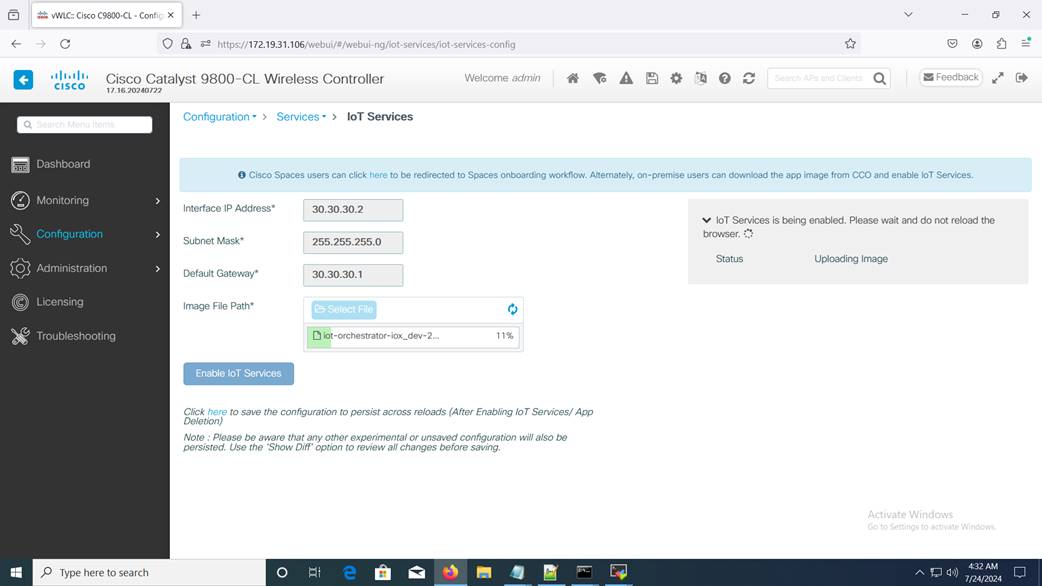
Cisco IoT Control Center is a SaaS connectivity management platform that manages cellular connectivity and the device lifecycle for IoT deployments. It automates SIM provisioning, applies rules-based configuration, and provides real-time network visibility, diagnostics, and flexible billing across service providers and countries.
An optional add-on, Cloud Connect, establishes secure connections between IoT devices and cloud IoT hubs such as AWS IoT Core and Azure IoT Hub. It centralizes device authentication and offloads telemetry for storage-constrained devices such as smart meters.
Key features include:
- Automated provisioning: Uses zero-touch provisioning and lifecycle-aware configuration to activate SIMs and deploy devices with rules-based automation.
- Real-time visibility and diagnostics: Provides network visibility, automated diagnostics, dynamic reporting, and AI/ML-based anomaly detection to respond to device and connectivity issues.
- Flexible billing: Supports a variety of rate plans, split and multi-party billing, and event-based incentives and credits.
- Integrated security: Includes multi-factor authentication, granular user and access controls, and device-side features such as IMEI lock and IoT SAFE SIM applets.
- eSIM and Cloud Connect: Supports eSIM with remote over-the-air provisioning, and the Cloud Connect add-on centralizes device authentication and offloads telemetry from constrained devices to cloud IoT hubs.
Limitations (as reported by users on G2):
- Custom field limits: A reviewer notes that the platform allows only one custom field per customer.
- Charging support: One reviewer reports that it does not support online charging for IoT data usage.
- Interface and performance: Some reviewers mention the interface can feel limited for certain tasks and that screens occasionally load slowly or show minor glitches.
Source: Cisco
IoT Device Management and Application Platforms
3. Microsoft Azure IoT Hub
Best for: Bidirectional device-to-cloud messaging within the Azure ecosystem
Strengths: Per-device auth, provisioning service, OTA updates, edge integration
Things to consider: Works best within the broader Microsoft Azure stack
Microsoft Azure IoT Hub is a cloud-hosted service that connects, monitors, and manages IoT devices at scale. It provides bidirectional communication, using device-to-cloud telemetry to track device state and cloud-to-device messages to send commands and notifications, with delivery acknowledgements and automatic resend for intermittent connectivity.
Each device receives its own identity and credentials, and access can be revoked per device. The service integrates with Azure IoT Edge, Event Grid, and the Device Update service to extend processing to the edge and manage updates.
Key features include:
- Bidirectional communication: Supports device-to-cloud telemetry and cloud-to-device messaging for commands and notifications, and routes messages to other Azure services without custom code.
- Device identity and authentication: Assigns per-device identities and credentials to protect messages and allows selective revocation of device access.
- Automated device provisioning: Registers and provisions devices with zero touches through the IoT Hub device provisioning service.
- Edge integration: Works with Azure IoT Edge to run analytics and processing on devices, including offline or intermittently connected operation.
- Over-the-air updates: Uses Device Update for IoT Hub to publish and manage firmware and software updates across devices.
- Protocol support: Connects devices over HTTPS, AMQP, AMQP over WebSockets, MQTT, and MQTT over WebSockets, backed by a 99.9% service-level agreement.
Limitations (as reported by users on G2):
- Cost: Reviewers report that it can be expensive, particularly for smaller or individual deployments.
- Documentation and setup: Some reviewers find the documentation confusing and lacking detail, and note that encryption setup is less straightforward than on some competing platforms.
- Learning curve: Users mention it takes considerable research to become comfortable with the service, and that it fits best within a Microsoft-centric environment.
4. AWS IoT Core

Best for: Connecting large device fleets to the AWS cloud at scale
Strengths: Managed MQTT broker, multi-protocol support, message rules engine
Things to consider: Full value depends on integrating other AWS services
AWS IoT Core is a managed cloud service that connects devices to the cloud and routes messages between them without provisioning servers. Its MQTT message broker maintains persistent device connections and handles messaging across large numbers of devices and topics.
Rules process and route incoming messages to other AWS services such as Lambda, S3, and DynamoDB. The service supports multiple authentication methods and includes tools to validate device functionality before deployment.
Key features include:
- Managed MQTT message broker: Supports persistent device connections, message retention, and messaging across large device and topic counts, and is compatible with both MQTT 5 and MQTT 3.
- Multi-protocol connectivity: Connects devices over MQTT, MQTT over WebSockets, HTTPS, and LoRaWAN.
- Programmable message routing: Lets developers define rules that process and route device messages to AWS services, with features such as shared subscriptions, user properties, and session expiry.
- Device authentication and access policies: Provides multiple authentication mechanisms and access controls, with mutual authentication and end-to-end encryption for device connections.
- Device validation tools: Includes Device Advisor test suites to validate device MQTT functionality during development before onboarding to the cloud.
Limitations (as reported by users on G2):
Changing interface: Reviewers mention that frequent changes to the AWS console make it harder to stay familiar with the workflow.
Integration effort: Users note that capabilities depend heavily on how the service is integrated with other AWS services, and that there is no graphical way to manage all device keys within the platform.
5. Radix IoT

Best for: Unifying operational data across distributed sites and protocols
Strengths: 40+ protocols, multi-site management, on-prem, edge, or cloud
Things to consider: Geared to infrastructure monitoring rather than consumer product IoT
Radix IoT provides an industrial IoT and SCADA platform, built around its Mango software, that connects to devices across more than 40 protocols and unifies operational data from distributed sites into a single real-time view. It acquires, normalizes, stores, visualizes, and acts on data from any device or manufacturer.
The platform runs on-premise, at the edge, or in the cloud. Teams in data centers, telecom, energy, and commercial properties use it to monitor and control equipment across many locations from one interface.
Key features include:
- Multi-protocol data acquisition: Connects to over 40 protocols simultaneously, including BACnet, Modbus, SNMP, MQTT, DNP3, and OPC DA, normalizing values into a common point model.
- Real-time dashboards: Offers three tiers of dashboarding, from a drag-and-drop designer to a page editor and full code control, all responsive and updated in real time.
- Alarming and events: Provides six-level alarm severity, filtering, acknowledgement workflows, and automated escalation via email, Slack, or custom handlers.
- Control and automation: Writes values back to devices, builds scripted automation with an ECMAScript engine, and creates virtual sensors that calculate metrics from live streams.
- Time-series historian: Stores large volumes of data points with configurable intervals and multiple rollup types on a PostgreSQL backend.
- Multi-site management and API: Manages distributed portfolios through Cloud Connect with secure remote access and role-based permissions, and exposes a full REST API with OpenAPI documentation.
Limitations (based on publicly available sources):
- Operational focus: The platform centers on operational and infrastructure monitoring for sectors such as data centers, utilities, and buildings, so it is less oriented toward consumer-product IoT or cellular device connectivity.
- Technical configuration: Advanced dashboards, scripting, and large deployments require technical setup and appropriate hardware and database sizing.
- Limited third-party review data: Little independent user review coverage is available publicly, which can make external due diligence harder.
6. Cumulocity IoT

Best for: Out-of-the-box industrial IoT device management and app enablement
Strengths: Protocol adapters, lifecycle management, analytics, low-code apps
Things to consider: Aimed at industrial deployments; breadth adds a learning curve
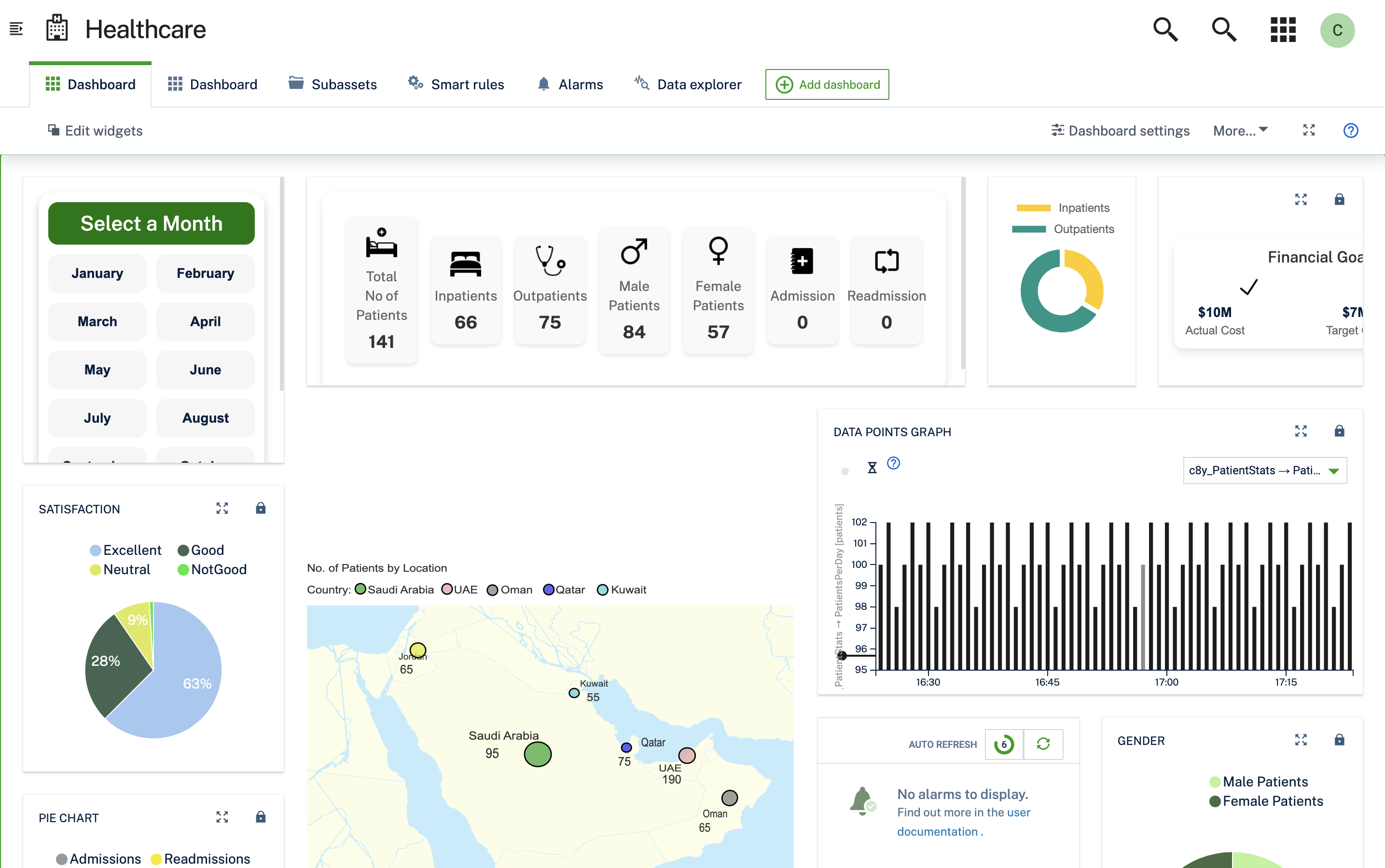
Cumulocity IoT is a self-service enterprise IoT platform that provides standard IoT functionality out of the box, from device onboarding and data management to analytics and applications. It connects and integrates devices through protocol adapters, thin-edge.io, an MQTT service, or SDKs, and manages device fleets across their full lifecycle.
Device data is brought into business context through a digital twin model, and the platform runs on major cloud providers as well as on-premises and edge environments. Following a 2025 management buyout, Cumulocity now operates as an independent company.
Key features include:
- Device integration: Connects devices using protocol adapters, thin-edge.io, MQTT v5, SmartREST, or custom SDKs, with open APIs and support for standard IIoT protocols.
- Device management: Manages fleets from onboarding and configuration through updates to decommissioning or replacement, including bulk registration and smart groups.
- Digital twin and data handling: Models physical devices as digital assets and, through DataHub, manages access, retention policies, and offload of IoT data to a data lake.
- Streaming analytics: Processes telemetry to produce business metrics and trigger actions, with analytics models that scale across the connected fleet.
- Low-code applications: The Cockpit application builds dashboards and applications using a widget library and no-code tooling.
- Flexible deployment: Runs on hyperscalers such as AWS and Azure, as well as on-premises and edge, with multi-tenant isolation and certificate-based authentication.
Limitations (as reported by users on G2):
- Beginner complexity: Reviewers report that the platform can be complex for newcomers.
- Customization limits: Some users note customization limitations within the platform.
- Remote access gaps: A reviewer notes that functions unavailable through a device’s own remote access are also unavailable in the platform, and that device support could be broadened and simplified.
Source: Cumulocity
7. OpenRemote

Best for: Building a custom, self-hosted IoT platform without vendor lock-in
Strengths: Open source, flexible asset model, rules engine, multi-tenant realms
Things to consider: Self-hosting and customization require in-house technical resources
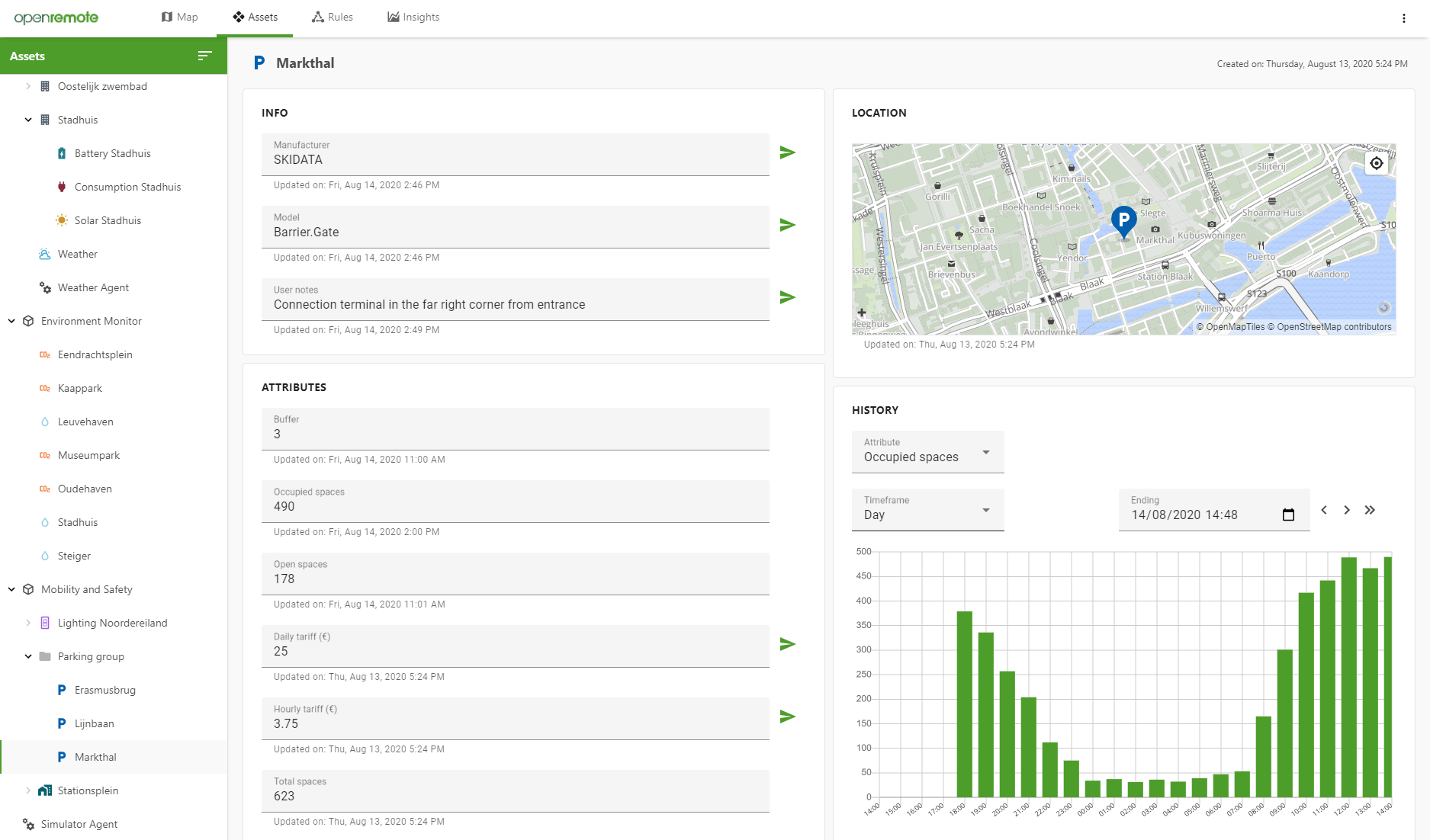
OpenRemote is a 100% open-source IoT platform for integrators building and managing asset ecosystems. Everything in the platform is modeled as an asset, with user-defined asset types and attributes for devices such as chargers, buildings, or vehicles.
It provides rules and automation, dashboards, mapping and geofencing, and a REST and WebSocket API. The platform supports multi-tenant realms, role-based access through Keycloak, edge gateways, and over-the-air firmware updates, and can be self-hosted or deployed with professional support.
Key features include:
- Asset management: Models devices and entities as configurable asset types with defined attributes, deploying many instances that inherit the same logic.
- Rules and automation: Automates behavior using When-Then rules, a visual flow editor, or Groovy scripting for more complex logic.
- Data visualization and mapping: Builds dashboards for different users and adds location context with maps, geofencing, and custom map layers or floor plans.
- Protocol agents: Includes built-in support for HTTP, SNMP, Modbus, MQTT, Bluetooth, LoRaWAN, KNX, and other protocols, with every attribute exposed through a REST API and WebSockets.
- Multi-tenancy and identity: Isolates users and data into separate realms and provides OAuth2/OpenID Connect and role-based access control through Keycloak.
- Edge and firmware management: Runs an edge gateway for local data collection and remote access, and manages over-the-air firmware updates through a Hawkbit integration.
Limitations (based on publicly available sources):
- Community and integrations: Independent comparisons note a smaller community and fewer ready-made third-party integrations than larger platforms.
- Technical resources: Self-hosting and customization require internal engineering and DevOps capability to deploy and maintain the platform.
- Deployment focus and licensing: Documented deployments concentrate on energy and smart-building use cases, mainly in Europe, and the AGPLv3 license is a consideration for commercial embedding.
Source: OpenRemote
8. ThingsBoard

Best for: Open-source data collection, visualization, and device management
Strengths: MQTT/CoAP/HTTP support, rule engine, dashboards, cloud or on-prem
Things to consider: Production and advanced features need self-management or paid tiers
ThingsBoard is an open-source IoT platform for data collection, processing, visualization, and device management. It connects devices over MQTT, CoAP, and HTTP and supports both cloud and on-premises deployments.
A rule engine processes incoming data through configurable rule chains, transforming telemetry and raising alarms, while dashboards with configurable widgets present data and allow remote device control. The platform supports multi-tenancy and can run as a monolith or scale out as microservices.
Key features include:
- Telemetry collection and storage: Collects and stores device data in a scalable, fault-tolerant way, with support for SQL, NoSQL, and hybrid databases.
- Device and asset management: Registers and manages devices and assets, monitors attributes, defines relations between entities, and sends RPC commands to devices.
- Rule engine: Processes incoming data with drag-and-drop rule chains, transforms and normalizes telemetry, raises alarms, and forwards data to external systems.
- Dashboards and visualization: Provides configurable widgets and dashboards for real-time monitoring and control, including SCADA capabilities.
- Multi-tenancy: Supports multi-tenant installations with multiple administrators, customers, and devices per tenant.
- Scalable architecture: Runs as a monolith for small environments or as microservices for horizontal scalability and high availability, and is licensed under Apache 2.0.
Limitations (as reported by users on G2):
- Premium features: Reviewers note that some features sit behind paid editions rather than the open-source core.
- Operational effort: Public comparisons note that running it in production requires managing infrastructure, upgrades, backups, and scaling, which needs DevOps capacity.
- Advanced capabilities: Advanced analytics and certain enterprise controls such as multi-tenancy management may require commercial editions or external tools.
Source: ThingsBoard

Choosing the Right IoT Management Platform
Selecting an IoT management platform requires careful evaluation of technical and operational requirements. The right choice depends on the scale, industry, and specific use cases of the IoT deployment:
- Device and protocol compatibility: Ensure the platform supports the types of devices you plan to use and communication protocols such as MQTT, CoAP, HTTP, or LoRaWAN. Compatibility affects integration speed and system stability.
- Scalability and performance: Look for platforms that can handle your current device volume and scale seamlessly as your fleet grows. Performance under load, especially during high-throughput operations, is critical.
- Deployment flexibility (cloud vs. edge vs. hybrid): Depending on latency requirements and network constraints, choose a platform that supports cloud, edge, or hybrid deployments. Edge capabilities are vital for real-time control in remote locations.
- Security and compliance: Assess the platform’s ability to enforce secure device communication, access control, data encryption, and audit logging. Support for industry-specific compliance standards is essential in regulated sectors.
- Data handling and integration: Evaluate data storage, normalization, and analytics capabilities. Integration with enterprise systems (e.g., ERP, CRM, analytics platforms) and APIs for custom development is also important.
- Operational tools and automation: Features like zero-touch provisioning, firmware updates, rule engines, and remote troubleshooting tools reduce manual overhead and improve reliability.
- Ecosystem and vendor support: A mature ecosystem with good documentation, SDKs, support options, and community activity can significantly reduce time-to-market and long-term maintenance effort.
- Cost and licensing model: Compare pricing models—subscription-based, usage-based, or open-source—and understand hidden costs related to scaling, premium features, or third-party integrations.
Learn more in our detailed guide on IoT platforms for enterprises
Conclusion
IoT management platforms play a vital role in ensuring connected devices are deployed, maintained, and scaled efficiently across diverse environments. By centralizing control, enhancing security, and enabling automation, these platforms help organizations reduce operational complexity and unlock the full value of their IoT investments.